 Add to Chrome
 Add to Firefox
 Add to Edge
When Clients Stop Following: A Cognitive Conceptualization Diagram-driven Framework for Strategic Counseling
Jun 03, 2026
Large Language Models (LLMs) show promise in psychological counseling, yet existing benchmarks rely heavily on highly cooperative simulated clients. We observe a critical counselor-following phenomenon: these clients often rapidly shift from resistance to compliance after only a few turns, creating an illusion of therapeutic progress and inflating scores under current evaluation protocols through superficial empathy. To address this evaluation mismatch, we propose a Cognitive Behavioral Therapy (CBT)-grounded resistance-aware framework. We introduce CARS, a client simulator that explicitly models dynamic resistance via Cognitive Conceptualization Diagrams (CCDs). We present STREAMS, a dual-module framework that decouples strategic reasoning (Thinker) from response generation (Presenter) and optimizes it via reinforcement learning. We further propose EWTS-MI, an entropy-weighted metric for evaluating responsiveness under high-friction interactions. Experiments across resistant and non-resistant counseling settings validate our findings on evaluation mismatch and demonstrate the effectiveness of resistance-aware training for improving strategic robustness under challenging counseling interactions.

IPD: Boosting Sequential Policy with Imaginary Planning Distillation in Offline Reinforcement Learning
Mar 04, 2026Decision transformer based sequential policies have emerged as a powerful paradigm in offline reinforcement learning (RL), yet their efficacy remains constrained by the quality of static datasets and inherent architectural limitations. Specifically, these models often struggle to effectively integrate suboptimal experiences and fail to explicitly plan for an optimal policy. To bridge this gap, we propose \textbf{Imaginary Planning Distillation (IPD)}, a novel framework that seamlessly incorporates offline planning into data generation, supervised training, and online inference. Our framework first learns a world model equipped with uncertainty measures and a quasi-optimal value function from the offline data. These components are utilized to identify suboptimal trajectories and augment them with reliable, imagined optimal rollouts generated via Model Predictive Control (MPC). A Transformer-based sequential policy is then trained on this enriched dataset, complemented by a value-guided objective that promotes the distillation of the optimal policy. By replacing the conventional, manually-tuned return-to-go with the learned quasi-optimal value function, IPD improves both decision-making stability and performance during inference. Empirical evaluations on the D4RL benchmark demonstrate that IPD significantly outperforms several state-of-the-art value-based and transformer-based offline RL methods across diverse tasks.
Physics-informed Diffusion Mamba Transformer for Real-world Driving
Jan 31, 2026Autonomous driving systems demand trajectory planners that not only model the inherent uncertainty of future motions but also respect complex temporal dependencies and underlying physical laws. While diffusion-based generative models excel at capturing multi-modal distributions, they often fail to incorporate long-term sequential contexts and domain-specific physical priors. In this work, we bridge these gaps with two key innovations. First, we introduce a Diffusion Mamba Transformer architecture that embeds mamba and attention into the diffusion process, enabling more effective aggregation of sequential input contexts from sensor streams and past motion histories. Second, we design a Port-Hamiltonian Neural Network module that seamlessly integrates energy-based physical constraints into the diffusion model, thereby enhancing trajectory predictions with both consistency and interpretability. Extensive evaluations on standard autonomous driving benchmarks demonstrate that our unified framework significantly outperforms state-of-the-art baselines in predictive accuracy, physical plausibility, and robustness, thereby advancing safe and reliable motion planning.
Large Language Models are Qualified Benchmark Builders: Rebuilding Pre-Training Datasets for Advancing Code Intelligence Tasks
Apr 28, 2025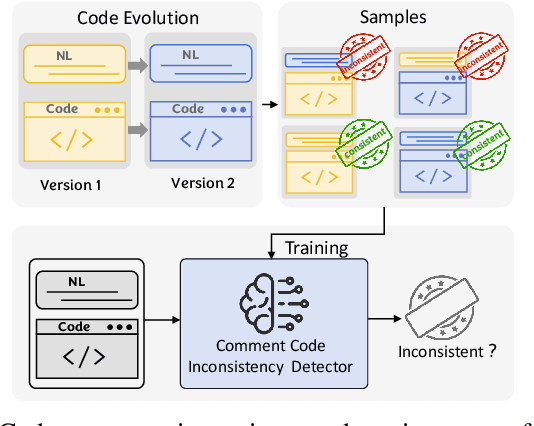
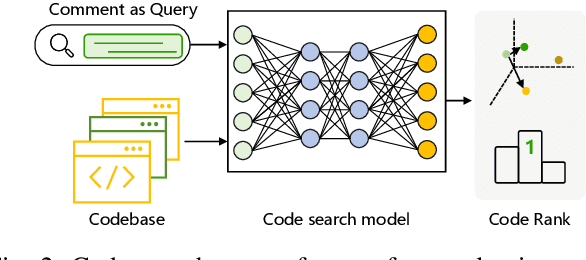
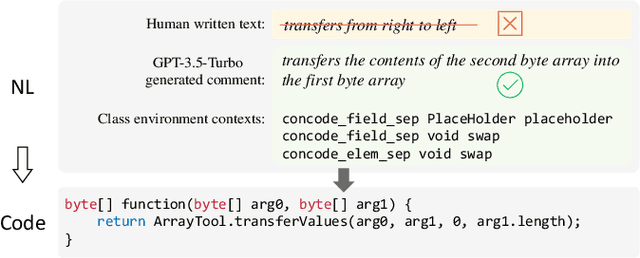
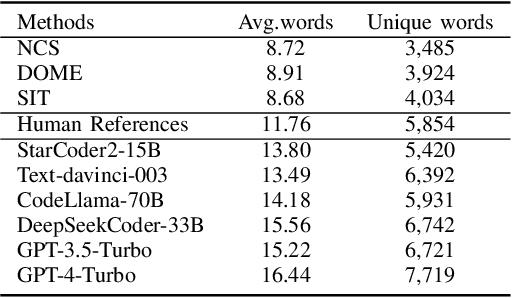
Pre-trained code models rely heavily on high-quality pre-training data, particularly human-written reference comments that bridge code and natural language. However, these comments often become outdated as software evolves, degrading model performance. Large language models (LLMs) excel at generating high-quality code comments. We investigate whether replacing human-written comments with LLM-generated ones improves pre-training datasets. Since standard metrics cannot assess reference comment quality, we propose two novel reference-free evaluation tasks: code-comment inconsistency detection and semantic code search. Results show that LLM-generated comments are more semantically consistent with code than human-written ones, as confirmed by manual evaluation. Leveraging this finding, we rebuild the CodeSearchNet dataset with LLM-generated comments and re-pre-train CodeT5. Evaluations demonstrate that models trained on LLM-enhanced data outperform those using original human comments in code summarization, generation, and translation tasks. This work validates rebuilding pre-training datasets with LLMs to advance code intelligence, challenging the traditional reliance on human reference comments.