 Add to Chrome
 Add to Firefox
 Add to Edge
Animal AI
Papers and Code
PrevizWhiz: Combining Rough 3D Scenes and 2D Video to Guide Generative Video Previsualization
Feb 03, 2026
In pre-production, filmmakers and 3D animation experts must rapidly prototype ideas to explore a film's possibilities before fullscale production, yet conventional approaches involve trade-offs in efficiency and expressiveness. Hand-drawn storyboards often lack spatial precision needed for complex cinematography, while 3D previsualization demands expertise and high-quality rigged assets. To address this gap, we present PrevizWhiz, a system that leverages rough 3D scenes in combination with generative image and video models to create stylized video previews. The workflow integrates frame-level image restyling with adjustable resemblance, time-based editing through motion paths or external video inputs, and refinement into high-fidelity video clips. A study with filmmakers demonstrates that our system lowers technical barriers for film-makers, accelerates creative iteration, and effectively bridges the communication gap, while also surfacing challenges of continuity, authorship, and ethical consideration in AI-assisted filmmaking.

SIDiffAgent: Self-Improving Diffusion Agent
Feb 02, 2026Text-to-image diffusion models have revolutionized generative AI, enabling high-quality and photorealistic image synthesis. However, their practical deployment remains hindered by several limitations: sensitivity to prompt phrasing, ambiguity in semantic interpretation (e.g., ``mouse" as animal vs. a computer peripheral), artifacts such as distorted anatomy, and the need for carefully engineered input prompts. Existing methods often require additional training and offer limited controllability, restricting their adaptability in real-world applications. We introduce Self-Improving Diffusion Agent (SIDiffAgent), a training-free agentic framework that leverages the Qwen family of models (Qwen-VL, Qwen-Image, Qwen-Edit, Qwen-Embedding) to address these challenges. SIDiffAgent autonomously manages prompt engineering, detects and corrects poor generations, and performs fine-grained artifact removal, yielding more reliable and consistent outputs. It further incorporates iterative self-improvement by storing a memory of previous experiences in a database. This database of past experiences is then used to inject prompt-based guidance at each stage of the agentic pipeline. \modelour achieved an average VQA score of 0.884 on GenAIBench, significantly outperforming open-source, proprietary models and agentic methods. We will publicly release our code upon acceptance.
A Platform for Interactive AI Character Experiences
Jan 03, 2026From movie characters to modern science fiction - bringing characters into interactive, story-driven conversations has captured imaginations across generations. Achieving this vision is highly challenging and requires much more than just language modeling. It involves numerous complex AI challenges, such as conversational AI, maintaining character integrity, managing personality and emotions, handling knowledge and memory, synthesizing voice, generating animations, enabling real-world interactions, and integration with physical environments. Recent advancements in the development of foundation models, prompt engineering, and fine-tuning for downstream tasks have enabled researchers to address these individual challenges. However, combining these technologies for interactive characters remains an open problem. We present a system and platform for conveniently designing believable digital characters, enabling a conversational and story-driven experience while providing solutions to all of the technical challenges. As a proof-of-concept, we introduce Digital Einstein, which allows users to engage in conversations with a digital representation of Albert Einstein about his life, research, and persona. While Digital Einstein exemplifies our methods for a specific character, our system is flexible and generalizes to any story-driven or conversational character. By unifying these diverse AI components into a single, easy-to-adapt platform, our work paves the way for immersive character experiences, turning the dream of lifelike, story-based interactions into a reality.
Is Visual Realism Enough? Evaluating Gait Biometric Fidelity in Generative AI Human Animation
Dec 22, 2025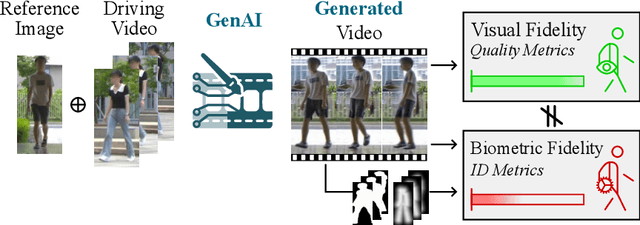

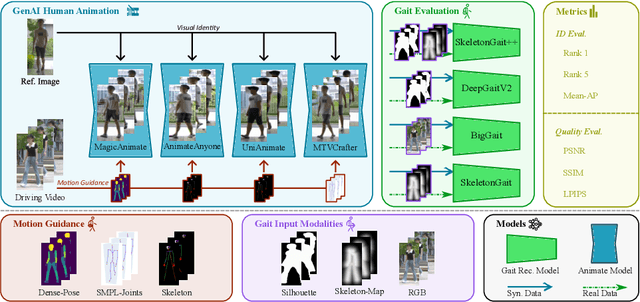
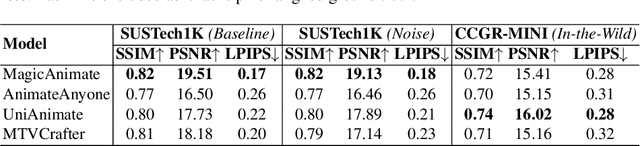
Generative AI (GenAI) models have revolutionized animation, enabling the synthesis of humans and motion patterns with remarkable visual fidelity. However, generating truly realistic human animation remains a formidable challenge, where even minor inconsistencies can make a subject appear unnatural. This limitation is particularly critical when AI-generated videos are evaluated for behavioral biometrics, where subtle motion cues that define identity are easily lost or distorted. The present study investigates whether state-of-the-art GenAI human animation models can preserve the subtle spatio-temporal details needed for person identification through gait biometrics. Specifically, we evaluate four different GenAI models across two primary evaluation tasks to assess their ability to i) restore gait patterns from reference videos under varying conditions of complexity, and ii) transfer these gait patterns to different visual identities. Our results show that while visual quality is mostly high, biometric fidelity remains low in tasks focusing on identification, suggesting that current GenAI models struggle to disentangle identity from motion. Furthermore, through an identity transfer task, we expose a fundamental flaw in appearance-based gait recognition: when texture is disentangled from motion, identification collapses, proving current GenAI models rely on visual attributes rather than temporal dynamics.
An AI Monkey Gets Grapes for Sure -- Sphere Neural Networks for Reliable Decision-Making
Jan 01, 2026This paper compares three methodological categories of neural reasoning: LLM reasoning, supervised learning-based reasoning, and explicit model-based reasoning. LLMs remain unreliable and struggle with simple decision-making that animals can master without extensive corpora training. Through disjunctive syllogistic reasoning testing, we show that reasoning via supervised learning is less appealing than reasoning via explicit model construction. Concretely, we show that an Euler Net trained to achieve 100.00% in classic syllogistic reasoning can be trained to reach 100.00% accuracy in disjunctive syllogistic reasoning. However, the retrained Euler Net suffers severely from catastrophic forgetting (its performance drops to 6.25% on already-learned classic syllogistic reasoning), and its reasoning competence is limited to the pattern level. We propose a new version of Sphere Neural Networks that embeds concepts as circles on the surface of an n-dimensional sphere. These Sphere Neural Networks enable the representation of the negation operator via complement circles and achieve reliable decision-making by filtering out illogical statements that form unsatisfiable circular configurations. We demonstrate that the Sphere Neural Network can master 16 syllogistic reasoning tasks, including rigorous disjunctive syllogistic reasoning, while preserving the rigour of classical syllogistic reasoning. We conclude that neural reasoning with explicit model construction is the most reliable among the three methodological categories of neural reasoning.
Visual-textual Dermatoglyphic Animal Biometrics: A First Case Study on Panthera tigris
Dec 16, 2025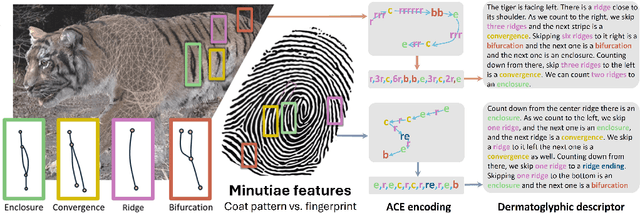
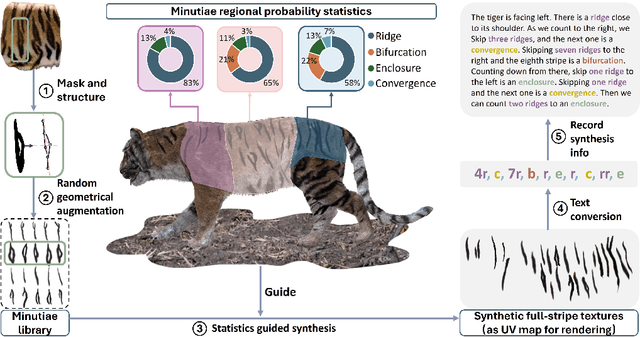
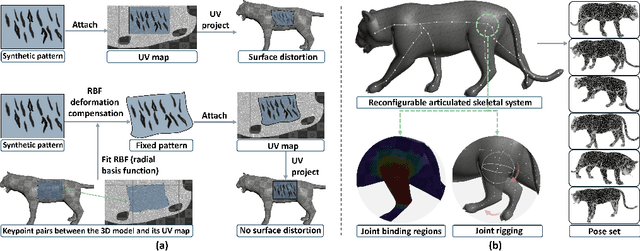
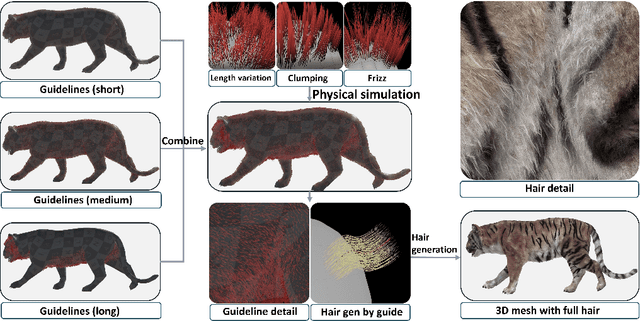
Biologists have long combined visuals with textual field notes to re-identify (Re-ID) animals. Contemporary AI tools automate this for species with distinctive morphological features but remain largely image-based. Here, we extend Re-ID methodologies by incorporating precise dermatoglyphic textual descriptors-an approach used in forensics but new to ecology. We demonstrate that these specialist semantics abstract and encode animal coat topology using human-interpretable language tags. Drawing on 84,264 manually labelled minutiae across 3,355 images of 185 tigers (Panthera tigris), we evaluate this visual-textual methodology, revealing novel capabilities for cross-modal identity retrieval. To optimise performance, we developed a text-image co-synthesis pipeline to generate 'virtual individuals', each comprising dozens of life-like visuals paired with dermatoglyphic text. Benchmarking against real-world scenarios shows this augmentation significantly boosts AI accuracy in cross-modal retrieval while alleviating data scarcity. We conclude that dermatoglyphic language-guided biometrics can overcome vision-only limitations, enabling textual-to-visual identity recovery underpinned by human-verifiable matchings. This represents a significant advance towards explainability in Re-ID and a language-driven unification of descriptive modalities in ecological monitoring.
Open Ad-hoc Categorization with Contextualized Feature Learning
Dec 18, 2025Adaptive categorization of visual scenes is essential for AI agents to handle changing tasks. Unlike fixed common categories for plants or animals, ad-hoc categories are created dynamically to serve specific goals. We study open ad-hoc categorization: Given a few labeled exemplars and abundant unlabeled data, the goal is to discover the underlying context and to expand ad-hoc categories through semantic extension and visual clustering around it. Building on the insight that ad-hoc and common categories rely on similar perceptual mechanisms, we propose OAK, a simple model that introduces a small set of learnable context tokens at the input of a frozen CLIP and optimizes with both CLIP's image-text alignment objective and GCD's visual clustering objective. On Stanford and Clevr-4 datasets, OAK achieves state-of-the-art in accuracy and concept discovery across multiple categorizations, including 87.4% novel accuracy on Stanford Mood, surpassing CLIP and GCD by over 50%. Moreover, OAK produces interpretable saliency maps, focusing on hands for Action, faces for Mood, and backgrounds for Location, promoting transparency and trust while enabling adaptive and generalizable categorization.
* 26 pages, 17 figures
MACE-Dance: Motion-Appearance Cascaded Experts for Music-Driven Dance Video Generation
Dec 20, 2025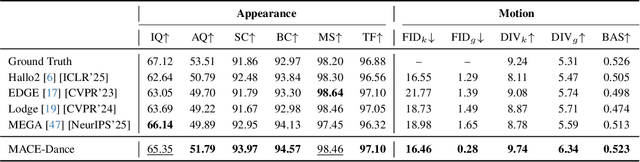
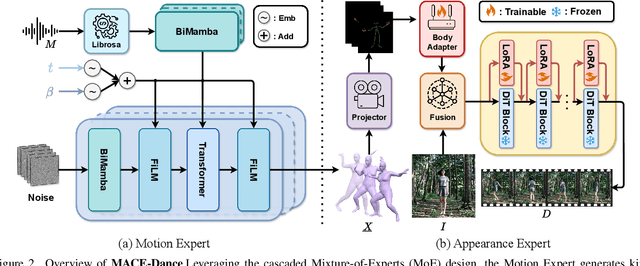
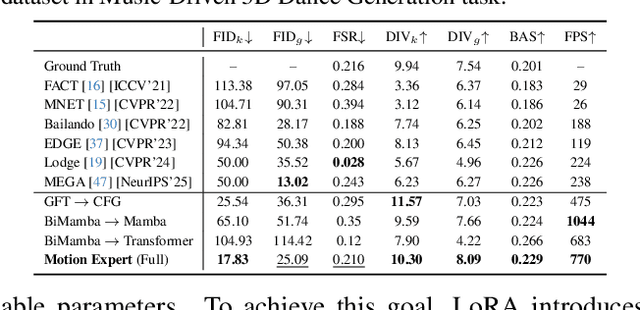
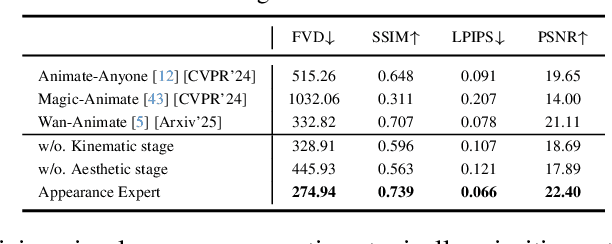
With the rise of online dance-video platforms and rapid advances in AI-generated content (AIGC), music-driven dance generation has emerged as a compelling research direction. Despite substantial progress in related domains such as music-driven 3D dance generation, pose-driven image animation, and audio-driven talking-head synthesis, existing methods cannot be directly adapted to this task. Moreover, the limited studies in this area still struggle to jointly achieve high-quality visual appearance and realistic human motion. Accordingly, we present MACE-Dance, a music-driven dance video generation framework with cascaded Mixture-of-Experts (MoE). The Motion Expert performs music-to-3D motion generation while enforcing kinematic plausibility and artistic expressiveness, whereas the Appearance Expert carries out motion- and reference-conditioned video synthesis, preserving visual identity with spatiotemporal coherence. Specifically, the Motion Expert adopts a diffusion model with a BiMamba-Transformer hybrid architecture and a Guidance-Free Training (GFT) strategy, achieving state-of-the-art (SOTA) performance in 3D dance generation. The Appearance Expert employs a decoupled kinematic-aesthetic fine-tuning strategy, achieving state-of-the-art (SOTA) performance in pose-driven image animation. To better benchmark this task, we curate a large-scale and diverse dataset and design a motion-appearance evaluation protocol. Based on this protocol, MACE-Dance also achieves state-of-the-art performance. Project page: https://macedance.github.io/
Decomate: Leveraging Generative Models for Co-Creative SVG Animation
Nov 09, 2025Designers often encounter friction when animating static SVG graphics, especially when the visual structure does not match the desired level of motion detail. Existing tools typically depend on predefined groupings or require technical expertise, which limits designers' ability to experiment and iterate independently. We present Decomate, a system that enables intuitive SVG animation through natural language. Decomate leverages a multimodal large language model to restructure raw SVGs into semantically meaningful, animation-ready components. Designers can then specify motions for each component via text prompts, after which the system generates corresponding HTML/CSS/JS animations. By supporting iterative refinement through natural language interaction, Decomate integrates generative AI into creative workflows, allowing animation outcomes to be directly shaped by user intent.
The Double Contingency Problem: AI Recursion and the Limits of Interspecies Understanding
Nov 12, 2025Current bioacoustic AI systems achieve impressive cross-species performance by processing animal communication through transformer architectures, foundation model paradigms, and other computational approaches. However, these approaches overlook a fundamental question: what happens when one form of recursive cognition--AI systems with their attention mechanisms, iterative processing, and feedback loops--encounters the recursive communicative processes of other species? Drawing on philosopher Yuk Hui's work on recursivity and contingency, I argue that AI systems are not neutral pattern detectors but recursive cognitive agents whose own information processing may systematically obscure or distort other species' communicative structures. This creates a double contingency problem: each species' communication emerges through contingent ecological and evolutionary conditions, while AI systems process these signals through their own contingent architectural and training conditions. I propose that addressing this challenge requires reconceptualizing bioacoustic AI from universal pattern recognition toward diplomatic encounter between different forms of recursive cognition, with implications for model design, evaluation frameworks, and research methodologies.