 Add to Chrome
 Add to Firefox
 Add to Edge
Compos3D: Interactive Part-Based Composition for Creative Control in Generative 3D Models
Jul 13, 2026
While generative AI has unlocked new opportunities for 3D content creation, current workflows often rely on multiple regenerations, which provides limited control and unpredictable outcomes. We present Compos3D, a system that introduces a compositional workflow for generative 3D modeling through remixing. Instead of repeatedly regenerating models, users generate multiple candidates from text or image prompts, select parts of interest via 2D image regions or 3D mesh segments, and assemble them into a coherent design. The system synthesizes these compositions into a refined 3D model, preserving high-level intent while resolving low-level geometry. To evaluate this approach, we conducted a controlled user study comparing remixing and regeneration workflows across both 2D and 3D modalities. Results show that the remixing workflow provides participants with greater creative control, stronger alignment with their intent, and higher satisfaction. We conclude with design recommendations for future AI-assisted 3D modeling workflows.

PlayWrite: A Multimodal System for AI Supported Narrative Co-Authoring Through Play in XR
Mar 02, 2026Current AI writing tools, which rely on text prompts, poorly support the spatial and interactive nature of storytelling where ideas emerge from direct manipulation and play. We present PlayWrite, a mixed-reality system where users author stories by directly manipulating virtual characters and props. A multi-agent AI pipeline interprets these actions into Intent Frames -structured narrative beats visualized as rearrangeable story marbles on a timeline. A large language model then transforms the user's assembled sequence into a final narrative. A user study (N=13) with writers from varying domains found that PlayWrite fosters a highly improvisational and playful process. Users treated the AI as a collaborative partner, using its unexpected responses to spark new ideas and overcome creative blocks. PlayWrite demonstrates an approach for co-creative systems that move beyond text to embrace direct manipulation and play as core interaction modalities.
PrevizWhiz: Combining Rough 3D Scenes and 2D Video to Guide Generative Video Previsualization
Feb 03, 2026In pre-production, filmmakers and 3D animation experts must rapidly prototype ideas to explore a film's possibilities before fullscale production, yet conventional approaches involve trade-offs in efficiency and expressiveness. Hand-drawn storyboards often lack spatial precision needed for complex cinematography, while 3D previsualization demands expertise and high-quality rigged assets. To address this gap, we present PrevizWhiz, a system that leverages rough 3D scenes in combination with generative image and video models to create stylized video previews. The workflow integrates frame-level image restyling with adjustable resemblance, time-based editing through motion paths or external video inputs, and refinement into high-fidelity video clips. A study with filmmakers demonstrates that our system lowers technical barriers for film-makers, accelerates creative iteration, and effectively bridges the communication gap, while also surfacing challenges of continuity, authorship, and ethical consideration in AI-assisted filmmaking.
FeedQUAC: Quick Unobtrusive AI-Generated Commentary
Apr 23, 2025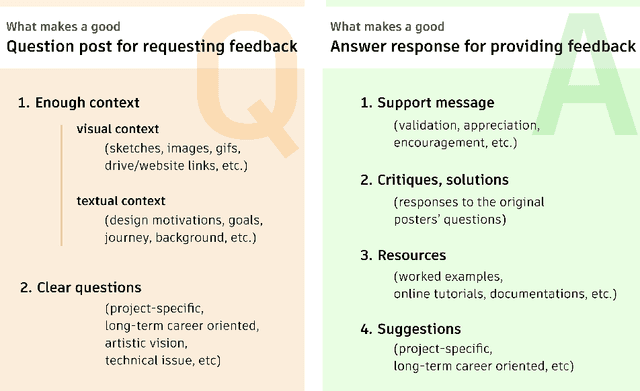
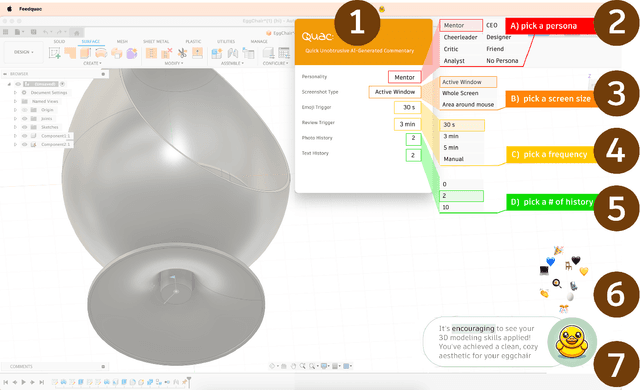
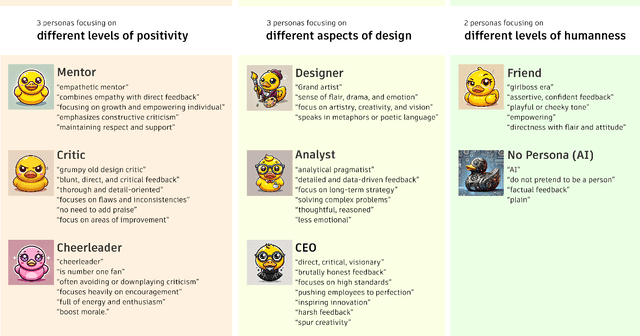
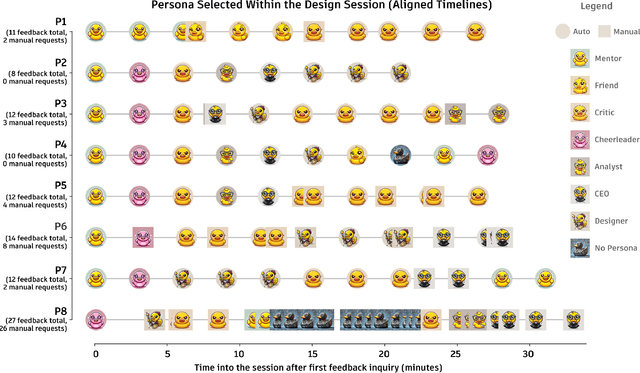
Design thrives on feedback. However, gathering constant feedback throughout the design process can be labor-intensive and disruptive. We explore how AI can bridge this gap by providing effortless, ambient feedback. We introduce FeedQUAC, a design companion that delivers real-time AI-generated commentary from a variety of perspectives through different personas. A design probe study with eight participants highlights how designers can leverage quick yet ambient AI feedback to enhance their creative workflows. Participants highlight benefits such as convenience, playfulness, confidence boost, and inspiration from this lightweight feedback agent, while suggesting additional features, like chat interaction and context curation. We discuss the role of AI feedback, its strengths and limitations, and how to integrate it into existing design workflows while balancing user involvement. Our findings also suggest that ambient interaction is a valuable consideration for both the design and evaluation of future creativity support systems.