 Add to Chrome
 Add to Firefox
 Add to Edge
6D Pose Estimation Of A Single Object
Papers and Code
Yolo-Key-6D: Single Stage Monocular 6D Pose Estimation with Keypoint Enhancements
Mar 04, 2026
Estimating the 6D pose of objects from a single RGB image is a critical task for robotics and extended reality applications. However, state-of-the-art multi stage methods often suffer from high latency, making them unsuitable for real time use. In this paper, we present Yolo-Key-6D, a novel single stage, end-to-end framework for monocular 6D pose estimation designed for both speed and accuracy. Our approach enhances a YOLO based architecture by integrating an auxiliary head that regresses the 2D projections of an object's 3D bounding box corners. This keypoint detection task significantly improves the network's understanding of 3D geometry. For stable end-to-end training, we directly regress rotation using a continuous 9D representation projected to SO(3) via singular value decomposition. On the LINEMOD and LINEMOD-Occluded benchmarks, YOLO-Key-6D achieves competitive accuracy scores of 96.24% and 69.41%, respectively, with the ADD(-S) 0.1d metric, while proving itself to operate in real time. Our results demonstrate that a carefully designed single stage method can provide a practical and effective balance of performance and efficiency for real world deployment.

Differentiable Inverse Graphics for Zero-shot Scene Reconstruction and Robot Grasping
Feb 04, 2026Operating effectively in novel real-world environments requires robotic systems to estimate and interact with previously unseen objects. Current state-of-the-art models address this challenge by using large amounts of training data and test-time samples to build black-box scene representations. In this work, we introduce a differentiable neuro-graphics model that combines neural foundation models with physics-based differentiable rendering to perform zero-shot scene reconstruction and robot grasping without relying on any additional 3D data or test-time samples. Our model solves a series of constrained optimization problems to estimate physically consistent scene parameters, such as meshes, lighting conditions, material properties, and 6D poses of previously unseen objects from a single RGBD image and bounding boxes. We evaluated our approach on standard model-free few-shot benchmarks and demonstrated that it outperforms existing algorithms for model-free few-shot pose estimation. Furthermore, we validated the accuracy of our scene reconstructions by applying our algorithm to a zero-shot grasping task. By enabling zero-shot, physically-consistent scene reconstruction and grasping without reliance on extensive datasets or test-time sampling, our approach offers a pathway towards more data efficient, interpretable and generalizable robot autonomy in novel environments.
IndustryShapes: An RGB-D Benchmark dataset for 6D object pose estimation of industrial assembly components and tools
Feb 05, 2026We introduce IndustryShapes, a new RGB-D benchmark dataset of industrial tools and components, designed for both instance-level and novel object 6D pose estimation approaches. The dataset provides a realistic and application-relevant testbed for benchmarking these methods in the context of industrial robotics bridging the gap between lab-based research and deployment in real-world manufacturing scenarios. Unlike many previous datasets that focus on household or consumer products or use synthetic, clean tabletop datasets, or objects captured solely in controlled lab environments, IndustryShapes introduces five new object types with challenging properties, also captured in realistic industrial assembly settings. The dataset has diverse complexity, from simple to more challenging scenes, with single and multiple objects, including scenes with multiple instances of the same object and it is organized in two parts: the classic set and the extended set. The classic set includes a total of 4,6k images and 6k annotated poses. The extended set introduces additional data modalities to support the evaluation of model-free and sequence-based approaches. To the best of our knowledge, IndustryShapes is the first dataset to offer RGB-D static onboarding sequences. We further evaluate the dataset on a representative set of state-of-the art methods for instance-based and novel object 6D pose estimation, including also object detection, segmentation, showing that there is room for improvement in this domain. The dataset page can be found in https://pose-lab.github.io/IndustryShapes.
OSCAR: Open-Set CAD Retrieval from a Language Prompt and a Single Image
Jan 12, 20266D object pose estimation plays a crucial role in scene understanding for applications such as robotics and augmented reality. To support the needs of ever-changing object sets in such context, modern zero-shot object pose estimators were developed to not require object-specific training but only rely on CAD models. Such models are hard to obtain once deployed, and a continuously changing and growing set of objects makes it harder to reliably identify the instance model of interest. To address this challenge, we introduce an Open-Set CAD Retrieval from a Language Prompt and a Single Image (OSCAR), a novel training-free method that retrieves a matching object model from an unlabeled 3D object database. During onboarding, OSCAR generates multi-view renderings of database models and annotates them with descriptive captions using an image captioning model. At inference, GroundedSAM detects the queried object in the input image, and multi-modal embeddings are computed for both the Region-of-Interest and the database captions. OSCAR employs a two-stage retrieval: text-based filtering using CLIP identifies candidate models, followed by image-based refinement using DINOv2 to select the most visually similar object. In our experiments we demonstrate that OSCAR outperforms all state-of-the-art methods on the cross-domain 3D model retrieval benchmark MI3DOR. Furthermore, we demonstrate OSCAR's direct applicability in automating object model sourcing for 6D object pose estimation. We propose using the most similar object model for pose estimation if the exact instance is not available and show that OSCAR achieves an average precision of 90.48\% during object retrieval on the YCB-V object dataset. Moreover, we demonstrate that the most similar object model can be utilized for pose estimation using Megapose achieving better results than a reconstruction-based approach.
AlignPose: Generalizable 6D Pose Estimation via Multi-view Feature-metric Alignment
Dec 23, 2025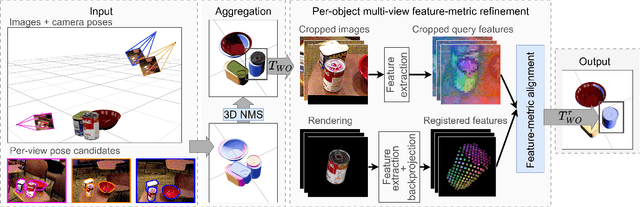
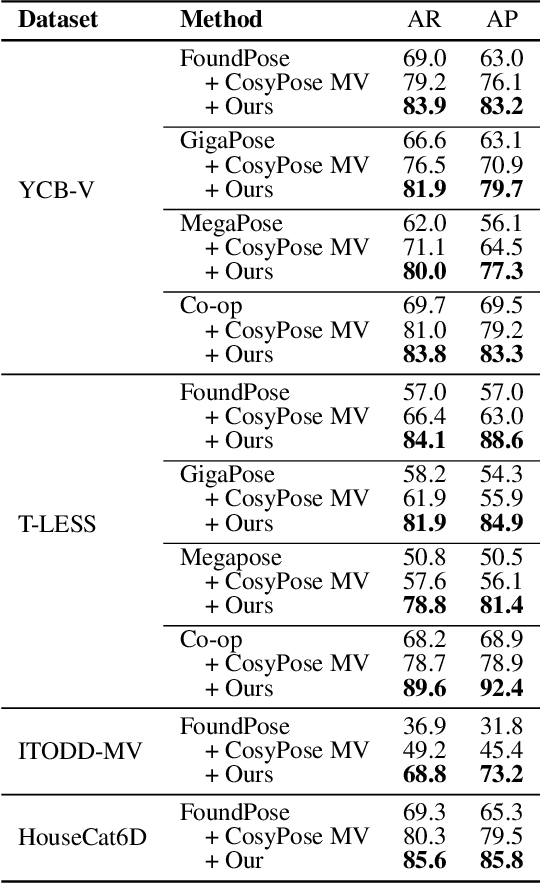
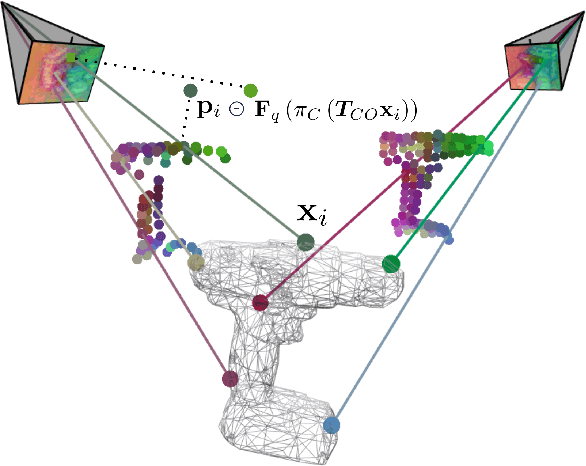
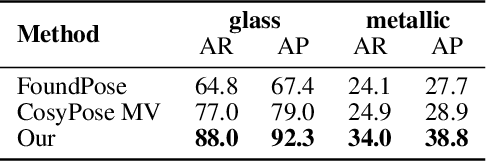
Single-view RGB model-based object pose estimation methods achieve strong generalization but are fundamentally limited by depth ambiguity, clutter, and occlusions. Multi-view pose estimation methods have the potential to solve these issues, but existing works rely on precise single-view pose estimates or lack generalization to unseen objects. We address these challenges via the following three contributions. First, we introduce AlignPose, a 6D object pose estimation method that aggregates information from multiple extrinsically calibrated RGB views and does not require any object-specific training or symmetry annotation. Second, the key component of this approach is a new multi-view feature-metric refinement specifically designed for object pose. It optimizes a single, consistent world-frame object pose minimizing the feature discrepancy between on-the-fly rendered object features and observed image features across all views simultaneously. Third, we report extensive experiments on four datasets (YCB-V, T-LESS, ITODD-MV, HouseCat6D) using the BOP benchmark evaluation and show that AlignPose outperforms other published methods, especially on challenging industrial datasets where multiple views are readily available in practice.
Geo6DPose: Fast Zero-Shot 6D Object Pose Estimation via Geometry-Filtered Feature Matching
Dec 11, 2025Recent progress in zero-shot 6D object pose estimation has been driven largely by large-scale models and cloud-based inference. However, these approaches often introduce high latency, elevated energy consumption, and deployment risks related to connectivity, cost, and data governance; factors that conflict with the practical constraints of real-world robotics, where compute is limited and on-device inference is frequently required. We introduce Geo6DPose, a lightweight, fully local, and training-free pipeline for zero-shot 6D pose estimation that trades model scale for geometric reliability. Our method combines foundation model visual features with a geometric filtering strategy: Similarity maps are computed between onboarded template DINO descriptors and scene patches, and mutual correspondences are established by projecting scene patch centers to 3D and template descriptors to the object model coordinate system. Final poses are recovered via correspondence-driven RANSAC and ranked using a weighted geometric alignment metric that jointly accounts for reprojection consistency and spatial support, improving robustness to noise, clutter, and partial visibility. Geo6DPose achieves sub-second inference on a single commodity GPU while matching the average recall of significantly larger zero-shot baselines (53.7 AR, 1.08 FPS). It requires no training, fine-tuning, or network access, and remains compatible with evolving foundation backbones, advancing practical, fully local 6D perception for robotic deployment.
STORM: Segment, Track, and Object Re-Localization from a Single 3D Model
Nov 12, 2025Accurate 6D pose estimation and tracking are fundamental capabilities for physical AI systems such as robots. However, existing approaches typically rely on a manually annotated segmentation mask of the target in the first frame, which is labor-intensive and leads to reduced performance when faced with occlusions or rapid movement. To address these limi- tations, we propose STORM (Segment, Track, and Object Re-localization from a single 3D Model), an open-source robust real-time 6D pose estimation system that requires no manual annotation. STORM employs a novel three-stage pipeline combining vision-language understanding with self-supervised feature matching: contextual object descriptions guide localization, self-cross-attention mechanisms identify candidate regions, and a segmentation model produces precise masks for accurate pose estimation. Another key innovation is our automatic re-registration mechanism that detects tracking failures through feature similarity monitoring and recovers from severe occlusions or rapid motion. STORM achieves state-of-the-art accuracy on challenging industrial datasets featuring multi-object occlusions, high-speed motion, and varying illumination, while operating at real-time speeds without additional training. This annotation-free approach significantly reduces deployment overhead, providing a practical solution for modern applications, such as flexible manufacturing and intelligent quality control.
CoordAR: One-Reference 6D Pose Estimation of Novel Objects via Autoregressive Coordinate Map Generation
Nov 17, 2025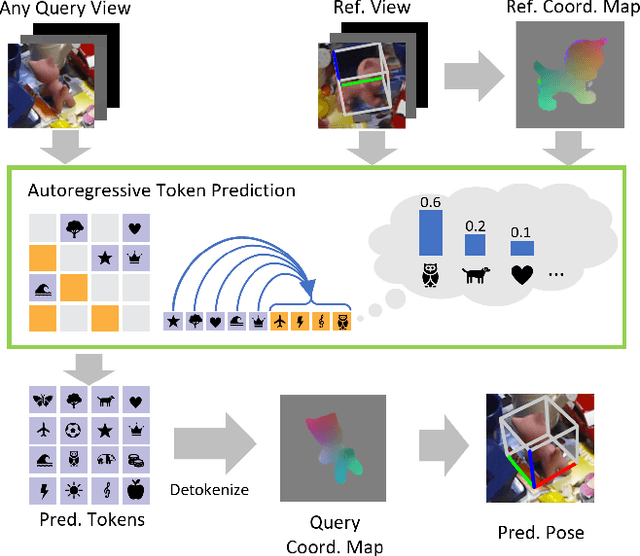
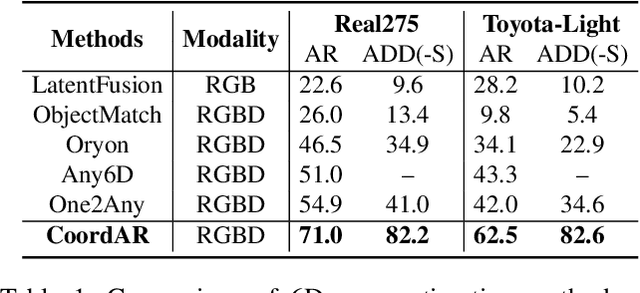
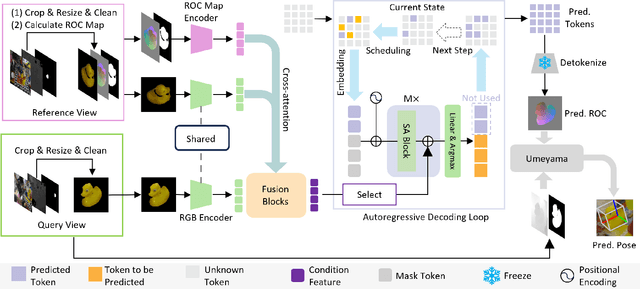
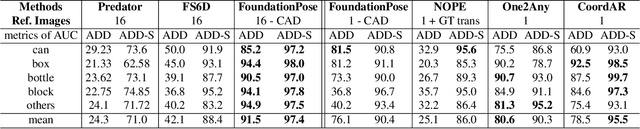
Object 6D pose estimation, a crucial task for robotics and augmented reality applications, becomes particularly challenging when dealing with novel objects whose 3D models are not readily available. To reduce dependency on 3D models, recent studies have explored one-reference-based pose estimation, which requires only a single reference view instead of a complete 3D model. However, existing methods that rely on real-valued coordinate regression suffer from limited global consistency due to the local nature of convolutional architectures and face challenges in symmetric or occluded scenarios owing to a lack of uncertainty modeling. We present CoordAR, a novel autoregressive framework for one-reference 6D pose estimation of unseen objects. CoordAR formulates 3D-3D correspondences between the reference and query views as a map of discrete tokens, which is obtained in an autoregressive and probabilistic manner. To enable accurate correspondence regression, CoordAR introduces 1) a novel coordinate map tokenization that enables probabilistic prediction over discretized 3D space; 2) a modality-decoupled encoding strategy that separately encodes RGB appearance and coordinate cues; and 3) an autoregressive transformer decoder conditioned on both position-aligned query features and the partially generated token sequence. With these novel mechanisms, CoordAR significantly outperforms existing methods on multiple benchmarks and demonstrates strong robustness to symmetry, occlusion, and other challenges in real-world tests.
YCB-Ev SD: Synthetic event-vision dataset for 6DoF object pose estimation
Nov 14, 2025We introduce YCB-Ev SD, a synthetic dataset of event-camera data at standard definition (SD) resolution for 6DoF object pose estimation. While synthetic data has become fundamental in frame-based computer vision, event-based vision lacks comparable comprehensive resources. Addressing this gap, we present 50,000 event sequences of 34 ms duration each, synthesized from Physically Based Rendering (PBR) scenes of YCB-Video objects following the Benchmark for 6D Object Pose (BOP) methodology. Our generation framework employs simulated linear camera motion to ensure complete scene coverage, including background activity. Through systematic evaluation of event representations for CNN-based inference, we demonstrate that time-surfaces with linear decay and dual-channel polarity encoding achieve superior pose estimation performance, outperforming exponential decay and single-channel alternatives by significant margins. Our analysis reveals that polarity information contributes most substantially to performance gains, while linear temporal encoding preserves critical motion information more effectively than exponential decay. The dataset is provided in a structured format with both raw event streams and precomputed optimal representations to facilitate immediate research use and reproducible benchmarking. The dataset is publicly available at https://huggingface.co/datasets/paroj/ycbev_sd.
SingRef6D: Monocular Novel Object Pose Estimation with a Single RGB Reference
Sep 26, 2025Recent 6D pose estimation methods demonstrate notable performance but still face some practical limitations. For instance, many of them rely heavily on sensor depth, which may fail with challenging surface conditions, such as transparent or highly reflective materials. In the meantime, RGB-based solutions provide less robust matching performance in low-light and texture-less scenes due to the lack of geometry information. Motivated by these, we propose SingRef6D, a lightweight pipeline requiring only a single RGB image as a reference, eliminating the need for costly depth sensors, multi-view image acquisition, or training view synthesis models and neural fields. This enables SingRef6D to remain robust and capable even under resource-limited settings where depth or dense templates are unavailable. Our framework incorporates two key innovations. First, we propose a token-scaler-based fine-tuning mechanism with a novel optimization loss on top of Depth-Anything v2 to enhance its ability to predict accurate depth, even for challenging surfaces. Our results show a 14.41% improvement (in $\delta_{1.05}$) on REAL275 depth prediction compared to Depth-Anything v2 (with fine-tuned head). Second, benefiting from depth availability, we introduce a depth-aware matching process that effectively integrates spatial relationships within LoFTR, enabling our system to handle matching for challenging materials and lighting conditions. Evaluations of pose estimation on the REAL275, ClearPose, and Toyota-Light datasets show that our approach surpasses state-of-the-art methods, achieving a 6.1% improvement in average recall.