 Add to Chrome
 Add to Firefox
 Add to Edge
MolBioKG: Grounding Out-of-Graph Molecules in Biomedical Knowledge Graphs via Multi-Resolution Structural Anchoring
Aug 07, 2026
Biomedical knowledge graphs (KGs) accelerate drug discovery, but standard pipelines assume query molecules already exist as graph entities, leaving unregistered molecules disconnected. We address this cold-start challenge, termed the out-of-graph molecule problem, by introducing MolBioKG. This two-layer system grounds unseen molecules in biomedical evidence via multi-resolution structural anchoring. It connects an index of 2.74 million molecules (represented by scaffolds, fragments, functional groups, and fingerprints) to a 9.6-million-edge KG. Given only a SMILES string, MolBioKG retrieves structurally related graph entities and traverses their biomedical neighborhoods without task-specific training. It features two inference mechanisms: static multi-anchor retrieval using Reciprocal Rank Fusion, and Adapt-KG, a tool-using LLM policy for adaptive traversal. Evaluated across in-graph link recovery, complex multi-hop reasoning, and out-of-graph generalization, MolBioKG outperforms strong baselines. Notably, it raises Hits@10 from 0.585 to 0.876 in multi-hop reasoning and out-of-graph target recall from 0.145 to 0.269, all while ensuring predictions retain traceable structural anchors and source-attributed KG evidence.

Pepti-drift: Toxicity-Repulsive Drifting for Antigen-Conditioned Discrete Peptide Generation
Jun 29, 2026Peptides are a promising therapeutic modality that combine the chemical tunability of small molecules with the target specificity of macromolecular therapeutics. However, designing antigen-specific binding peptides while avoiding toxicity remains a major challenge for therapeutic peptide discovery. Here, we present Pepti-drift, a toxicity-aware latent refinement framework that generates peptide candidates through a single antigen-conditioned drift step. In a peptide embedding space, Pepti-drift learns to attract generated peptide latents toward antigen-matched binding peptides while repelling them from toxicity-associated regions. This is challenging because binding-promoting physicochemical features often overlap with toxicity-associated features in peptide representation space. To address this, we introduce a warm-up strategy to stabilize this competing objective by first learning binding-oriented attraction and then increasing toxicity repulsion. Pepti-drift achieves highly efficient generation, running 16.2-fold faster than PepMLM and 1,092.0-fold faster than PepTune. Generated peptides show 100% validity, 98.1% uniqueness, the highest sequence diversity, and near-zero cross-antigen reuse. Further evaluation indicates consistently reduced toxicity and hemolysis risk across most peptide-length ranges while retaining target-related predictive binding signal. Pepti-drift thus provides a fast, scalable, and controllable framework for antigen-specific peptide design that directly encodes safe-and-active properties.
Learning Explicit Behavioral Models with Adaptive Questions and World-Model Probes
Jun 05, 2026Interactive agents trained only against task return can achieve high scores while failing to represent the mechanisms that make their actions succeed. This makes brittle behavior difficult to diagnose and limits adaptation when environment dynamics change. Existing LLM reflection and policy-code repair can revise behavior from failed trajectories, but questions and world-understanding tests are usually used only after training. We introduce an Explicit Symbolic Behavioral Model (ESBM), a trainable behavioral model that couples task performance with evidence-grounded question answering and executable mechanism prediction. An ESBM represents behavior through typed predicates, weighted rules, bounded options and mechanism memory; the mechanism layer predicts symbolic events, object changes, rewards and terminal consequences under action interventions. After each rollout, adaptive questions and active world-model probes convert score failures, QA errors and transition-prediction errors into constraints for local ESBM edits. Candidate models are selected by a multi-criterion rule that jointly evaluates task score, answerability and active world-model consistency. Under the tested Atari-style protocols, ESBM learns high-scoring policies while producing explicit answers and executable mechanism predictions, indicating that adaptive questions can serve as both training pressure and reusable benchmarks for mechanistic policy learning in this setting.
Kintsugi: Learning Policies by Repairing Executable Knowledge Bases
May 10, 2026Modern embodied agents achieve impressive performance, but their task knowledge is often stored in neural weights, latent state, or prompt-bound memory, making individual policy knowledge difficult to inspect, validate, recombine, and reuse. We introduce \textbf{Kintsugi}, a white-box policy-learning framework that treats embodied policy improvement as verifier-gated construction of a typed executable Knowledge Base (KB). Kintsugi represents task-level policy knowledge as composable typed entries -- predicates, operators, policy schemas, monitors, recovery rules, experience records, and goals -- and improves this artifact through localized typed edits induced from rollout evidence, rather than relying on test-time language-model reasoning. Between rollouts, a tool-constrained agentic editing loop diagnoses trajectory failures, localizes them to editable KB layers, and proposes candidate edits. A deterministic verification gate admits an edit only when the candidate type-checks, the resulting KB executes, and focused validation success or trajectory-health metrics improve without violating protected-regression checks. At inference, the accepted KB is executed by a deterministic symbolic executor with zero LLM calls. Across long-horizon text-agent benchmarks and representative object-centric manipulation settings, Kintsugi achieves strong endpoint performance while preserving inspectability, local editability, and verifier-gated deployment. These results suggest that embodied policy improvement can be organized around executable task knowledge.
LLMs Gaming Verifiers: RLVR can Lead to Reward Hacking
Apr 16, 2026As reinforcement Learning with Verifiable Rewards (RLVR) has become the dominant paradigm for scaling reasoning capabilities in LLMs, a new failure mode emerges: LLMs gaming verifiers. We study this phenomenon on inductive reasoning tasks, where models must induce and output logical rules. We find that RLVR-trained models systematically abandon rule induction. Instead of learning generalizable patterns (e.g., ``trains carrying red cars go east''), they enumerate instance-level labels, producing outputs that pass verifiers without capturing the relational patterns required by the task. We show that this behavior is not a failure of understanding but a form of reward hacking: imperfect verifiers that check only extensional correctness admit false positives. To detect such shortcuts, we introduce Isomorphic Perturbation Testing (IPT), which evaluates a single model output under both extensional and isomorphic verification, where the latter enforces invariance under logically isomorphic tasks. While genuine rule induction remains invariant, shortcut strategies fail. We find that shortcut behavior is specific to RLVR-trained reasoning models (e.g., GPT-5, Olmo3) and absent in non-RLVR models (e.g., GPT-4o, GPT-4.5, Ministral). Moreover, shortcut prevalence increases with task complexity and inference-time compute. In controlled training experiments, extensional verification directly induces shortcut strategies, while isomorphic verification eliminates them. These results show that RLVR can incentivize reward hacking not only through overt manipulation but also by exploiting what the verifier fails to enforce.
STORM: Segment, Track, and Object Re-Localization from a Single 3D Model
Nov 12, 2025Accurate 6D pose estimation and tracking are fundamental capabilities for physical AI systems such as robots. However, existing approaches typically rely on a manually annotated segmentation mask of the target in the first frame, which is labor-intensive and leads to reduced performance when faced with occlusions or rapid movement. To address these limi- tations, we propose STORM (Segment, Track, and Object Re-localization from a single 3D Model), an open-source robust real-time 6D pose estimation system that requires no manual annotation. STORM employs a novel three-stage pipeline combining vision-language understanding with self-supervised feature matching: contextual object descriptions guide localization, self-cross-attention mechanisms identify candidate regions, and a segmentation model produces precise masks for accurate pose estimation. Another key innovation is our automatic re-registration mechanism that detects tracking failures through feature similarity monitoring and recovers from severe occlusions or rapid motion. STORM achieves state-of-the-art accuracy on challenging industrial datasets featuring multi-object occlusions, high-speed motion, and varying illumination, while operating at real-time speeds without additional training. This annotation-free approach significantly reduces deployment overhead, providing a practical solution for modern applications, such as flexible manufacturing and intelligent quality control.
BlendRL: A Framework for Merging Symbolic and Neural Policy Learning
Oct 15, 2024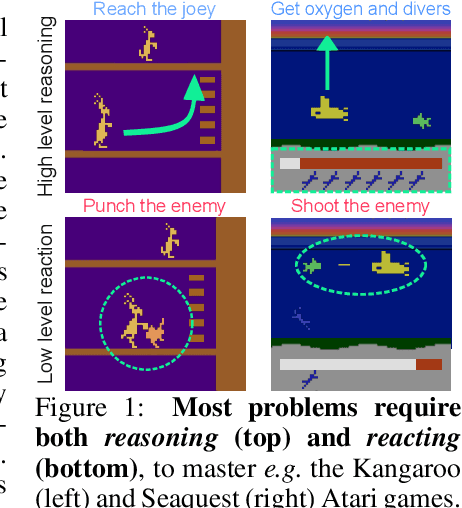
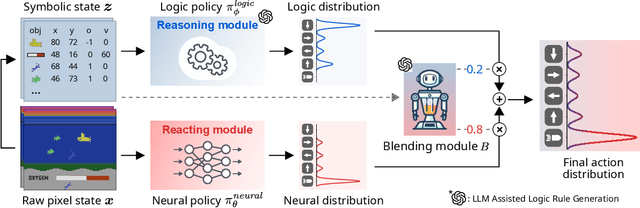
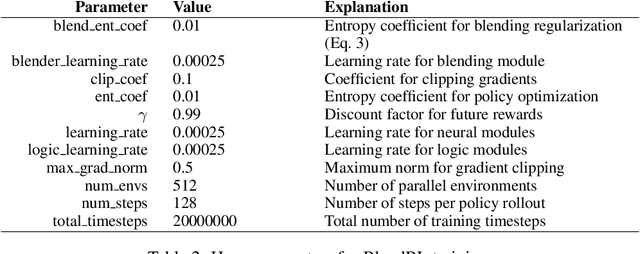
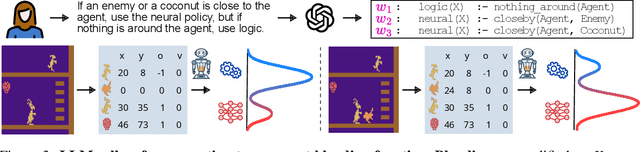
Humans can leverage both symbolic reasoning and intuitive reactions. In contrast, reinforcement learning policies are typically encoded in either opaque systems like neural networks or symbolic systems that rely on predefined symbols and rules. This disjointed approach severely limits the agents' capabilities, as they often lack either the flexible low-level reaction characteristic of neural agents or the interpretable reasoning of symbolic agents. To overcome this challenge, we introduce BlendRL, a neuro-symbolic RL framework that harmoniously integrates both paradigms within RL agents that use mixtures of both logic and neural policies. We empirically demonstrate that BlendRL agents outperform both neural and symbolic baselines in standard Atari environments, and showcase their robustness to environmental changes. Additionally, we analyze the interaction between neural and symbolic policies, illustrating how their hybrid use helps agents overcome each other's limitations.
EXPIL: Explanatory Predicate Invention for Learning in Games
Jun 10, 2024Reinforcement learning (RL) has proven to be a powerful tool for training agents that excel in various games. However, the black-box nature of neural network models often hinders our ability to understand the reasoning behind the agent's actions. Recent research has attempted to address this issue by using the guidance of pretrained neural agents to encode logic-based policies, allowing for interpretable decisions. A drawback of such approaches is the requirement of large amounts of predefined background knowledge in the form of predicates, limiting its applicability and scalability. In this work, we propose a novel approach, Explanatory Predicate Invention for Learning in Games (EXPIL), that identifies and extracts predicates from a pretrained neural agent, later used in the logic-based agents, reducing the dependency on predefined background knowledge. Our experimental evaluation on various games demonstrate the effectiveness of EXPIL in achieving explainable behavior in logic agents while requiring less background knowledge.
DeiSAM: Segment Anything with Deictic Prompting
Feb 21, 2024
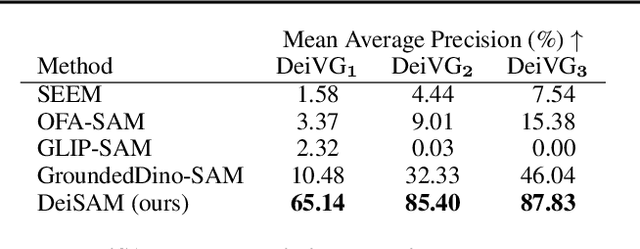
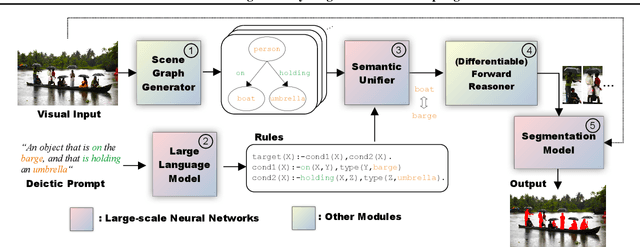
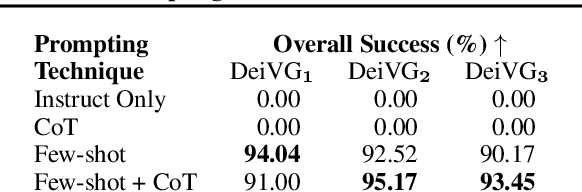
Large-scale, pre-trained neural networks have demonstrated strong capabilities in various tasks, including zero-shot image segmentation. To identify concrete objects in complex scenes, humans instinctively rely on deictic descriptions in natural language, i.e., referring to something depending on the context such as "The object that is on the desk and behind the cup.". However, deep learning approaches cannot reliably interpret such deictic representations due to their lack of reasoning capabilities in complex scenarios. To remedy this issue, we propose DeiSAM -- a combination of large pre-trained neural networks with differentiable logic reasoners -- for deictic promptable segmentation. Given a complex, textual segmentation description, DeiSAM leverages Large Language Models (LLMs) to generate first-order logic rules and performs differentiable forward reasoning on generated scene graphs. Subsequently, DeiSAM segments objects by matching them to the logically inferred image regions. As part of our evaluation, we propose the Deictic Visual Genome (DeiVG) dataset, containing paired visual input and complex, deictic textual prompts. Our empirical results demonstrate that DeiSAM is a substantial improvement over purely data-driven baselines for deictic promptable segmentation.
Learning by Self-Explaining
Sep 15, 2023Artificial intelligence (AI) research has a long track record of drawing inspirations from findings from biology, in particular human intelligence. In contrast to current AI research that mainly treats explanations as a means for model inspection, a somewhat neglected finding from human psychology is the benefit of self-explaining in an agents' learning process. Motivated by this, we introduce a novel learning paradigm, termed Learning by Self-Explaining (LSX). The underlying idea is that a learning module (learner) performs a base task, e.g. image classification, and provides explanations to its decisions. An internal critic module next evaluates the quality of these explanations given the original task. Finally, the learner is refined with the critic's feedback and the loop is repeated as required. The intuition behind this is that an explanation is considered "good" if the critic can perform the same task given the respective explanation. Despite many implementation possibilities the structure of any LSX instantiation can be taxonomized based on four learning modules which we identify as: Fit, Explain, Reflect and Revise. In our work, we provide distinct instantiations of LSX for two different learner models, each illustrating different choices for the various LSX components. We broadly evaluate these on several datasets and show that Learning by Self-Explaining not only boosts the generalization abilities of AI models, particularly in small-data regimes, but also aids in mitigating the influence of confounding factors, as well as leading to more task specific and faithful model explanations. Overall, our results provide experimental evidence of the potential of self-explaining within the learning phase of an AI model.