 Add to Chrome
 Add to Firefox
 Add to Edge
EgoRecovery: Acquiring Failure Recovery Ability Through Human Recovery Demonstration
Jul 23, 2026
Robust embodied robots should be able to recover from failures and retry tasks in order to operate reliably in unstructured and noisy real-world environments. Achieving this capability requires training policies on data that captures recovery behaviors. However, collecting such data through robot teleoperation is difficult to scale, as it is time-consuming to induce diverse failure states, perform corrective actions, and reset the environment. This challenge is further exacerbated by the high diversity of failure modes, which demands substantially more recovery data than success demonstrations. In this work, we show that egocentric human data capturing failure recovery processes provides a scalable alternative. By efficiently arranging task-level failure configurations and recording short recovery segments, human operators can generate more than 10x as much valid recovery data per hour compared to robot teleoperation under our protocol. To address the embodiment gap between human and robot, we propose EgoRecovery, a co-training framework for learning recovery behavior, where human recovery demonstrations are aligned to a compact corrective-intent space shared with robot data, which captures the timing and magnitude of correction. Only a small number of robot recovery demonstrations are required to connect this intent to executable robot actions. At deployment, a learned recovery gate predicts when correction is needed from robot observations and activates the corrective intent only in recovery states. Experiments on real-world recovery tasks show that EgoRecovery improves success from failure starts over robot-only recovery, direct co-training with human recovery data, and direct intent-transfer baselines.

EvoMemNav: Efficient Self-Evolving Fine-Grained Memory for Zero-Shot Embodied Navigation
Jun 02, 2026Building memory is essential for long-horizon planning in zero-shot embodied navigation. Detector-centric scene graphs often compress observations into sparse nodes, discarding fine-grained visual evidence and accumulating noise, while 3D reconstruction-based methods remain computationally prohibitive. We present EvoMemNav, an efficient, self-evolving, fine-grained memory framework for zero-shot embodied navigation. EvoMemNav constructs a Visual-Semantic Memory Graph (VSMGraph) that keeps raw views as first-class memory and organizes them with lightweight semantic cues and topological relations into a room-view-object hierarchy, preserving fine-grained details for disambiguation and Stop verification. To scale to growing memory, we introduce a budgeted coarse-to-fine policy: a coarse stage compresses the search space into promising regions, and a fine stage invokes a VLM only for targeted verification and decision. Beyond static memories, EvoMemNav performs reflection-driven write-back after each subtask, updating graph-attached priors that encode accumulated environmental knowledge to refine future decisions without retraining. Experiments on GOAT-Bench and HM3D across object, text-description, and image-goal modalities show consistent gains in SR/SPL, with better multi-instance disambiguation, fewer premature stops, and stronger zero-shot generalization.
GuidedVLA: Specifying Task-Relevant Factors via Plug-and-Play Action Attention Specialization
May 12, 2026Vision-Language-Action (VLA) models aim for general robot learning by aligning action as a modality within powerful Vision-Language Models (VLMs). Existing VLAs rely on end-to-end supervision to implicitly enable the action decoding process to learn task-relevant features. However, without explicit guidance, these models often overfit to spurious correlations, such as visual shortcuts or environmental noise, limiting their generalization. In this paper, we introduce GuidedVLA, a framework designed to manually guide the action generation to focus on task-relevant factors. Our core insight is to treat the action decoder not as a monolithic learner, but as an assembly of functional components. Individual attention heads are supervised by manually defined auxiliary signals to capture distinct factors. As an initial study, we instantiate this paradigm with three specialized heads: object grounding, spatial geometry, and temporal skill logic. Across simulation and real-robot experiments, GuidedVLA improves success rates in both in-domain and out-of-domain settings compared to strong VLA baselines. Finally, we show that the quality of these specialized factors correlates positively with task performance and that our mechanism yields decoupled, high-quality features. Our results suggest that explicitly guiding action-decoder learning is a promising direction for building more robust and general VLA models.
Sampling to Distill: Knowledge Transfer from Open-World Data
Jul 31, 2023Data-Free Knowledge Distillation (DFKD) is a novel task that aims to train high-performance student models using only the teacher network without original training data. Despite encouraging results, existing DFKD methods rely heavily on generation modules with high computational costs. Meanwhile, they ignore the fact that the generated and original data exist domain shifts due to the lack of supervision information. Moreover, knowledge is transferred through each example, ignoring the implicit relationship among multiple examples. To this end, we propose a novel Open-world Data Sampling Distillation (ODSD) method without a redundant generation process. First, we try to sample open-world data close to the original data's distribution by an adaptive sampling module. Then, we introduce a low-noise representation to alleviate the domain shifts and build a structured relationship of multiple data examples to exploit data knowledge. Extensive experiments on CIFAR-10, CIFAR-100, NYUv2, and ImageNet show that our ODSD method achieves state-of-the-art performance. Especially, we improve 1.50\%-9.59\% accuracy on the ImageNet dataset compared with the existing results.
Explicit and Implicit Knowledge Distillation via Unlabeled Data
Feb 23, 2023
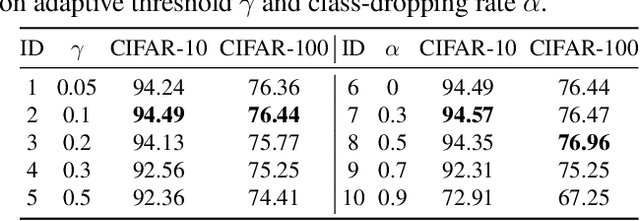

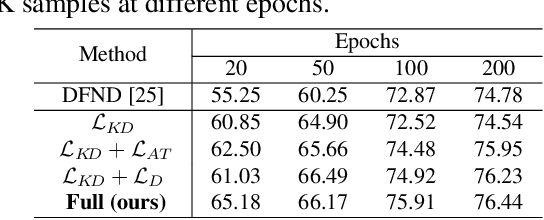
Data-free knowledge distillation is a challenging model lightweight task for scenarios in which the original dataset is not available. Previous methods require a lot of extra computational costs to update one or more generators and their naive imitate-learning lead to lower distillation efficiency. Based on these observations, we first propose an efficient unlabeled sample selection method to replace high computational generators and focus on improving the training efficiency of the selected samples. Then, a class-dropping mechanism is designed to suppress the label noise caused by the data domain shifts. Finally, we propose a distillation method that incorporates explicit features and implicit structured relations to improve the effect of distillation. Experimental results show that our method can quickly converge and obtain higher accuracy than other state-of-the-art methods.