 Add to Chrome
 Add to Firefox
 Add to Edge
Inertia-1: An Open Exploration of Wearable Motion Foundation Models
Jul 07, 2026
Wearable motion sensing provides a continuous and scalable window into human behavior and health, making it a natural fit for foundation models, yet its pretraining and scaling principles remain poorly understood. Prior work studies isolated design choices, such as sensor placement or sampling frequency, often under fixed settings and narrow downstream tasks that fail to capture real-world sensing diversity. We introduce Inertia-1, a fully open exploration of wearable motion foundation models. Using massive corpora of accelerometer data from global sources spanning more than 18.2M hours, we build a controlled framework for studying the full lifecycle of wearable motion foundation models, covering data choices such as sensor modality, device placement, sampling rate, window length; model choices such as architectures and model size; and training choices such as pretraining objective and data scale. Extensive evaluations across 15 datasets spanning human activity recognition, freezing-of-gait detection, and disease prediction reveal intriguing findings for building motion foundation models that generalize across tasks and sensing conditions. Collectively, Inertia-1 not only presents state-of-the-art recipes for diverse downstream tasks, but also serves as a comprehensive, practical, and open cookbook for wearable motion representation learning.

Signal or Noise? Understanding Generative Models for Real-World Sensor Time Series
Jul 05, 2026Generative models have changed how machine learning represents complex data distributions, especially in language and vision, yet many real-world systems are observed instead as continuous, high-dimensional, and noisy sensor time series. Existing generative modeling of sensor data, however, remains fragmented across modalities, datasets, and task formulations, limiting a systematic understanding of when, how, and why generative models succeed or fail in real-world settings. To address this gap, we introduce SensorGen, a large-scale study of sensor-signal generation spanning 14 settings across 4 domains, 7 datasets, and 12 signal modalities. Leveraging SensorGen, we systematically evaluate generative models from five major families and uncover three key findings: (1) flow-matching models provide strong overall performance across most settings; (2) signal properties matter, with demographic covariates improving longitudinal generation and time-frequency modeling improving high-frequency signal generation; and (3) generated signals have practical utility beyond visual realism, with scaling improving generation quality and synthetic data improving downstream performance. Together, SensorGen establishes a broader understanding of design choices, evaluation protocols, and failure modes in real-world sensor data generation.
SleepLM: Natural-Language Intelligence for Human Sleep
Feb 27, 2026We present SleepLM, a family of sleep-language foundation models that enable human sleep alignment, interpretation, and interaction with natural language. Despite the critical role of sleep, learning-based sleep analysis systems operate in closed label spaces (e.g., predefined stages or events) and fail to describe, query, or generalize to novel sleep phenomena. SleepLM bridges natural language and multimodal polysomnography, enabling language-grounded representations of sleep physiology. To support this alignment, we introduce a multilevel sleep caption generation pipeline that enables the curation of the first large-scale sleep-text dataset, comprising over 100K hours of data from more than 10,000 individuals. Furthermore, we present a unified pretraining objective that combines contrastive alignment, caption generation, and signal reconstruction to better capture physiological fidelity and cross-modal interactions. Extensive experiments on real-world sleep understanding tasks verify that SleepLM outperforms state-of-the-art in zero-shot and few-shot learning, cross-modal retrieval, and sleep captioning. Importantly, SleepLM also exhibits intriguing capabilities including language-guided event localization, targeted insight generation, and zero-shot generalization to unseen tasks. All code and data will be open-sourced.
OSF: On Pre-training and Scaling of Sleep Foundation Models
Feb 27, 2026Polysomnography (PSG) provides the gold standard for sleep assessment but suffers from substantial heterogeneity across recording devices and cohorts. There have been growing efforts to build general-purpose foundation models (FMs) for sleep physiology, but lack an in-depth understanding of the pre-training process and scaling patterns that lead to more generalizable sleep FMs. To fill this gap, we curate a massive corpus of 166,500 hours of sleep recordings from nine public sources and establish SleepBench, a comprehensive, fully open-source benchmark. Leveraging SleepBench, we systematically evaluate four families of self-supervised pre-training objectives and uncover three critical findings: (1) existing FMs fail to generalize to missing channels at inference; (2) channel-invariant feature learning is essential for pre-training; and (3) scaling sample size, model capacity, and multi-source data mixture consistently improves downstream performance.With an enhanced pre-training and scaling recipe, we introduce OSF, a family of sleep FMs that achieves state-of-the-art performance across nine datasets on diverse sleep and disease prediction tasks. Further analysis of OSF also reveals intriguing properties in sample efficiency, hierarchical aggregation, and cross-dataset scaling.
V2X-DG: Domain Generalization for Vehicle-to-Everything Cooperative Perception
Mar 19, 2025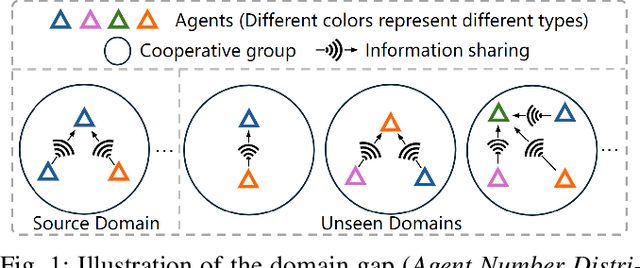
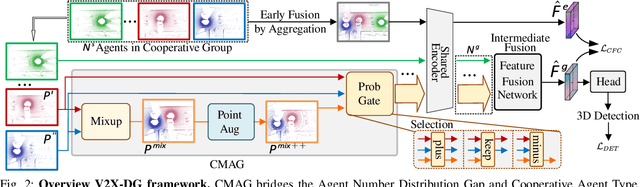
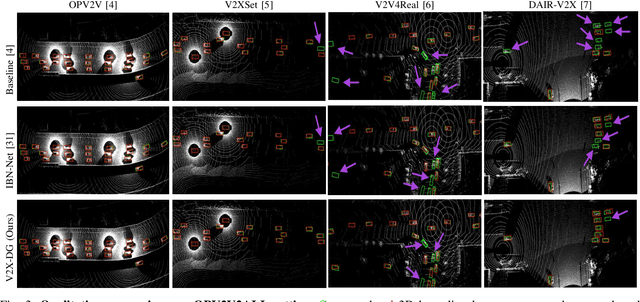

LiDAR-based Vehicle-to-Everything (V2X) cooperative perception has demonstrated its impact on the safety and effectiveness of autonomous driving. Since current cooperative perception algorithms are trained and tested on the same dataset, the generalization ability of cooperative perception systems remains underexplored. This paper is the first work to study the Domain Generalization problem of LiDAR-based V2X cooperative perception (V2X-DG) for 3D detection based on four widely-used open source datasets: OPV2V, V2XSet, V2V4Real and DAIR-V2X. Our research seeks to sustain high performance not only within the source domain but also across other unseen domains, achieved solely through training on source domain. To this end, we propose Cooperative Mixup Augmentation based Generalization (CMAG) to improve the model generalization capability by simulating the unseen cooperation, which is designed compactly for the domain gaps in cooperative perception. Furthermore, we propose a constraint for the regularization of the robust generalized feature representation learning: Cooperation Feature Consistency (CFC), which aligns the intermediately fused features of the generalized cooperation by CMAG and the early fused features of the original cooperation in source domain. Extensive experiments demonstrate that our approach achieves significant performance gains when generalizing to other unseen datasets while it also maintains strong performance on the source dataset.
Specialized Foundation Models Struggle to Beat Supervised Baselines
Nov 05, 2024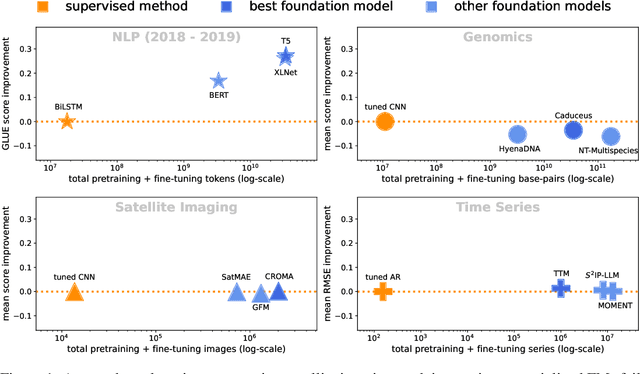

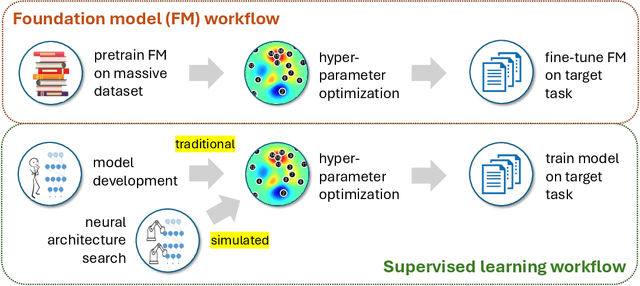

Following its success for vision and text, the "foundation model" (FM) paradigm -- pretraining large models on massive data, then fine-tuning on target tasks -- has rapidly expanded to domains in the sciences, engineering, healthcare, and beyond. Has this achieved what the original FMs accomplished, i.e. the supplanting of traditional supervised learning in their domains? To answer we look at three modalities -- genomics, satellite imaging, and time series -- with multiple recent FMs and compare them to a standard supervised learning workflow: model development, hyperparameter tuning, and training, all using only data from the target task. Across these three specialized domains, we find that it is consistently possible to train simple supervised models -- no more complicated than a lightly modified wide ResNet or UNet -- that match or even outperform the latest foundation models. Our work demonstrates that the benefits of large-scale pretraining have yet to be realized in many specialized areas, reinforces the need to compare new FMs to strong, well-tuned baselines, and introduces two new, easy-to-use, open-source, and automated workflows for doing so.