 Add to Chrome
 Add to Firefox
 Add to Edge
AgentCo-op: Retrieval-Based Synthesis of Interoperable Multi-Agent Workflows
May 19, 2026
Designing multi-agent workflows is especially difficult in open-ended scientific settings where tasks lack curated training sets, reliable scalar evaluation metrics, and standardized interfaces between existing tools and agents. We propose AgentCo-op, a retrieval-based synthesis framework that composes reusable skills, tools, and external agents into executable workflows through typed artifact handoffs, then applies bounded self-guided local repair to implicated components when execution evidence indicates failure. In two open-world genomics case studies, AgentCo-op composes independently developed scientific agents and external tool repositories into auditable workflows without redesigning them or running global topology search. It coordinates specialized agents for spatial transcriptomics and gene-set interpretation to enable collaborative discovery from spatial transcriptomics data, and builds a parallel workflow for cross-modality marker analysis on single-cell multiome data. AgentCo-op can also import a searched workflow as a structural prior and improve it by grounding nodes with retrieved components and applying local repair, showing that synthesis and search are complementary. On six coding, math, and question-answering benchmarks, AgentCo-op achieves the best result on four benchmarks and the best average score under a unified backbone setting, while consistently reducing per-task cost relative to multi-agent baselines. Together, these results suggest that retrieval-based synthesis can extend automated agentic workflow design beyond benchmark-optimized agent graphs to open-world workflows built from existing agents, tools, and typed artifacts.

SKILLFOUNDRY: Building Self-Evolving Agent Skill Libraries from Heterogeneous Scientific Resources
Apr 05, 2026Modern scientific ecosystems are rich in procedural knowledge across repositories, APIs, scripts, notebooks, documentation, databases, and papers, yet much of this knowledge remains fragmented across heterogeneous artifacts that agents cannot readily operationalize. This gap between abundant scientific know-how and usable agent capabilities is a key bottleneck for building effective scientific agents. We present SkillFoundry, a self-evolving framework that converts such resources into validated agent skills, reusable packages that encode task scope, inputs and outputs, execution steps, environment assumptions, provenance, and tests. SkillFoundry organizes a target domain as a domain knowledge tree, mines resources from high-value branches, extracts operational contracts, compiles them into executable skill packages, and then iteratively expands, repairs, merges, or prunes the resulting library through a closed-loop validation process. SkillFoundry produces a substantially novel and internally valid skill library, with 71.1\% of mined skills differing from existing skill libraries such as SkillHub and SkillSMP. We demonstrate that these mined skills improve coding agent performance on five of the six MoSciBench datasets. We further show that SkillFoundry can design new task-specific skills on demand for concrete scientific objectives, and that the resulting skills substantially improve performance on two challenging genomics tasks: cell type annotation and the scDRS workflow. Together, these results show that automatically mined skills improve agent performance on benchmarks and domain-specific tasks, expand coverage beyond hand-crafted skill libraries, and provide a practical foundation for more capable scientific agents.
Specialized Foundation Models Struggle to Beat Supervised Baselines
Nov 05, 2024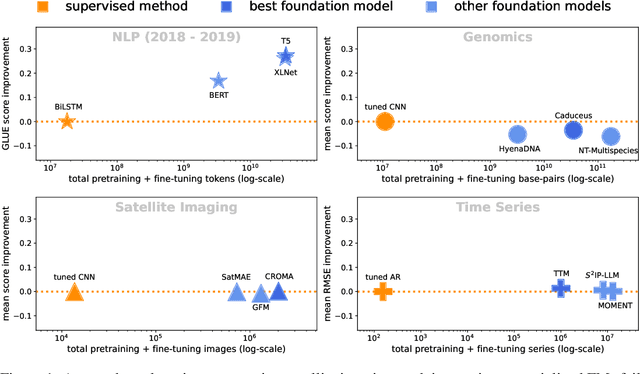

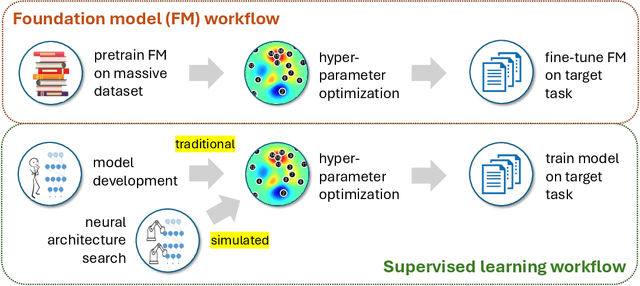

Following its success for vision and text, the "foundation model" (FM) paradigm -- pretraining large models on massive data, then fine-tuning on target tasks -- has rapidly expanded to domains in the sciences, engineering, healthcare, and beyond. Has this achieved what the original FMs accomplished, i.e. the supplanting of traditional supervised learning in their domains? To answer we look at three modalities -- genomics, satellite imaging, and time series -- with multiple recent FMs and compare them to a standard supervised learning workflow: model development, hyperparameter tuning, and training, all using only data from the target task. Across these three specialized domains, we find that it is consistently possible to train simple supervised models -- no more complicated than a lightly modified wide ResNet or UNet -- that match or even outperform the latest foundation models. Our work demonstrates that the benefits of large-scale pretraining have yet to be realized in many specialized areas, reinforces the need to compare new FMs to strong, well-tuned baselines, and introduces two new, easy-to-use, open-source, and automated workflows for doing so.