 Add to Chrome
 Add to Firefox
 Add to Edge
Keeping Score: Efficiency Improvements in Neural Likelihood Surrogate Training via Score-Augmented Loss Functions
May 12, 2026
For stochastic process models, parameter inference is often severely bottlenecked by computationally expensive likelihood functions. Simulation-based inference (SBI) bypasses this restriction by constructing amortized surrogate likelihoods, but most SBI methods assume a black-box data generating process. While these surrogates are exact in the limit of infinite training data, practical scenarios force a strict tradeoff between model quality and simulation cost. In this work, we loosen the black-box assumption of SBI to improve this tradeoff for structured stochastic process models. Specifically, for neural network likelihood surrogates trained via probabilistic classification, we propose to augment the standard binary cross-entropy loss with exact score information $\nabla_θ\log p(x \mid θ)$ and adaptive weighting based on loss gradients. We evaluate our approach on case studies involving network dynamics and spatial processes, demonstrating that our method improves surrogate quality at a drastically lower computational cost than generating more training data. Notably, in some cases, our approach achieves downstream inference performance equivalent to a 10x increase in training data with less than a 1.1x increase in training time.

Humanity's Last Exam
Jan 24, 2025Benchmarks are important tools for tracking the rapid advancements in large language model (LLM) capabilities. However, benchmarks are not keeping pace in difficulty: LLMs now achieve over 90\% accuracy on popular benchmarks like MMLU, limiting informed measurement of state-of-the-art LLM capabilities. In response, we introduce Humanity's Last Exam (HLE), a multi-modal benchmark at the frontier of human knowledge, designed to be the final closed-ended academic benchmark of its kind with broad subject coverage. HLE consists of 3,000 questions across dozens of subjects, including mathematics, humanities, and the natural sciences. HLE is developed globally by subject-matter experts and consists of multiple-choice and short-answer questions suitable for automated grading. Each question has a known solution that is unambiguous and easily verifiable, but cannot be quickly answered via internet retrieval. State-of-the-art LLMs demonstrate low accuracy and calibration on HLE, highlighting a significant gap between current LLM capabilities and the expert human frontier on closed-ended academic questions. To inform research and policymaking upon a clear understanding of model capabilities, we publicly release HLE at https://lastexam.ai.
Specialized Foundation Models Struggle to Beat Supervised Baselines
Nov 05, 2024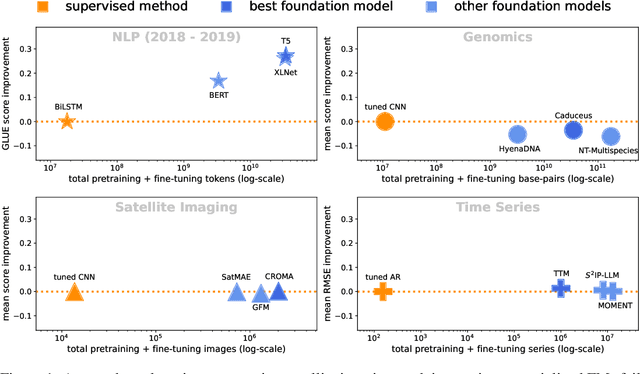

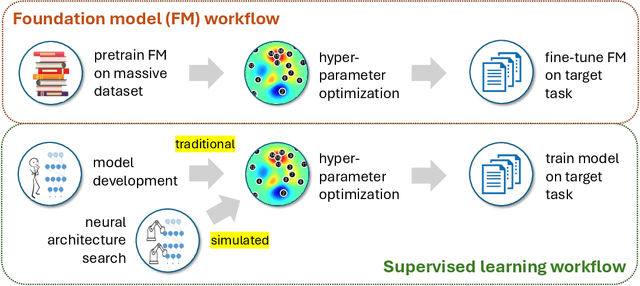

Following its success for vision and text, the "foundation model" (FM) paradigm -- pretraining large models on massive data, then fine-tuning on target tasks -- has rapidly expanded to domains in the sciences, engineering, healthcare, and beyond. Has this achieved what the original FMs accomplished, i.e. the supplanting of traditional supervised learning in their domains? To answer we look at three modalities -- genomics, satellite imaging, and time series -- with multiple recent FMs and compare them to a standard supervised learning workflow: model development, hyperparameter tuning, and training, all using only data from the target task. Across these three specialized domains, we find that it is consistently possible to train simple supervised models -- no more complicated than a lightly modified wide ResNet or UNet -- that match or even outperform the latest foundation models. Our work demonstrates that the benefits of large-scale pretraining have yet to be realized in many specialized areas, reinforces the need to compare new FMs to strong, well-tuned baselines, and introduces two new, easy-to-use, open-source, and automated workflows for doing so.