 Add to Chrome
 Add to Firefox
 Add to Edge
DPRM: A Plug-in Doob h transform-induced Token-Ordering Module for Diffusion Language Models
Apr 27, 2026
Diffusion language models generate without a fixed left-to-right order, making token ordering a central algorithmic choice: which tokens should be revealed, retained, revised or verified at each step? Existing systems mainly use random masking or confidence-driven ordering. Random masking creates train--test mismatch, while confidence-only rules are efficient but can be myopic and suppress useful exploration. We introduce DPRM (Doob h-transform Process Reward Model), a plug-in token-ordering module for diffusion language models. DPRM keeps the host architecture, denoising objective and supervision unchanged, and changes only the ordering policy. It starts from confidence-driven progressive ordering and gradually shifts to Doob h transform Process Reward guided ordering through online estimates. We characterize the exact DPRM policy as a reward-tilted Gibbs reveal law, prove O(1/N) convergence of the stagewise Soft-BoN approximation, and show that the online bucketized controller tracks the exact DPRM score at empirical-Bernstein rates. Under tractable optimization assumptions, DPRM also yields a sample-complexity advantage over random and confidence-only ordering. DPRM improves over confidence-based baselines in pretraining, post-training, test-time scaling, and single-cell masked diffusion, with particularly strong gains on harder reasoning subsets. In protein, molecular generation and DNA design, the effect is more multi-objective: ordering-aware variants significantly improve selected structural or fragment-constrained metrics while not uniformly dominating the host baseline on every quality metric. These results identify token ordering as a fundamental control axis in diffusion language models and establish DPRM as a general-purpose module for improving it. Code is available at https://github.com/DakeBU/DPRM-DLLM.

Alternating Diffusion for Proximal Sampling with Zeroth Order Queries
Mar 20, 2026This work introduces a new approximate proximal sampler that operates solely with zeroth-order information of the potential function. Prior theoretical analyses have revealed that proximal sampling corresponds to alternating forward and backward iterations of the heat flow. The backward step was originally implemented by rejection sampling, whereas we directly simulate the dynamics. Unlike diffusion-based sampling methods that estimate scores via learned models or by invoking auxiliary samplers, our method treats the intermediate particle distribution as a Gaussian mixture, thereby yielding a Monte Carlo score estimator from directly samplable distributions. Theoretically, when the score estimation error is sufficiently controlled, our method inherits the exponential convergence of proximal sampling under isoperimetric conditions on the target distribution. In practice, the algorithm avoids rejection sampling, permits flexible step sizes, and runs with a deterministic runtime budget. Numerical experiments demonstrate that our approach converges rapidly to the target distribution, driven by interactions among multiple particles and by exploiting parallel computation.
Towards a Unified Analysis of Neural Networks in Nonparametric Instrumental Variable Regression: Optimization and Generalization
Nov 18, 2025We establish the first global convergence result of neural networks for two stage least squares (2SLS) approach in nonparametric instrumental variable regression (NPIV). This is achieved by adopting a lifted perspective through mean-field Langevin dynamics (MFLD), unlike standard MFLD, however, our setting of 2SLS entails a \emph{bilevel} optimization problem in the space of probability measures. To address this challenge, we leverage the penalty gradient approach recently developed for bilevel optimization which formulates bilevel optimization as a Lagrangian problem. This leads to a novel fully first-order algorithm, termed \texttt{F$^2$BMLD}. Apart from the convergence bound, we further provide a generalization bound, revealing an inherent trade-off in the choice of the Lagrange multiplier between optimization and statistical guarantees. Finally, we empirically validate the effectiveness of the proposed method on an offline reinforcement learning benchmark.
Provable Benefit of Curriculum in Transformer Tree-Reasoning Post-Training
Nov 10, 2025Recent curriculum techniques in the post-training stage of LLMs have been widely observed to outperform non-curriculum approaches in enhancing reasoning performance, yet a principled understanding of why and to what extent they work remains elusive. To address this gap, we develop a theoretical framework grounded in the intuition that progressively learning through manageable steps is more efficient than directly tackling a hard reasoning task, provided each stage stays within the model's effective competence. Under mild complexity conditions linking consecutive curriculum stages, we show that curriculum post-training avoids the exponential complexity bottleneck. To substantiate this result, drawing insights from the Chain-of-Thoughts (CoTs) solving mathematical problems such as Countdown and parity, we model CoT generation as a states-conditioned autoregressive reasoning tree, define a uniform-branching base model to capture pretrained behavior, and formalize curriculum stages as either depth-increasing (longer reasoning chains) or hint-decreasing (shorter prefixes) subtasks. Our analysis shows that, under outcome-only reward signals, reinforcement learning finetuning achieves high accuracy with polynomial sample complexity, whereas direct learning suffers from an exponential bottleneck. We further establish analogous guarantees for test-time scaling, where curriculum-aware querying reduces both reward oracle calls and sampling cost from exponential to polynomial order.
Consistency Is Not Always Correct: Towards Understanding the Role of Exploration in Post-Training Reasoning
Nov 10, 2025Foundation models exhibit broad knowledge but limited task-specific reasoning, motivating post-training strategies such as RLVR and inference scaling with outcome or process reward models (ORM/PRM). While recent work highlights the role of exploration and entropy stability in improving pass@K, empirical evidence points to a paradox: RLVR and ORM/PRM typically reinforce existing tree-like reasoning paths rather than expanding the reasoning scope, raising the question of why exploration helps at all if no new patterns emerge. To reconcile this paradox, we adopt the perspective of Kim et al. (2025), viewing easy (e.g., simplifying a fraction) versus hard (e.g., discovering a symmetry) reasoning steps as low- versus high-probability Markov transitions, and formalize post-training dynamics through Multi-task Tree-structured Markov Chains (TMC). In this tractable model, pretraining corresponds to tree expansion, while post-training corresponds to chain-of-thought reweighting. We show that several phenomena recently observed in empirical studies arise naturally in this setting: (1) RLVR induces a squeezing effect, reducing reasoning entropy and forgetting some correct paths; (2) population rewards of ORM/PRM encourage consistency rather than accuracy, thereby favoring common patterns; and (3) certain rare, high-uncertainty reasoning paths by the base model are responsible for solving hard problem instances. Together, these explain why exploration -- even when confined to the base model's reasoning scope -- remains essential: it preserves access to rare but crucial reasoning traces needed for difficult cases, which are squeezed out by RLVR or unfavored by inference scaling. Building on this, we further show that exploration strategies such as rejecting easy instances and KL regularization help preserve rare reasoning traces. Empirical simulations corroborate our theoretical results.
Statistical Analysis of the Sinkhorn Iterations for Two-Sample Schrödinger Bridge Estimation
Oct 26, 2025The Schr\"odinger bridge problem seeks the optimal stochastic process that connects two given probability distributions with minimal energy modification. While the Sinkhorn algorithm is widely used to solve the static optimal transport problem, a recent work (Pooladian and Niles-Weed, 2024) proposed the Sinkhorn bridge, which estimates Schr\"odinger bridges by plugging optimal transport into the time-dependent drifts of SDEs, with statistical guarantees in the one-sample estimation setting where the true source distribution is fully accessible. In this work, to further justify this method, we study the statistical performance of intermediate Sinkhorn iterations in the two-sample estimation setting, where only finite samples from both source and target distributions are available. Specifically, we establish a statistical bound on the squared total variation error of Sinkhorn bridge iterations: $O(1/m+1/n + r^{4k})~(r \in (0,1))$, where $m$ and $n$ are the sample sizes from the source and target distributions, respectively, and $k$ is the number of Sinkhorn iterations. This result provides a theoretical guarantee for the finite-sample performance of the Schr\"odinger bridge estimator and offers practical guidance for selecting sample sizes and the number of Sinkhorn iterations. Notably, our theoretical results apply to several representative methods such as [SF]$^2$M, DSBM-IMF, BM2, and LightSB(-M) under specific settings, through the previously unnoticed connection between these estimators.
Uniform convergence of the smooth calibration error and its relationship with functional gradient
May 26, 2025Calibration is a critical requirement for reliable probabilistic prediction, especially in high-risk applications. However, the theoretical understanding of which learning algorithms can simultaneously achieve high accuracy and good calibration remains limited, and many existing studies provide empirical validation or a theoretical guarantee in restrictive settings. To address this issue, in this work, we focus on the smooth calibration error (CE) and provide a uniform convergence bound, showing that the smooth CE is bounded by the sum of the smooth CE over the training dataset and a generalization gap. We further prove that the functional gradient of the loss function can effectively control the training smooth CE. Based on this framework, we analyze three representative algorithms: gradient boosting trees, kernel boosting, and two-layer neural networks. For each, we derive conditions under which both classification and calibration performances are simultaneously guaranteed. Our results offer new theoretical insights and practical guidance for designing reliable probabilistic models with provable calibration guarantees.
Propagation of Chaos for Mean-Field Langevin Dynamics and its Application to Model Ensemble
Feb 09, 2025Mean-field Langevin dynamics (MFLD) is an optimization method derived by taking the mean-field limit of noisy gradient descent for two-layer neural networks in the mean-field regime. Recently, the propagation of chaos (PoC) for MFLD has gained attention as it provides a quantitative characterization of the optimization complexity in terms of the number of particles and iterations. A remarkable progress by Chen et al. (2022) showed that the approximation error due to finite particles remains uniform in time and diminishes as the number of particles increases. In this paper, by refining the defective log-Sobolev inequality -- a key result from that earlier work -- under the neural network training setting, we establish an improved PoC result for MFLD, which removes the exponential dependence on the regularization coefficient from the particle approximation term of the optimization complexity. As an application, we propose a PoC-based model ensemble strategy with theoretical guarantees.
Direct Distributional Optimization for Provable Alignment of Diffusion Models
Feb 05, 2025
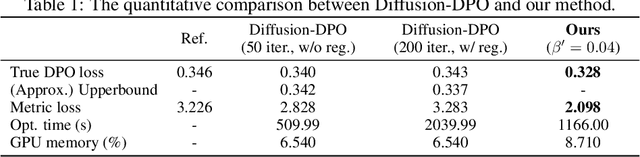
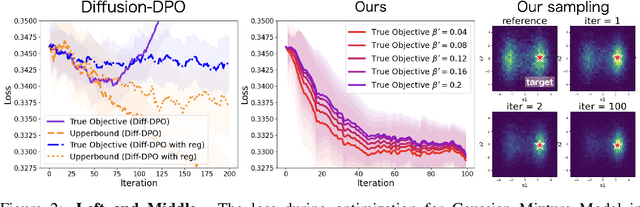
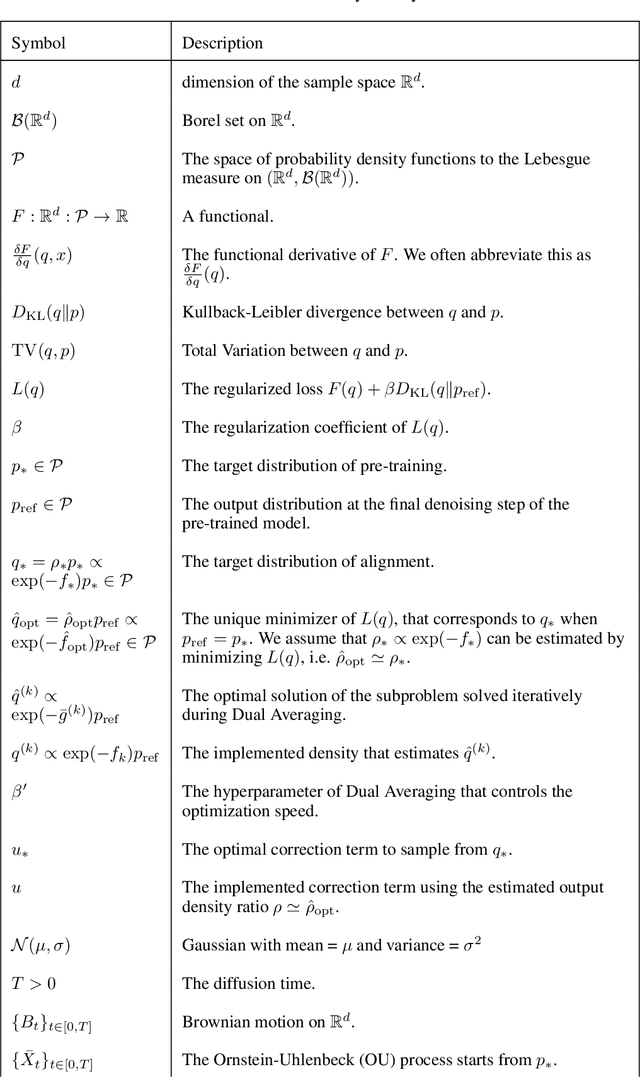
We introduce a novel alignment method for diffusion models from distribution optimization perspectives while providing rigorous convergence guarantees. We first formulate the problem as a generic regularized loss minimization over probability distributions and directly optimize the distribution using the Dual Averaging method. Next, we enable sampling from the learned distribution by approximating its score function via Doob's $h$-transform technique. The proposed framework is supported by rigorous convergence guarantees and an end-to-end bound on the sampling error, which imply that when the original distribution's score is known accurately, the complexity of sampling from shifted distributions is independent of isoperimetric conditions. This framework is broadly applicable to general distribution optimization problems, including alignment tasks in Reinforcement Learning with Human Feedback (RLHF), Direct Preference Optimization (DPO), and Kahneman-Tversky Optimization (KTO). We empirically validate its performance on synthetic and image datasets using the DPO objective.
Provably Transformers Harness Multi-Concept Word Semantics for Efficient In-Context Learning
Nov 04, 2024Transformer-based large language models (LLMs) have displayed remarkable creative prowess and emergence capabilities. Existing empirical studies have revealed a strong connection between these LLMs' impressive emergence abilities and their in-context learning (ICL) capacity, allowing them to solve new tasks using only task-specific prompts without further fine-tuning. On the other hand, existing empirical and theoretical studies also show that there is a linear regularity of the multi-concept encoded semantic representation behind transformer-based LLMs. However, existing theoretical work fail to build up an understanding of the connection between this regularity and the innovative power of ICL. Additionally, prior work often focuses on simplified, unrealistic scenarios involving linear transformers or unrealistic loss functions, and they achieve only linear or sub-linear convergence rates. In contrast, this work provides a fine-grained mathematical analysis to show how transformers leverage the multi-concept semantics of words to enable powerful ICL and excellent out-of-distribution ICL abilities, offering insights into how transformers innovate solutions for certain unseen tasks encoded with multiple cross-concept semantics. Inspired by empirical studies on the linear latent geometry of LLMs, the analysis is based on a concept-based low-noise sparse coding prompt model. Leveraging advanced techniques, this work showcases the exponential 0-1 loss convergence over the highly non-convex training dynamics, which pioneeringly incorporates the challenges of softmax self-attention, ReLU-activated MLPs, and cross-entropy loss. Empirical simulations corroborate the theoretical findings.