 Add to Chrome
 Add to Firefox
 Add to Edge
ORACLE: Optimizing Reasoning Abilities of Large Language Models via Constraint-Led Synthetic Data Elicitation
Mar 22, 2026
Training large language models (LLMs) with synthetic reasoning data has become a popular approach to enhancing their reasoning capabilities, while a key factor influencing the effectiveness of this paradigm is the quality of the generated multi-step reasoning data. To generate high-quality reasoning data, many recent methods generate synthetic reasoning paths and filter them based on final answer correctness, often overlooking flaws in intermediate reasoning steps. To enhance the verification of intermediate reasoning steps, prior work primarily resorts to code execution or symbolic reasoning engines. However, code-based validation is restricted to code or mathematical tasks, and reasoning engines require a well-structured and complete context. As a result, existing methods fail to function effectively in natural language reasoning tasks that involve ambiguous or incomplete contexts. In these tasks, synthetic data still lack reliable checks for verifying each reasoning step. To address this challenge, we introduce ORACLE, a structured data generation framework inspired by syllogistic reasoning. ORACLE integrates the generative strengths of LLMs with symbolic supervision: the LLM produces step-wise reasoning contexts, while a symbolic reasoning engine verifies the validity of each intermediate step. By employing a unified prompting template to elicit modular reasoning chains, ORACLE enables fine-grained, step-level validation, facilitating the construction of high-quality multi-step reasoning data. Across six logical, factual, and commonsense reasoning benchmarks, our ORACLE consistently outperforms strong baselines on multiple models.

KABB: Knowledge-Aware Bayesian Bandits for Dynamic Expert Coordination in Multi-Agent Systems
Feb 11, 2025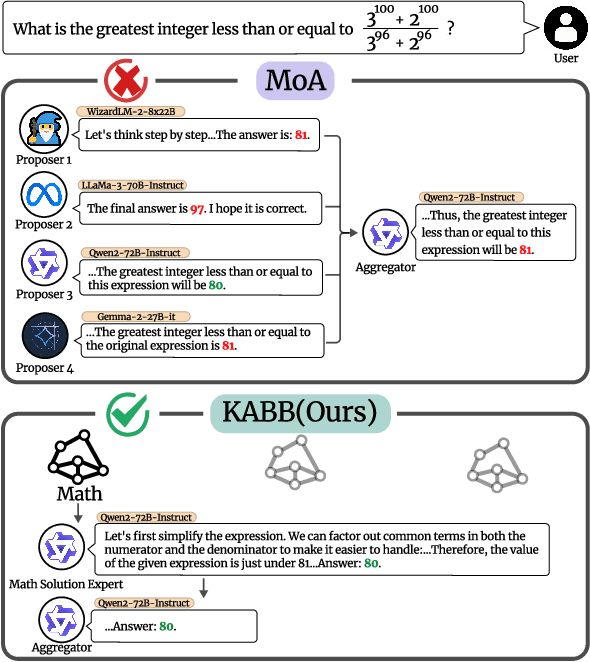
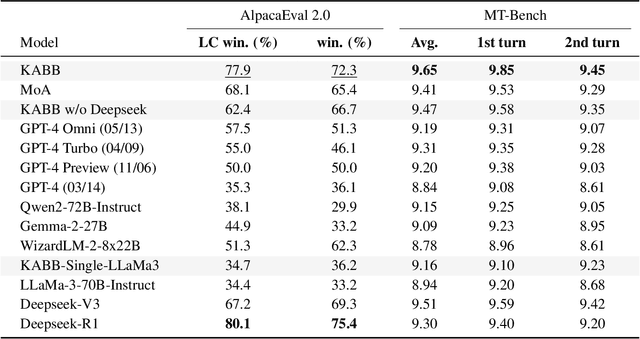
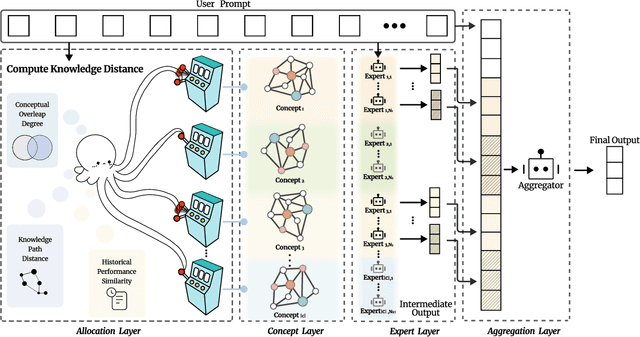
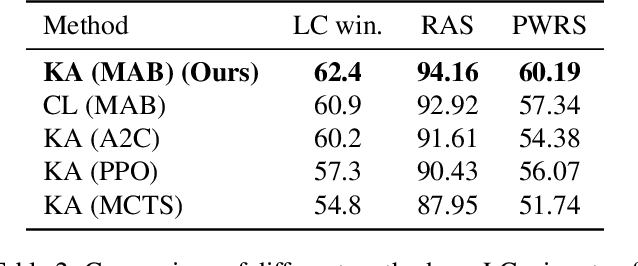
As scaling large language models faces prohibitive costs, multi-agent systems emerge as a promising alternative, though challenged by static knowledge assumptions and coordination inefficiencies. We introduces Knowledge-Aware Bayesian Bandits (KABB), a novel framework that enhances multi-agent system coordination through semantic understanding and dynamic adaptation. The framework features three key innovations: a three-dimensional knowledge distance model for deep semantic understanding, a dual-adaptation mechanism for continuous expert optimization, and a knowledge-aware Thompson Sampling strategy for efficient expert selection. Extensive evaluation demonstrates KABB achieves an optimal cost-performance balance, maintaining high performance while keeping computational demands relatively low in multi-agent coordination.
SR-FoT: A Syllogistic-Reasoning Framework of Thought for Large Language Models Tackling Knowledge-based Reasoning Tasks
Jan 20, 2025Deductive reasoning is a crucial logical capability that assists us in solving complex problems based on existing knowledge. Although augmented by Chain-of-Thought prompts, Large Language Models (LLMs) might not follow the correct reasoning paths. Enhancing the deductive reasoning abilities of LLMs, and leveraging their extensive built-in knowledge for various reasoning tasks, remains an open question. Attempting to mimic the human deductive reasoning paradigm, we propose a multi-stage Syllogistic-Reasoning Framework of Thought (SR-FoT) that enables LLMs to perform syllogistic deductive reasoning to handle complex knowledge-based reasoning tasks. Our SR-FoT begins by interpreting the question and then uses the interpretation and the original question to propose a suitable major premise. It proceeds by generating and answering minor premise questions in two stages to match the minor premises. Finally, it guides LLMs to use the previously generated major and minor premises to perform syllogistic deductive reasoning to derive the answer to the original question. Extensive and thorough experiments on knowledge-based reasoning tasks have demonstrated the effectiveness and advantages of our SR-FoT.