 Add to Chrome
 Add to Firefox
 Add to Edge
Locally Private Online Quantile Regression: Estimation and Inference
Jul 06, 2026
We study estimation and inference for online quantile regression under a one-report user-level $\eps$-locally differentially private ($\eps$-LDP) protocol. The main difficulty is that the standard quantile-regression estimating-equation contribution couples covariates with a residual comparison, so a server that receives only privatized reports cannot form the usual online update. We address this by developing a finite-alphabet channel in which each user computes the contribution locally, applies support-aware stochastic quantization and randomized response to one selected-block category, and sends one report. A public decoder corrects the randomized-response distortion and reconstructs a server-side estimating-equation input with the correct conditional mean. These decoded inputs are then used in projected Polyak-Ruppert averaging. For fixed finite channel designs, we establish local privacy, decoder unbiasedness, consistency, asymptotic normality, and Hessian-free self-normalized inference for prespecified scalar contrasts. Simulations and a New York City taxi-trip illustration show that the private trajectory approaches the nonprivate online reference as the privacy budget grows and outperforms direct Laplace and face-exponential geometric releases in the reported regimes.

Geometric Renyi Differential Privacy: Ricci Curvature Characterized by Heat Diffusion Mechanisms
Apr 22, 2026In this paper, we develop a novel privacy mechanism for Riemannian manifold-valued data. Our key contribution lies in uncovering unexpected connections among geometric analysis, heat diffusion models, and differential privacy (DP). We characterize the Renyi divergence via dimension-free Harnack inequalities on Riemannian manifolds and establish Renyi differential privacy guarantees governed by Ricci curvature. For manifolds with nonnegative Ricci curvature, we propose a mechanism based on heat diffusion. In contrast, for general manifolds we introduce a Langevin-process-based approach that yields intrinsic mechanisms supporting normalization-free sampling and continuous privacy-utility trade-offs. We derive detailed utility analyses for both mechanisms. As a statistical application, we develop privacy-preserving estimation of the generalized Frechet mean, including nontrivial sensitivity analysis and phase transition characterizations. Numerical experiments further demonstrate the advantages of the proposed DP mechanisms over existing approaches.
ARM: Advantage Reward Modeling for Long-Horizon Manipulation
Apr 03, 2026Long-horizon robotic manipulation remains challenging for reinforcement learning (RL) because sparse rewards provide limited guidance for credit assignment. Practical policy improvement thus relies on richer intermediate supervision, such as dense progress rewards, which are costly to obtain and ill-suited to non-monotonic behaviors such as backtracking and recovery. To address this, we propose Advantage Reward Modeling (ARM), a framework that shifts from hard-to-quantify absolute progress to estimating relative advantage. We introduce a cost-effective tri-state labeling strategy -- Progressive, Regressive, and Stagnant -- that reduces human cognitive overhead while ensuring high cross-annotator consistency. By training on these intuitive signals, ARM enables automated progress annotation for both complete demonstrations and fragmented DAgger-style data. Integrating ARM into an offline RL pipeline allows for adaptive action-reward reweighting, effectively filtering suboptimal samples. Our approach achieves a 99.4% success rate on a challenging long-horizon towel-folding task, demonstrating improved stability and data efficiency over current VLA baselines with near-zero human intervention during policy training.
LightCity: An Urban Dataset for Outdoor Inverse Rendering and Reconstruction under Multi-illumination Conditions
Feb 01, 2026Inverse rendering in urban scenes is pivotal for applications like autonomous driving and digital twins. Yet, it faces significant challenges due to complex illumination conditions, including multi-illumination and indirect light and shadow effects. However, the effects of these challenges on intrinsic decomposition and 3D reconstruction have not been explored due to the lack of appropriate datasets. In this paper, we present LightCity, a novel high-quality synthetic urban dataset featuring diverse illumination conditions with realistic indirect light and shadow effects. LightCity encompasses over 300 sky maps with highly controllable illumination, varying scales with street-level and aerial perspectives over 50K images, and rich properties such as depth, normal, material components, light and indirect light, etc. Besides, we leverage LightCity to benchmark three fundamental tasks in the urban environments and conduct a comprehensive analysis of these benchmarks, laying a robust foundation for advancing related research.
NIS-SLAM: Neural Implicit Semantic RGB-D SLAM for 3D Consistent Scene Understanding
Jul 30, 2024
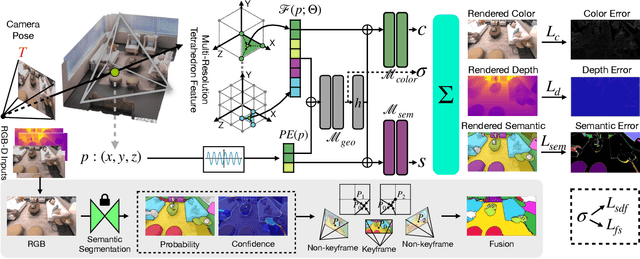
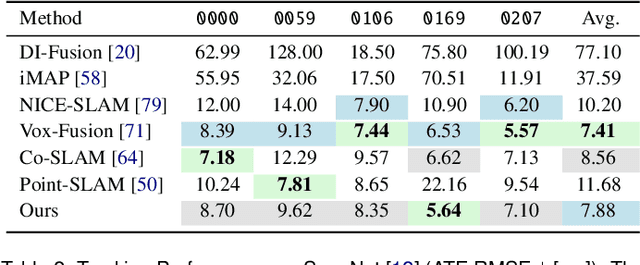
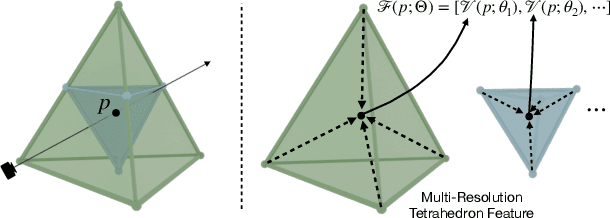
In recent years, the paradigm of neural implicit representations has gained substantial attention in the field of Simultaneous Localization and Mapping (SLAM). However, a notable gap exists in the existing approaches when it comes to scene understanding. In this paper, we introduce NIS-SLAM, an efficient neural implicit semantic RGB-D SLAM system, that leverages a pre-trained 2D segmentation network to learn consistent semantic representations. Specifically, for high-fidelity surface reconstruction and spatial consistent scene understanding, we combine high-frequency multi-resolution tetrahedron-based features and low-frequency positional encoding as the implicit scene representations. Besides, to address the inconsistency of 2D segmentation results from multiple views, we propose a fusion strategy that integrates the semantic probabilities from previous non-keyframes into keyframes to achieve consistent semantic learning. Furthermore, we implement a confidence-based pixel sampling and progressive optimization weight function for robust camera tracking. Extensive experimental results on various datasets show the better or more competitive performance of our system when compared to other existing neural dense implicit RGB-D SLAM approaches. Finally, we also show that our approach can be used in augmented reality applications. Project page: \href{https://zju3dv.github.io/nis_slam}{https://zju3dv.github.io/nis\_slam}.