 Add to Chrome
 Add to Firefox
 Add to Edge
HSAP: A Hierarchical Sequence-aware Parallelism for Hybrid-Context Generative Models
Jun 30, 2026
In this paper, we aim to combine the advantages of existing sequence parallelism paradigms and overcomes their drawbacks, the most serious of which is the incapability to correctly compute causal attention on the hybrid-context packed sequences, in a stronger sequence parallelism framework. The practical technique of packing sequences for efficiently pretraining and fine-tuning large language models causes cross-contamination problem in attention computation, which can be effectively solved when no parallelism in the sequence length dimension is taken. However, in sequence parallelism, existing approaches either ignore the scenario of hybrid-context sequences or conversely sacrifice and limit parallelism degree for supporting the scenario. To this end, we innovatively propose an efficient Sequence-Aware Parallelism algorithm to conquer the obstacles of intensive tensor transmission and partial attention computation across multiple device groups. Our algorithm utilizes JIT (Just-In-Time) compilation to optimize the communication strategy of all device groups in NCCL level. Further, we integrate existing sequence parallelism paradigms into a Hierarchical Sequence-Aware Parallelism framework which benefits from our sequence-aware algorithm. We additionally elaborate on the memory and communication overhead management of the hierarchical framework to optimize its performance. Through multiple experiments, we demonstrate that our proposed approach outperform other state-of-the-arts sequence parallelism approches in multiple metrics.

Lakestream: A Consistent and Brokerless Data Plane for Large Foundation Model Training
May 11, 2026Modern Large Foundation Model (LFM) training has transformed the data pipeline from a static ingestion layer into a dynamic component that must co-evolve with the training process. Existing systems are ill-equipped: colocated dataloaders offer no failure isolation, while message queue-based disaggregated dataloaders operate on a record/offset abstraction that cannot express the batch-level semantics required by distributed training. We present Lakestream, a brokerless, object-store-native training data plane with three key properties. First, it introduces the Transactional Global Batch (TGB), which builds on lakehouse-style ACID storage semantics and extends them with training-specific consistency, including atomic all-rank batch visibility, a globally ordered step sequence, checkpoint-aligned lifecycle management, and end-to-end exactly-once recovery. Second, it realizes recovery and retention directly in the storage layer, by inlining producer state in the manifest and tying reclamation to distributed checkpoint state. Third, its Decentralized Adaptive Commit (DAC) algorithm sustains stable ingestion throughput as the manifest grows, without any inter-producer communication. Evaluations on large-scale multimodal pre-training and SFT workloads using 64 GPUs show that Lakestream outperforms colocated dataloader throughput while providing full failure isolation, outperforms Apache Kafka in ingestion throughput, and achieves lower consumer read latency than Kafka.
PVI: Plug-in Visual Injection for Vision-Language-Action Models
Mar 13, 2026VLA architectures that pair a pretrained VLM with a flow-matching action expert have emerged as a strong paradigm for language-conditioned manipulation. Yet the VLM, optimized for semantic abstraction and typically conditioned on static visual observations, tends to attenuate fine-grained geometric cues and often lacks explicit temporal evidence for the action expert. Prior work mitigates this by injecting auxiliary visual features, but existing approaches either focus on static spatial representations or require substantial architectural modifications to accommodate temporal inputs, leaving temporal information underexplored. We propose Plug-in Visual Injection (PVI), a lightweight, encoder-agnostic module that attaches to a pretrained action expert and injects auxiliary visual representations via zero-initialized residual pathways, preserving pretrained behavior with only single-stage fine-tuning. Using PVI, we obtain consistent gains over the base policy and a range of competitive alternative injection strategies, and our controlled study shows that temporal video features (V-JEPA2) outperform strong static image features (DINOv2), with the largest gains on multi-phase tasks requiring state tracking and coordination. Real-robot experiments on long-horizon bimanual cloth folding further demonstrate the practicality of PVI beyond simulation.
Astrea: A MOE-based Visual Understanding Model with Progressive Alignment
Mar 12, 2025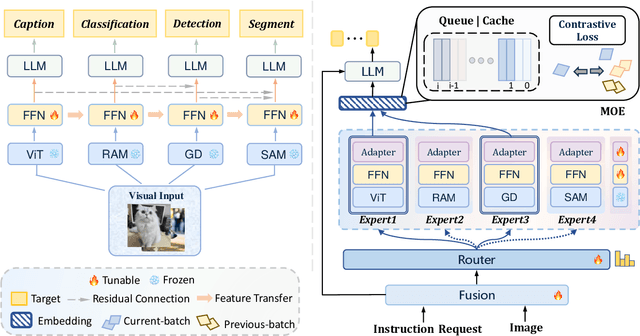
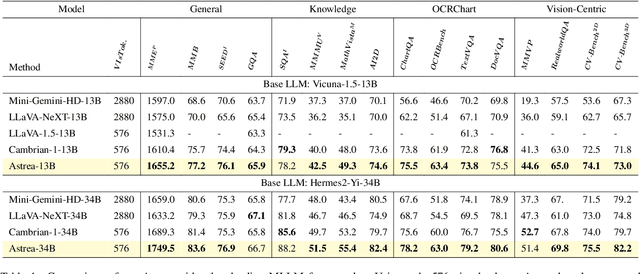
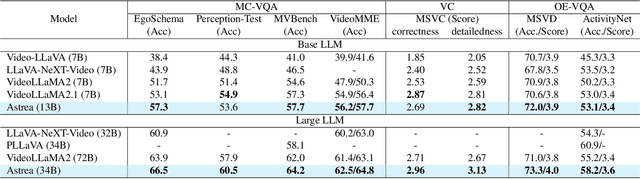
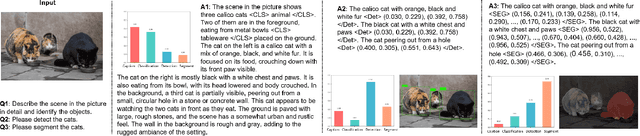
Vision-Language Models (VLMs) based on Mixture-of-Experts (MoE) architectures have emerged as a pivotal paradigm in multimodal understanding, offering a powerful framework for integrating visual and linguistic information. However, the increasing complexity and diversity of tasks present significant challenges in coordinating load balancing across heterogeneous visual experts, where optimizing one specialist's performance often compromises others' capabilities. To address task heterogeneity and expert load imbalance, we propose Astrea, a novel multi-expert collaborative VLM architecture based on progressive pre-alignment. Astrea introduces three key innovations: 1) A heterogeneous expert coordination mechanism that integrates four specialized models (detection, segmentation, classification, captioning) into a comprehensive expert matrix covering essential visual comprehension elements; 2) A dynamic knowledge fusion strategy featuring progressive pre-alignment to harmonize experts within the VLM latent space through contrastive learning, complemented by probabilistically activated stochastic residual connections to preserve knowledge continuity; 3) An enhanced optimization framework utilizing momentum contrastive learning for long-range dependency modeling and adaptive weight allocators for real-time expert contribution calibration. Extensive evaluations across 12 benchmark tasks spanning VQA, image captioning, and cross-modal retrieval demonstrate Astrea's superiority over state-of-the-art models, achieving an average performance gain of +4.7\%. This study provides the first empirical demonstration that progressive pre-alignment strategies enable VLMs to overcome task heterogeneity limitations, establishing new methodological foundations for developing general-purpose multimodal agents.
Learning to Trust Your Feelings: Leveraging Self-awareness in LLMs for Hallucination Mitigation
Jan 27, 2024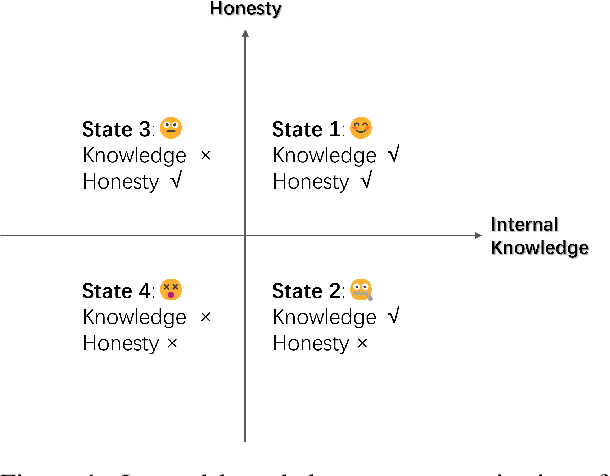
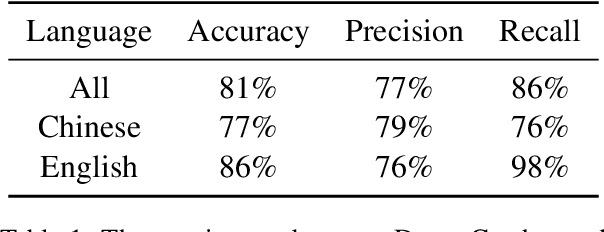
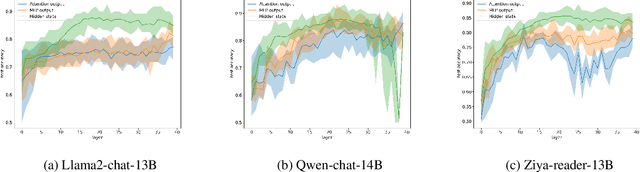
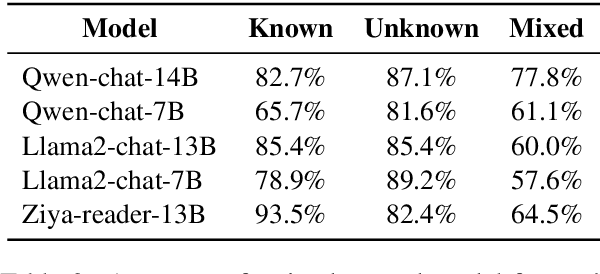
We evaluate the ability of Large Language Models (LLMs) to discern and express their internal knowledge state, a key factor in countering factual hallucination and ensuring reliable application of LLMs. We observe a robust self-awareness of internal knowledge state in LLMs, evidenced by over 85% accuracy in knowledge probing. However, LLMs often fail to express their internal knowledge during generation, leading to factual hallucinations. We develop an automated hallucination annotation tool, Dreamcatcher, which merges knowledge probing and consistency checking methods to rank factual preference data. Using knowledge preference as reward, We propose a Reinforcement Learning from Knowledge Feedback (RLKF) training framework, leveraging reinforcement learning to enhance the factuality and honesty of LLMs. Our experiments across multiple models show that RLKF training effectively enhances the ability of models to utilize their internal knowledge state, boosting performance in a variety of knowledge-based and honesty-related tasks.
Never Lost in the Middle: Improving Large Language Models via Attention Strengthening Question Answering
Nov 15, 2023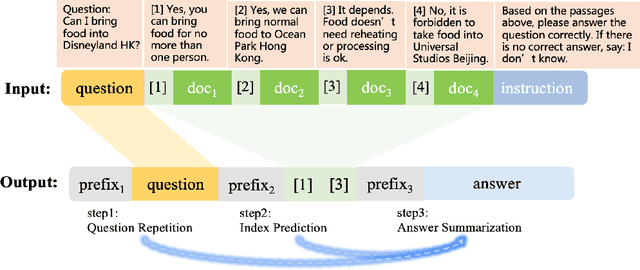
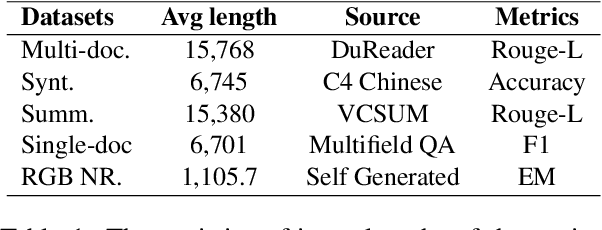
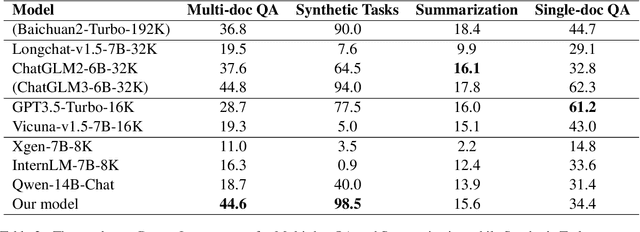
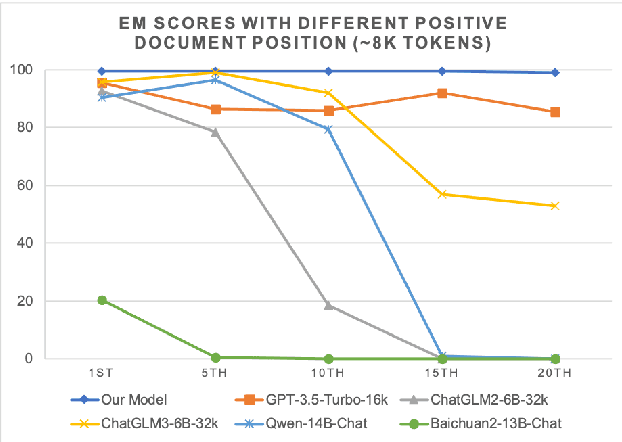
While large language models (LLMs) are equipped with longer text input capabilities than before, they are struggling to seek correct information in long contexts. The "lost in the middle" problem challenges most LLMs, referring to the dramatic decline in accuracy when correct information is located in the middle. To overcome this crucial issue, this paper proposes to enhance the information searching and reflection ability of LLMs in long contexts via specially designed tasks called Attention Strengthening Multi-doc QA (ASM QA). Following these tasks, our model excels in focusing more precisely on the desired information. Experimental results show substantial improvement in Multi-doc QA and other benchmarks, superior to state-of-the-art models by 13.7% absolute gain in shuffled settings, by 21.5% in passage retrieval task. We release our model, Ziya-Reader to promote related research in the community.