 Add to Chrome
 Add to Firefox
 Add to Edge
Physically-Guided Optical Inversion Enable Non-Contact Side-Channel Attack on Isolated Screens
Apr 15, 2026
Noncontact exfiltration of electronic screen content poses a security challenge, with side-channel incursions as the principal vector. We introduce an optical projection side-channel paradigm that confronts two core instabilities: (i) the near-singular Jacobian spectrum of projection mapping breaches Hadamard stability, rendering inversion hypersensitive to perturbations; (ii) irreversible compression in light transport obliterates global semantic cues, magnifying reconstruction ambiguity. Exploiting passive speckle patterns formed by diffuse reflection, our Irradiance Robust Radiometric Inversion Network (IR4Net) fuses a Physically Regularized Irradiance Approximation (PRIrr-Approximation), which embeds the radiative transfer equation in a learnable optimizer, with a contour-to-detail cross-scale reconstruction mechanism that arrests noise propagation. Moreover, an Irreversibility Constrained Semantic Reprojection (ICSR) module reinstates lost global structure through context-driven semantic mapping. Evaluated across four scene categories, IR4Net achieves fidelity beyond competing neural approaches while retaining resilience to illumination perturbations.

AndroTMem: From Interaction Trajectories to Anchored Memory in Long-Horizon GUI Agents
Mar 19, 2026Long-horizon GUI agents are a key step toward real-world deployment, yet effective interaction memory under prevailing paradigms remains under-explored. Replaying full interaction sequences is redundant and amplifies noise, while summaries often erase dependency-critical information and traceability. We present AndroTMem, a diagnostic framework for anchored memory in long-horizon Android GUI agents. Its core benchmark, AndroTMem-Bench, comprises 1,069 tasks with 34,473 interaction steps (avg. 32.1 per task, max. 65). We evaluate agents with TCR (Task Complete Rate), focusing on tasks whose completion requires carrying forward critical intermediate state; AndroTMem-Bench is designed to enforce strong step-to-step causal dependencies, making sparse yet essential intermediate states decisive for downstream actions and centering interaction memory in evaluation. Across open- and closed-source GUI agents, we observe a consistent pattern: as interaction sequences grow longer, performance drops are driven mainly by within-task memory failures, not isolated perception errors or local action mistakes. Guided by this diagnosis, we propose Anchored State Memory (ASM), which represents interaction sequences as a compact set of causally linked intermediate-state anchors to enable subgoal-targeted retrieval and attribution-aware decision making. Across multiple settings and 12 evaluated GUI agents, ASM consistently outperforms full-sequence replay and summary-based baselines, improving TCR by 5%-30.16% and AMS by 4.93%-24.66%, indicating that anchored, structured memory effectively mitigates the interaction-memory bottleneck in long-horizon GUI tasks. The code, benchmark, and related resources are publicly available at [https://github.com/CVC2233/AndroTMem](https://github.com/CVC2233/AndroTMem).
Trajectory Generation with Endpoint Regulation and Momentum-Aware Dynamics for Visually Impaired Scenarios
Feb 25, 2026Trajectory generation for visually impaired scenarios requires smooth and temporally consistent state in structured, low-speed dynamic environments. However, traditional jerk-based heuristic trajectory sampling with independent segment generation and conventional smoothness penalties often lead to unstable terminal behavior and state discontinuities under frequent regenerating. This paper proposes a trajectory generation approach that integrates endpoint regulation to stabilize terminal states within each segment and momentum-aware dynamics to regularize the evolution of velocity and acceleration for segment consistency. Endpoint regulation is incorporated into trajectory sampling to stabilize terminal behavior, while a momentum-aware dynamics enforces consistent velocity and acceleration evolution across consecutive trajectory segments. Experimental results demonstrate reduced acceleration peaks and lower jerk levels with decreased dispersion, smoother velocity and acceleration profiles, more stable endpoint distributions, and fewer infeasible trajectory candidates compared with a baseline planner.
Momentum-constrained Hybrid Heuristic Trajectory Optimization Framework with Residual-enhanced DRL for Visually Impaired Scenarios
Sep 19, 2025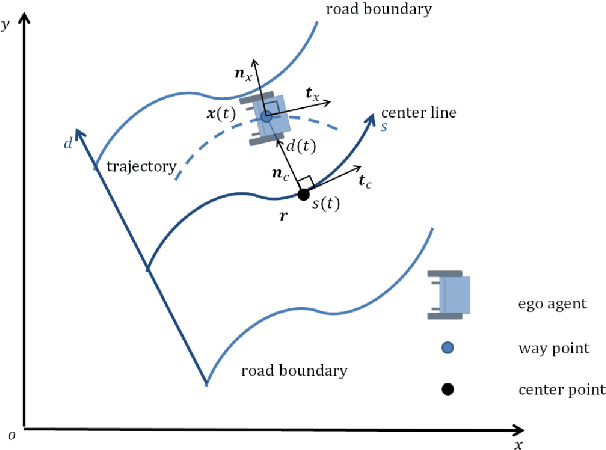
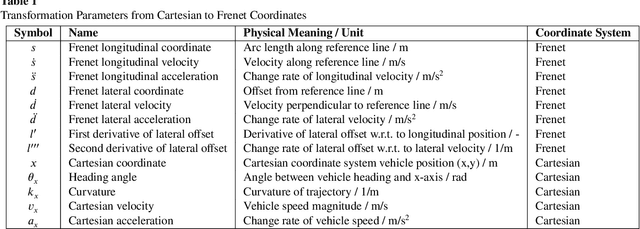
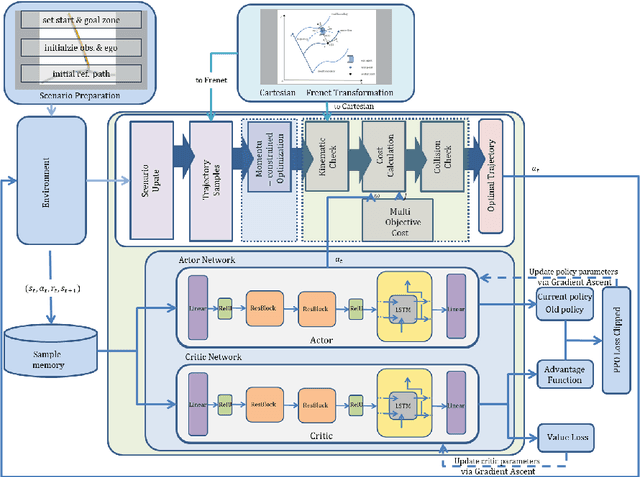

This paper proposes a momentum-constrained hybrid heuristic trajectory optimization framework (MHHTOF) tailored for assistive navigation in visually impaired scenarios, integrating trajectory sampling generation, optimization and evaluation with residual-enhanced deep reinforcement learning (DRL). In the first stage, heuristic trajectory sampling cluster (HTSC) is generated in the Frenet coordinate system using third-order interpolation with fifth-order polynomials and momentum-constrained trajectory optimization (MTO) constraints to ensure smoothness and feasibility. After first stage cost evaluation, the second stage leverages a residual-enhanced actor-critic network with LSTM-based temporal feature modeling to adaptively refine trajectory selection in the Cartesian coordinate system. A dual-stage cost modeling mechanism (DCMM) with weight transfer aligns semantic priorities across stages, supporting human-centered optimization. Experimental results demonstrate that the proposed LSTM-ResB-PPO achieves significantly faster convergence, attaining stable policy performance in approximately half the training iterations required by the PPO baseline, while simultaneously enhancing both reward outcomes and training stability. Compared to baseline method, the selected model reduces average cost and cost variance by 30.3% and 53.3%, and lowers ego and obstacle risks by over 77%. These findings validate the framework's effectiveness in enhancing robustness, safety, and real-time feasibility in complex assistive planning tasks.