 Add to Chrome
 Add to Firefox
 Add to Edge
UniTeD: Unified Temporal Diffusion for Joint Perception and Planning in Autonomous Driving
Jun 24, 2026
Diffusion models have shown strong potential for multi-modal planning in end-to-end autonomous driving. However, most existing methods confine diffusion to the planning module, conditioning on fixed outputs from separate discriminative perception networks. This decoupled design propagates perception errors to the planner, increasing optimization difficulty and reducing robustness. To overcome these limitations, we propose UniTeD, a Unified Temporal Diffusion framework that jointly models perception and planning through iterative denoising in a shared generative space. By enabling bidirectional information exchange, the framework facilitates mutual refinement between tasks and improves robustness via noise-conditioned multi-task training. We further extend this unified diffusion paradigm to a streaming setting by incorporating temporal context. A Temporal Transition Module (TTM) is introduced to resolve the noise-level mismatch between historical and current frames. In addition, we propose an Anchor Refresh Strategy (ARS) to alleviate the training-inference distribution shift commonly observed in sparse diffusion-based end-to-end driving frameworks. Without bells and whistles, UniTeD achieves state-of-the-art performance across multiple benchmarks, surpassing both recent discriminative end-to-end methods and diffusion-based planning approaches.

VICR: Visual In-Context Restoration for Real-World Image Super-Resolution
May 30, 2026Real-world image super-resolution (Real-ISR) requires balancing structural fidelity to degraded observations with realistic detail synthesis. However, existing generative Real-ISR methods often rely on entangled conditioning mechanisms, leading to structural drift or semantically inconsistent details. To address this issue, we propose Visual In-Context Restoration (VICR), a Diffusion Transformer (DiT)-based framework that formulates Real-ISR as image completion. Specifically, we introduce a decoupled visual prior injection mechanism that derives local and global cues from the low-quality (LQ) image: local cues help recover image structures and support high-frequency detail synthesis, while global cues guide overall generation and promote semantic consistency. For ambiguous regions under severe degradation, VICR employs an inference-time agent to refine semantic prompts using visual evidence from the LQ input while keeping model parameters fixed. Experiments show that VICR achieves state-of-the-art performance across multiple Real-ISR benchmarks with only 127M trainable parameters.
SimPB++: Simultaneously Detecting 2D and 3D Objects from Multiple Cameras
May 03, 2026Simultaneous perception of 2D objects in perspective view and 3D objects in Bird's Eye View (BEV) is challenging for multi-camera autonomous driving. Existing two-stage pipelines use 2D results only as a one-time cue for 3D detection. We propose SimPB++, which simultaneously detects 2D objects in perspective and 3D objects in BEV from multiple cameras. It unifies both tasks into an end-to-end model with a hybrid decoder architecture, coupling multi-view 2D and 3D decoders interactively. Two novel modules enable deep interaction: Dynamic Query Allocation adaptively assigns 2D queries to 3D candidates, and Adaptive Query Aggregation refines 3D representations using multi-view 2D features, forming a cyclic 3D-2D-3D refinement. For multi-view 2D detection, we use Query-group Attention for intra-group communication. We also design a Crop-and-Scale strategy for long-range perception and a Propagating Denoising strategy with an auxiliary RoI detector. SimPB++ supports mixed supervision with 2D-only and fully annotated data, reducing reliance on expensive 3D labels. Experiments show state-of-the-art performance on nuScenes for both tasks and strong long-range detection (up to 150m) on Argoverse2.
TopoHR: Hierarchical Centerline Representation for Cyclic Topology Reasoning in Driving Scenes with Point-to-Instance Relations
Apr 27, 2026Topology reasoning is crucial for autonomous driving. Current methods primarily focus on instance-level learning for centerline detection, followed by a sequential module for topology reasoning that relies on simplified MLP layers. Moreover, they often neglect the importance of \textit{point-to-instance} (P2I) relationships in topology reasoning. To address these limitations, we present TopoHR (Topological Hierarchical Representation), a novel end-to-end framework that establishes cyclic interaction between centerline detection and topology reasoning, allowing them to iteratively enhance each other. Specifically, we introduce a hierarchical centerline representation including point queries, instance queries, and semantic representations. These multi-level features are seamlessly integrated and fused within a hierarchical centerline decoder. Furthermore, we design a hierarchical topology reasoning module that captures both fine-grained P2I relationships and global instance-to-instance (I2I) connections within a unified architecture. With these novel components, TopoHR ensures accurate and robust topology reasoning. On the OpenLane-V2 benchmark, TopoHR refreshes state-of-the-art performance with significant improvements. Notably, compared with previous best results, TopoHR achieves +3.8 in $\mathrm{DET}_{\text{l}}$, +5.4 in $\mathrm{TOP}_{\text{ll}}$ on $\text{subset_A}$ and +11.0 in $\mathrm{DET}_{\text{l}}$, +7.9 in $\mathrm{TOP}_{\text{ll}}$ on $\text{subset_B}$, validating the effectiveness of the proposed components. The code will be shared publicly at https://github.com/Yifeng-Bai/TopoHR.git.
HiP-AD: Hierarchical and Multi-Granularity Planning with Deformable Attention for Autonomous Driving in a Single Decoder
Mar 11, 2025
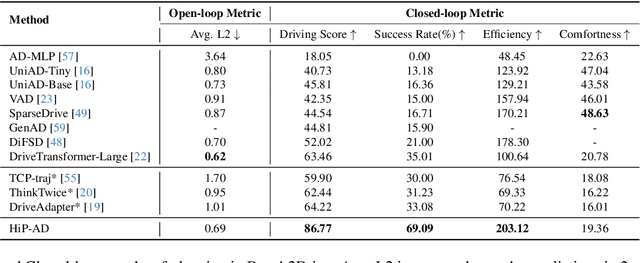
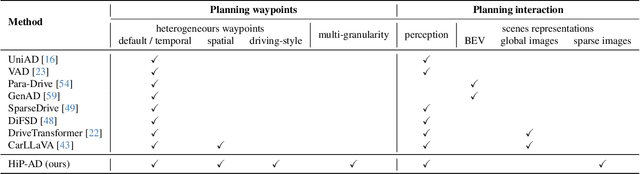
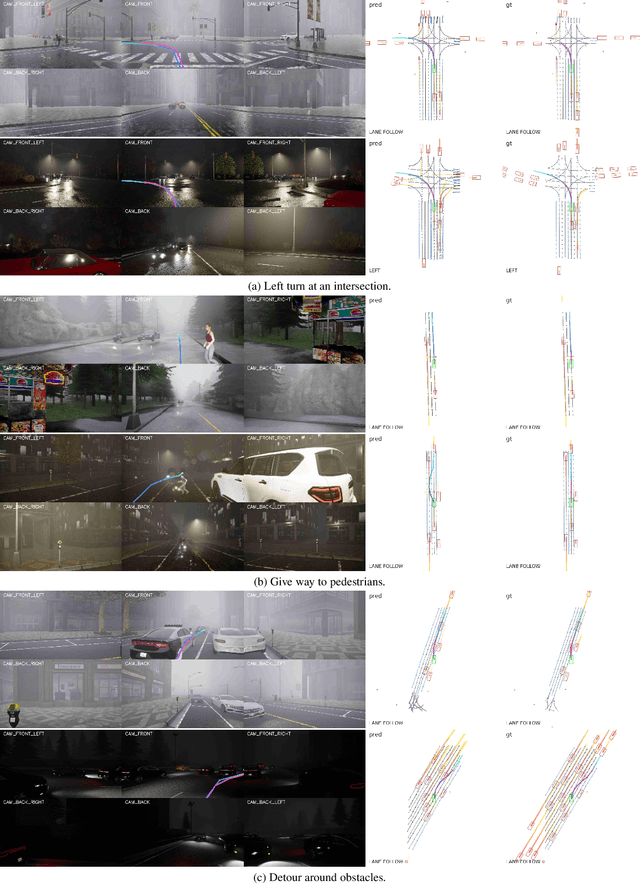
Although end-to-end autonomous driving (E2E-AD) technologies have made significant progress in recent years, there remains an unsatisfactory performance on closed-loop evaluation. The potential of leveraging planning in query design and interaction has not yet been fully explored. In this paper, we introduce a multi-granularity planning query representation that integrates heterogeneous waypoints, including spatial, temporal, and driving-style waypoints across various sampling patterns. It provides additional supervision for trajectory prediction, enhancing precise closed-loop control for the ego vehicle. Additionally, we explicitly utilize the geometric properties of planning trajectories to effectively retrieve relevant image features based on physical locations using deformable attention. By combining these strategies, we propose a novel end-to-end autonomous driving framework, termed HiP-AD, which simultaneously performs perception, prediction, and planning within a unified decoder. HiP-AD enables comprehensive interaction by allowing planning queries to iteratively interact with perception queries in the BEV space while dynamically extracting image features from perspective views. Experiments demonstrate that HiP-AD outperforms all existing end-to-end autonomous driving methods on the closed-loop benchmark Bench2Drive and achieves competitive performance on the real-world dataset nuScenes.
SimPB: A Single Model for 2D and 3D Object Detection from Multiple Cameras
Mar 15, 2024

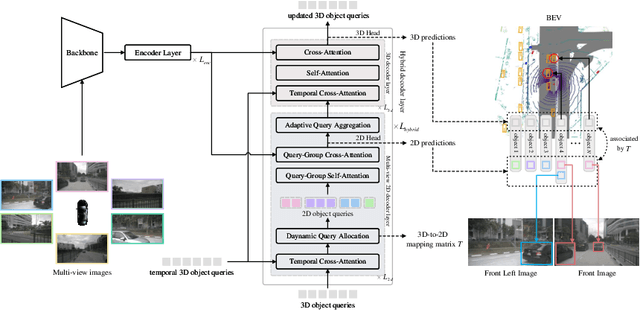
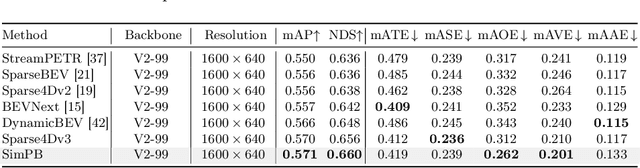
The field of autonomous driving has attracted considerable interest in approaches that directly infer 3D objects in the Bird's Eye View (BEV) from multiple cameras. Some attempts have also explored utilizing 2D detectors from single images to enhance the performance of 3D detection. However, these approaches rely on a two-stage process with separate detectors, where the 2D detection results are utilized only once for token selection or query initialization. In this paper, we present a single model termed SimPB, which simultaneously detects 2D objects in the perspective view and 3D objects in the BEV space from multiple cameras. To achieve this, we introduce a hybrid decoder consisting of several multi-view 2D decoder layers and several 3D decoder layers, specifically designed for their respective detection tasks. A Dynamic Query Allocation module and an Adaptive Query Aggregation module are proposed to continuously update and refine the interaction between 2D and 3D results, in a cyclic 3D-2D-3D manner. Additionally, Query-group Attention is utilized to strengthen the interaction among 2D queries within each camera group. In the experiments, we evaluate our method on the nuScenes dataset and demonstrate promising results for both 2D and 3D detection tasks. Our code is available at: https://github.com/nullmax-vision/SimPB.
Enhancing 3D Object Detection with 2D Detection-Guided Query Anchors
Mar 10, 2024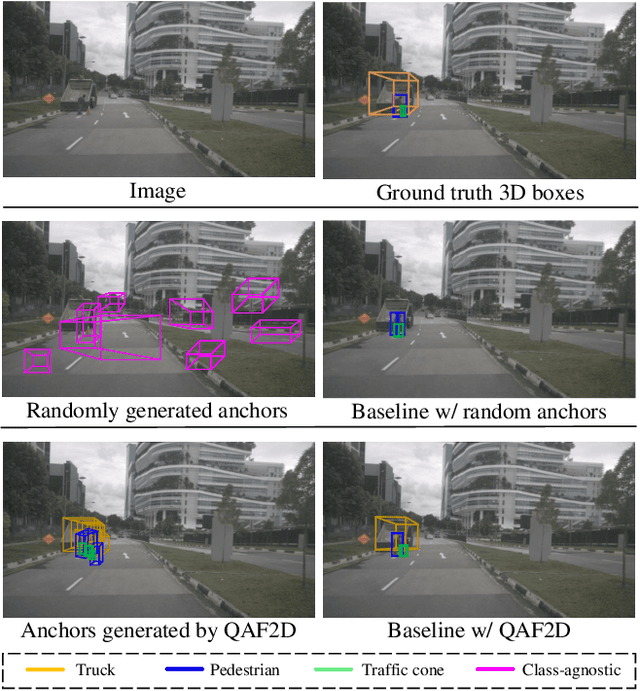
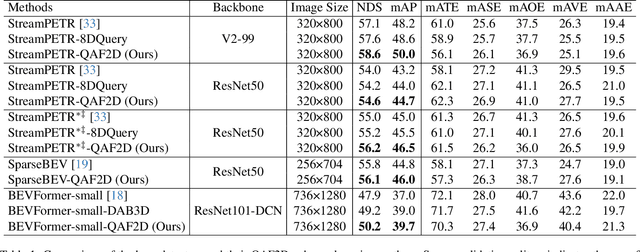
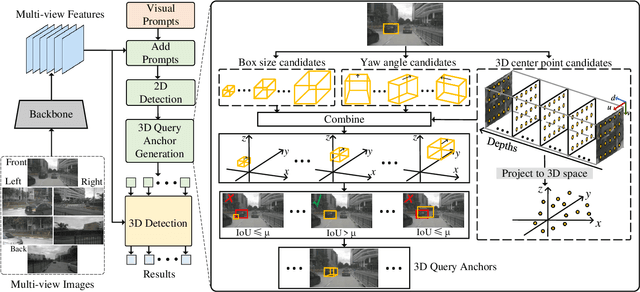
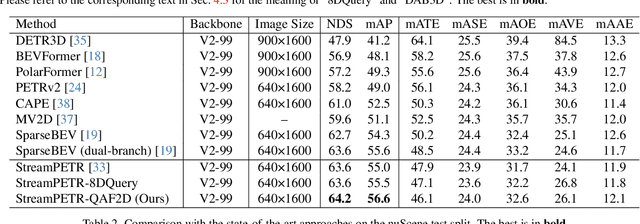
Multi-camera-based 3D object detection has made notable progress in the past several years. However, we observe that there are cases (e.g. faraway regions) in which popular 2D object detectors are more reliable than state-of-the-art 3D detectors. In this paper, to improve the performance of query-based 3D object detectors, we present a novel query generating approach termed QAF2D, which infers 3D query anchors from 2D detection results. A 2D bounding box of an object in an image is lifted to a set of 3D anchors by associating each sampled point within the box with depth, yaw angle, and size candidates. Then, the validity of each 3D anchor is verified by comparing its projection in the image with its corresponding 2D box, and only valid anchors are kept and used to construct queries. The class information of the 2D bounding box associated with each query is also utilized to match the predicted boxes with ground truth for the set-based loss. The image feature extraction backbone is shared between the 3D detector and 2D detector by adding a small number of prompt parameters. We integrate QAF2D into three popular query-based 3D object detectors and carry out comprehensive evaluations on the nuScenes dataset. The largest improvement that QAF2D can bring about on the nuScenes validation subset is $2.3\%$ NDS and $2.7\%$ mAP. Code is available at https://github.com/nullmax-vision/QAF2D.
CurveFormer++: 3D Lane Detection by Curve Propagation with Temporal Curve Queries and Attention
Feb 09, 2024In autonomous driving, 3D lane detection using monocular cameras is an important task for various downstream planning and control tasks. Recent CNN and Transformer approaches usually apply a two-stage scheme in the model design. The first stage transforms the image feature from a front image into a bird's-eye-view (BEV) representation. Subsequently, a sub-network processes the BEV feature map to generate the 3D detection results. However, these approaches heavily rely on a challenging image feature transformation module from a perspective view to a BEV representation. In our work, we present CurveFormer++, a single-stage Transformer-based method that does not require the image feature view transform module and directly infers 3D lane detection results from the perspective image features. Specifically, our approach models the 3D detection task as a curve propagation problem, where each lane is represented by a curve query with a dynamic and ordered anchor point set. By employing a Transformer decoder, the model can iteratively refine the 3D lane detection results. A curve cross-attention module is introduced in the Transformer decoder to calculate similarities between image features and curve queries of lanes. To handle varying lane lengths, we employ context sampling and anchor point restriction techniques to compute more relevant image features for a curve query. Furthermore, we apply a temporal fusion module that incorporates selected informative sparse curve queries and their corresponding anchor point sets to leverage historical lane information. In the experiments, we evaluate our approach for the 3D lane detection task on two publicly available real-world datasets. The results demonstrate that our method provides outstanding performance compared with both CNN and Transformer based methods. We also conduct ablation studies to analyze the impact of each component in our approach.
Multi-Correlation Siamese Transformer Network with Dense Connection for 3D Single Object Tracking
Dec 18, 2023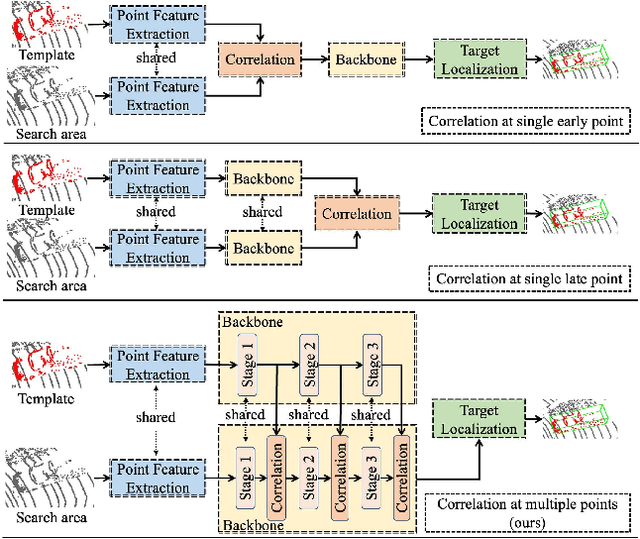
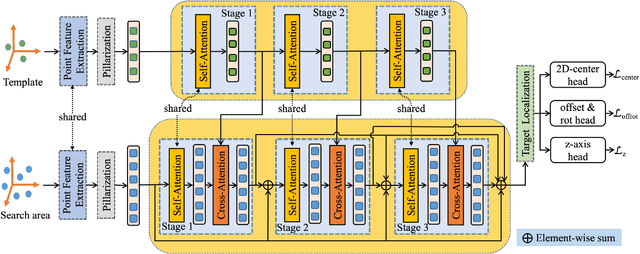
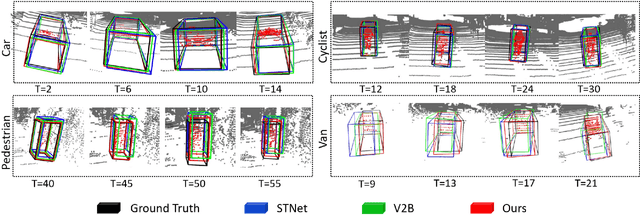
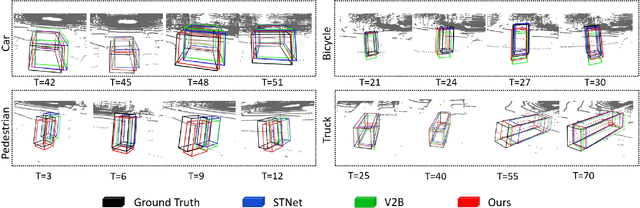
Point cloud-based 3D object tracking is an important task in autonomous driving. Though great advances regarding Siamese-based 3D tracking have been made recently, it remains challenging to learn the correlation between the template and search branches effectively with the sparse LIDAR point cloud data. Instead of performing correlation of the two branches at just one point in the network, in this paper, we present a multi-correlation Siamese Transformer network that has multiple stages and carries out feature correlation at the end of each stage based on sparse pillars. More specifically, in each stage, self-attention is first applied to each branch separately to capture the non-local context information. Then, cross-attention is used to inject the template information into the search area. This strategy allows the feature learning of the search area to be aware of the template while keeping the individual characteristics of the template intact. To enable the network to easily preserve the information learned at different stages and ease the optimization, for the search area, we densely connect the initial input sparse pillars and the output of each stage to all subsequent stages and the target localization network, which converts pillars to bird's eye view (BEV) feature maps and predicts the state of the target with a small densely connected convolution network. Deep supervision is added to each stage to further boost the performance as well. The proposed algorithm is evaluated on the popular KITTI, nuScenes, and Waymo datasets, and the experimental results show that our method achieves promising performance compared with the state-of-the-art. Ablation study that shows the effectiveness of each component is provided as well. Code is available at https://github.com/liangp/MCSTN-3DSOT.
* Preprint version for IEEE Robotics and Automation Letters (RAL)
CircleFormer: Circular Nuclei Detection in Whole Slide Images with Circle Queries and Attention
Aug 31, 2023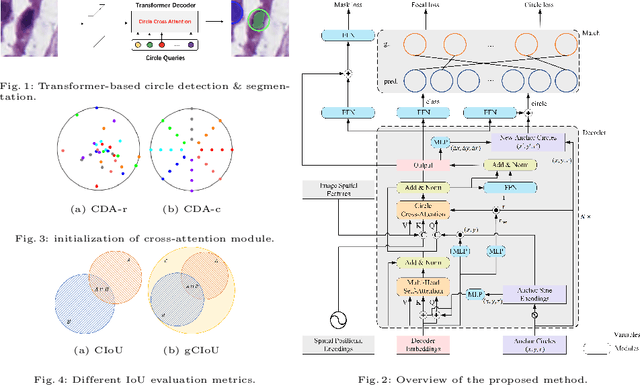
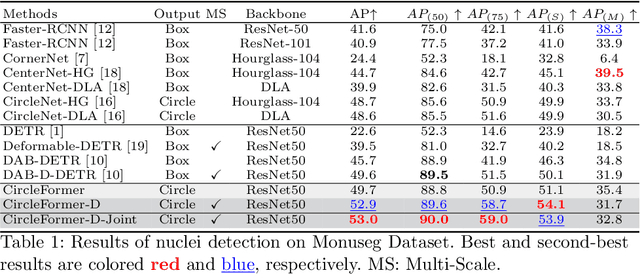
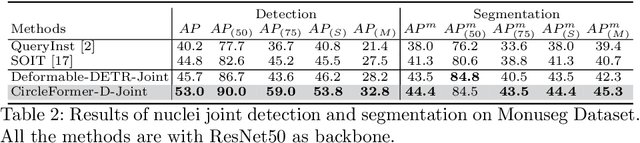
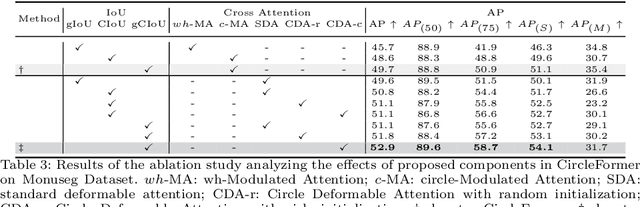
Both CNN-based and Transformer-based object detection with bounding box representation have been extensively studied in computer vision and medical image analysis, but circular object detection in medical images is still underexplored. Inspired by the recent anchor free CNN-based circular object detection method (CircleNet) for ball-shape glomeruli detection in renal pathology, in this paper, we present CircleFormer, a Transformer-based circular medical object detection with dynamic anchor circles. Specifically, queries with circle representation in Transformer decoder iteratively refine the circular object detection results, and a circle cross attention module is introduced to compute the similarity between circular queries and image features. A generalized circle IoU (gCIoU) is proposed to serve as a new regression loss of circular object detection as well. Moreover, our approach is easy to generalize to the segmentation task by adding a simple segmentation branch to CircleFormer. We evaluate our method in circular nuclei detection and segmentation on the public MoNuSeg dataset, and the experimental results show that our method achieves promising performance compared with the state-of-the-art approaches. The effectiveness of each component is validated via ablation studies as well. Our code is released at https://github.com/zhanghx-iim-ahu/CircleFormer.