 Add to Chrome
 Add to Firefox
 Add to Edge
Alpha-RTL: Test-Time Training for RTL Hardware Optimization
Jun 03, 2026
Large language models (LLMs) have shown increasing promise in generating functionally correct register-transfer-level (RTL) hardware designs. Recent systems improve further through EDA-integrated reinforcement learning with syntax, simulation, and PPA rewards, but train a general RTL generator before deployment while test-time approaches search with a frozen policy. We instead perform reinforcement learning at test time, allowing the LLM policy to adapt to executable EDA feedback for the specific RTL problem at hand. We propose TTT-RTL, to our knowledge the first per-design test-time training framework that closes the loop between an LLM policy and an EDA pipeline for RTL optimization. TTT-RTL samples candidate implementations, verifies them through syntax checking and simulation, scores valid designs using synthesis-derived PPA product, reuses high-reward variants through a PUCT-indexed design-state pool, and updates the policy with an entropic policy-gradient objective. To stabilize policy updates under sparse or plateaued rewards, we introduce an adaptive KL-budget controller that adjusts the entropy constraint using reference KL, effective sample size, and reward saturation signals. On RTLLM v2.0 under Nangate 45nm, TTT-RTL reduces the geometric-mean PPA product by 65.1% over the reference, outperforming the strongest published frozen-policy agent baseline at 26.1%. On an industrial XuanTie C910 FPU leading-zero-anticipation unit under Sky130, TTT-RTL achieves a 59.4% ADP reduction, and ablations confirm that policy adaptation, state reuse, and KL-budget control each contribute. These results suggest that test-time training with executable EDA feedback can move LLM-based RTL generation beyond functional correctness toward physically optimized hardware.

Wrong Code, Right Structure: Learning Netlist Representations from Imperfect LLM-Generated RTL
Mar 10, 2026Learning effective netlist representations is fundamentally constrained by the scarcity of labeled datasets, as real designs are protected by Intellectual Property (IP) and costly to annotate. Existing work therefore focuses on small-scale circuits with clean labels, limiting scalability to realistic designs. Meanwhile, Large Language Models (LLMs) can generate Register-Transfer-Level (RTL) at scale, but their functional incorrectness has hindered their use in circuit analysis. In this work, we make a key observation: even when LLM-Generated RTL is functionally imperfect, the synthesized netlists still preserve structural patterns that are strongly indicative of the intended functionality. Building on this insight, we propose a cost-effective data augmentation and training framework that systematically exploits imperfect LLM-Generated RTL as training data for netlist representation learning, forming an end-to-end pipeline from automated code generation to downstream tasks. We conduct evaluations on circuit functional understanding tasks, including sub-circuit boundary identification and component classification, across benchmarks of increasing scales, extending the task scope from operator-level to IP-level. The evaluations demonstrate that models trained on our noisy synthetic corpus generalize well to real-world netlists, matching or even surpassing methods trained on scarce high-quality data and effectively breaking the data bottleneck in circuit representation learning.
TriMoE: Augmenting GPU with AMX-Enabled CPU and DIMM-NDP for High-Throughput MoE Inference via Offloading
Mar 01, 2026To deploy large Mixture-of-Experts (MoE) models cost-effectively, offloading-based single-GPU heterogeneous inference is crucial. While GPU-CPU architectures that offload cold experts are constrained by host memory bandwidth, emerging GPU-NDP architectures utilize DIMM-NDP to offload non-hot experts. However, non-hot experts are not a homogeneous memory-bound group: a significant subset of warm experts exists is severely penalized by high GPU I/O latency yet can saturate NDP compute throughput, exposing a critical compute gap. We present TriMoE, a novel GPU-CPU-NDP architecture that fills this gap by synergistically leveraging AMX-enabled CPU to precisely map hot, warm, and cold experts onto their optimal compute units. We further introduce a bottleneck-aware expert scheduling policy and a prediction-driven dynamic relayout/rebalancing scheme. Experiments demonstrate that TriMoE achieves up to 2.83x speedup over state-of-the-art solutions.
Natural language is not enough: Benchmarking multi-modal generative AI for Verilog generation
Jul 11, 2024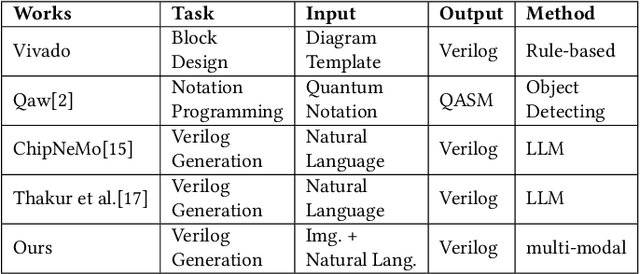
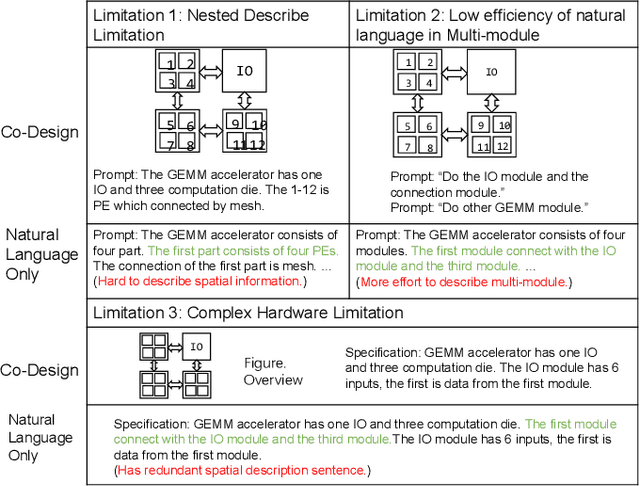
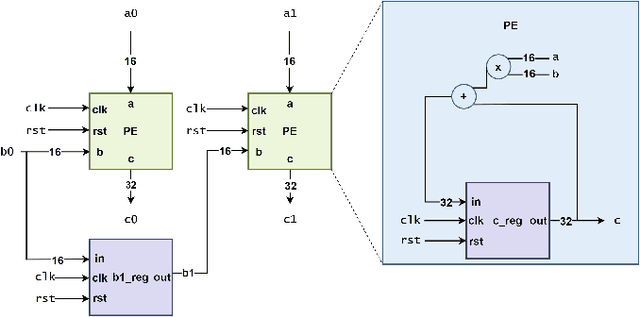
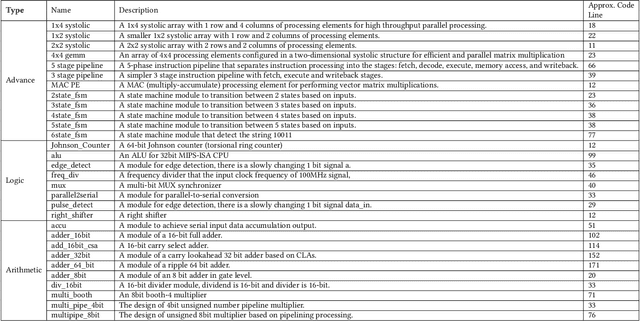
Natural language interfaces have exhibited considerable potential in the automation of Verilog generation derived from high-level specifications through the utilization of large language models, garnering significant attention. Nevertheless, this paper elucidates that visual representations contribute essential contextual information critical to design intent for hardware architectures possessing spatial complexity, potentially surpassing the efficacy of natural-language-only inputs. Expanding upon this premise, our paper introduces an open-source benchmark for multi-modal generative models tailored for Verilog synthesis from visual-linguistic inputs, addressing both singular and complex modules. Additionally, we introduce an open-source visual and natural language Verilog query language framework to facilitate efficient and user-friendly multi-modal queries. To evaluate the performance of the proposed multi-modal hardware generative AI in Verilog generation tasks, we compare it with a popular method that relies solely on natural language. Our results demonstrate a significant accuracy improvement in the multi-modal generated Verilog compared to queries based solely on natural language. We hope to reveal a new approach to hardware design in the large-hardware-design-model era, thereby fostering a more diversified and productive approach to hardware design.
Data is all you need: Finetuning LLMs for Chip Design via an Automated design-data augmentation framework
Mar 17, 2024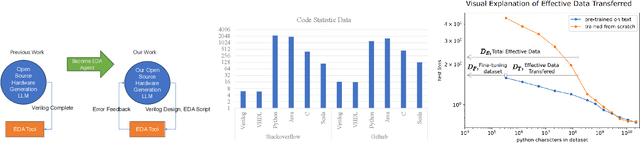

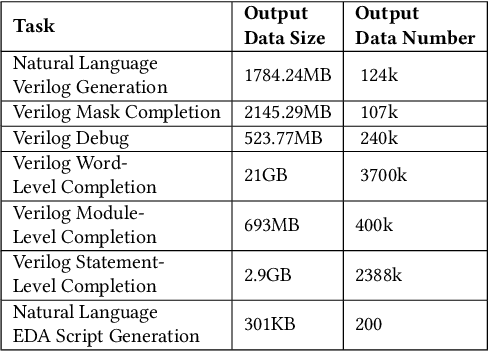
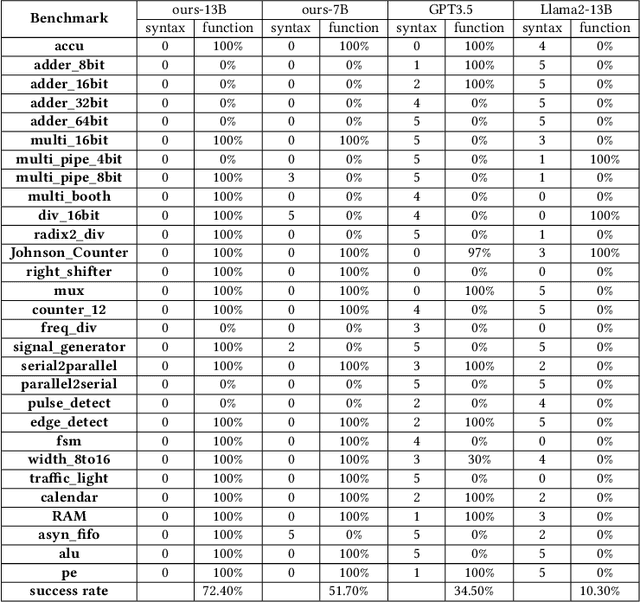
Recent advances in large language models have demonstrated their potential for automated generation of hardware description language (HDL) code from high-level prompts. Researchers have utilized fine-tuning to enhance the ability of these large language models (LLMs) in the field of Chip Design. However, the lack of Verilog data hinders further improvement in the quality of Verilog generation by LLMs. Additionally, the absence of a Verilog and Electronic Design Automation (EDA) script data augmentation framework significantly increases the time required to prepare the training dataset for LLM trainers. This paper proposes an automated design-data augmentation framework, which generates high-volume and high-quality natural language aligned with Verilog and EDA scripts. For Verilog generation, it translates Verilog files to an abstract syntax tree and then maps nodes to natural language with a predefined template. For Verilog repair, it uses predefined rules to generate the wrong verilog file and then pairs EDA Tool feedback with the right and wrong verilog file. For EDA Script generation, it uses existing LLM(GPT-3.5) to obtain the description of the Script. To evaluate the effectiveness of our data augmentation method, we finetune Llama2-13B and Llama2-7B models using the dataset generated by our augmentation framework. The results demonstrate a significant improvement in the Verilog generation tasks with LLMs. Moreover, the accuracy of Verilog generation surpasses that of the current state-of-the-art open-source Verilog generation model, increasing from 58.8% to 70.6% with the same benchmark. Our 13B model (ChipGPT-FT) has a pass rate improvement compared with GPT-3.5 in Verilog generation and outperforms in EDA script (i.e., SiliconCompiler) generation with only 200 EDA script data.
Can We Trust Race Prediction?
Aug 07, 2023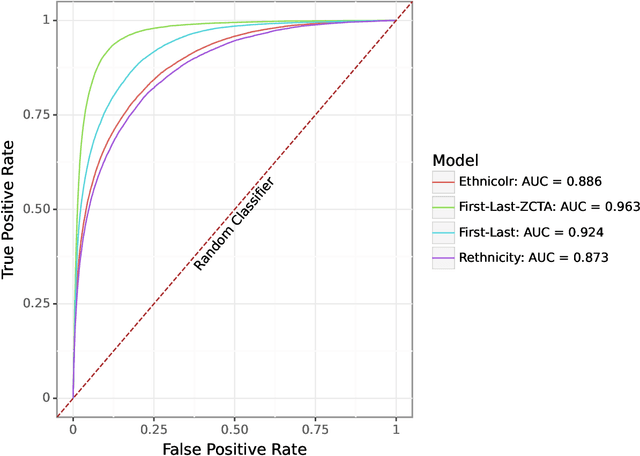
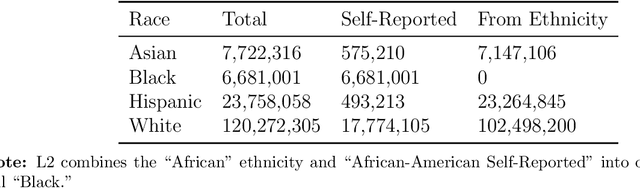
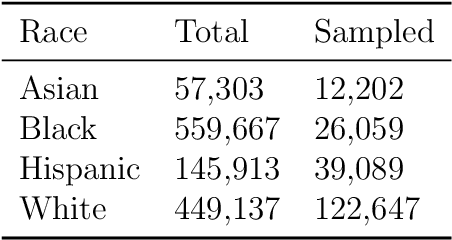
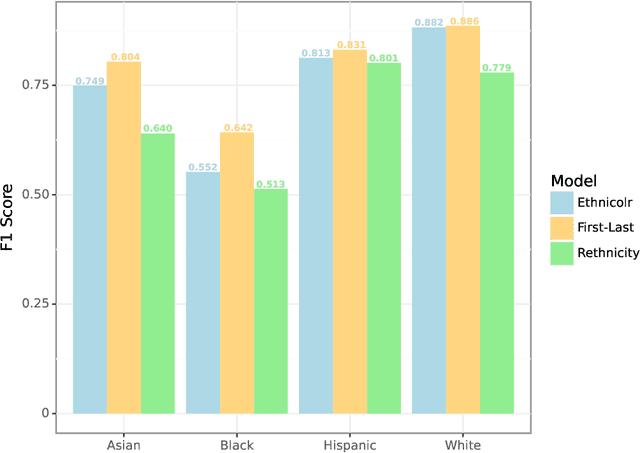
In the absence of sensitive race and ethnicity data, researchers, regulators, and firms alike turn to proxies. In this paper, I train a Bidirectional Long Short-Term Memory (BiLSTM) model on a novel dataset of voter registration data from all 50 US states and create an ensemble that achieves up to 36.8% higher out of sample (OOS) F1 scores than the best performing machine learning models in the literature. Additionally, I construct the most comprehensive database of first and surname distributions in the US in order to improve the coverage and accuracy of Bayesian Improved Surname Geocoding (BISG) and Bayesian Improved Firstname Surname Geocoding (BIFSG). Finally, I provide the first high-quality benchmark dataset in order to fairly compare existing models and aid future model developers.