 Add to Chrome
 Add to Firefox
 Add to Edge
FT-WBC: Learning Fault-Tolerant Whole-Body Control for Legged Loco-Manipulation
Jun 23, 2026
Legged manipulators combine the mobility of legged platforms with the manipulation capability of robotic arms. However, arm-induced Center-of-Mass shifts and dynamic disturbances make the system more prone to instability under actuator failures, potentially leading to falls, task failures, or safety risks. Existing fault-tolerant control methods mainly focus on locomotion alone, leaving the coupled problem of whole-body stability and arm reachability in fault-tolerant loco-manipulation largely unaddressed. To bridge this gap, we propose FT-WBC, a fault-tolerant loco-manipulation framework for robust whole-body control of legged manipulators under actuator failures. FT-WBC adopts a decoupled upper- and lower-body policy architecture and introduces two key modules: a Fault Estimator (FE) and a Posture Adaptation Module (PAM). The FE predicts faulty joints from lower-body proprioceptive histories, while the PAM uses this fault information to adapt the base posture plan generated by the arm policy, converting potentially unstable posture requests into safe and executable base posture commands. Through this fault-aware posture adaptation mechanism, FT-WBC synthesizes compensatory gaits under actuator failures and preserves as much arm workspace as possible while maintaining whole-body stability. Simulation and real-world experiments show that FT-WBC significantly improves survival rate and workspace under weakening or locked failures, and transfers zero-shot to a real legged manipulator in the real world.

RoboDexVLM: Visual Language Model-Enabled Task Planning and Motion Control for Dexterous Robot Manipulation
Mar 03, 2025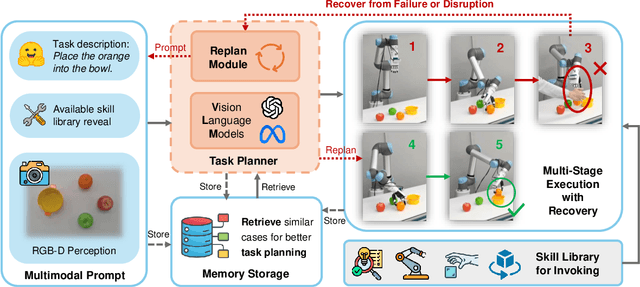
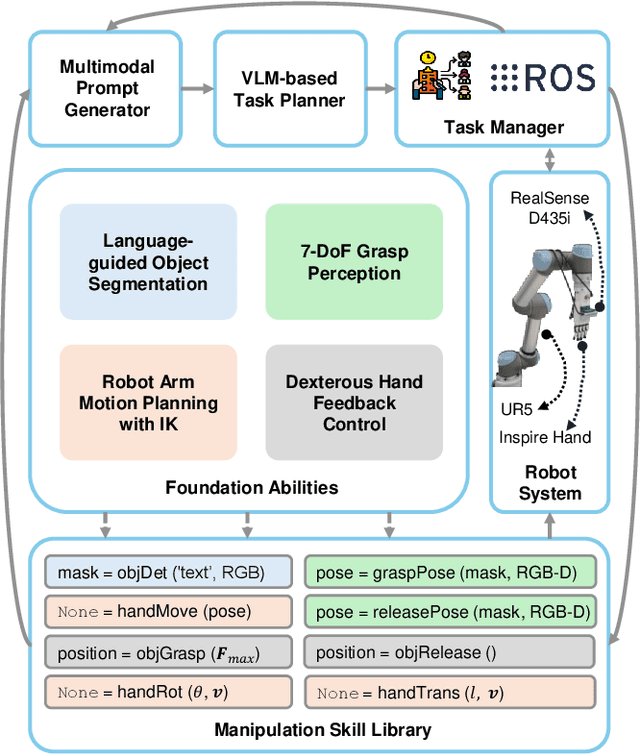
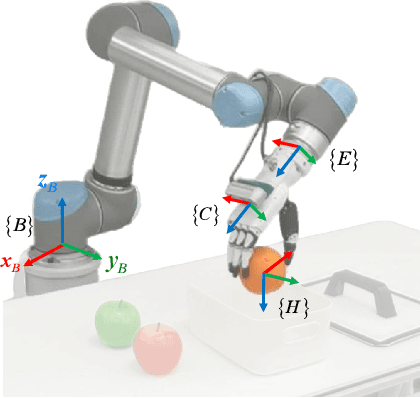
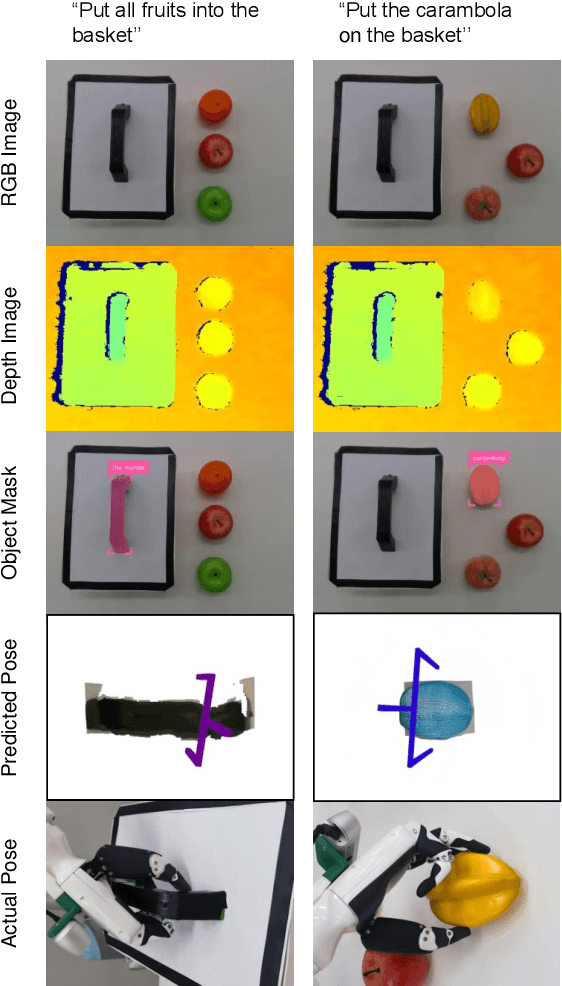
This paper introduces RoboDexVLM, an innovative framework for robot task planning and grasp detection tailored for a collaborative manipulator equipped with a dexterous hand. Previous methods focus on simplified and limited manipulation tasks, which often neglect the complexities associated with grasping a diverse array of objects in a long-horizon manner. In contrast, our proposed framework utilizes a dexterous hand capable of grasping objects of varying shapes and sizes while executing tasks based on natural language commands. The proposed approach has the following core components: First, a robust task planner with a task-level recovery mechanism that leverages vision-language models (VLMs) is designed, which enables the system to interpret and execute open-vocabulary commands for long sequence tasks. Second, a language-guided dexterous grasp perception algorithm is presented based on robot kinematics and formal methods, tailored for zero-shot dexterous manipulation with diverse objects and commands. Comprehensive experimental results validate the effectiveness, adaptability, and robustness of RoboDexVLM in handling long-horizon scenarios and performing dexterous grasping. These results highlight the framework's ability to operate in complex environments, showcasing its potential for open-vocabulary dexterous manipulation. Our open-source project page can be found at https://henryhcliu.github.io/robodexvlm.