 Add to Chrome
 Add to Firefox
 Add to Edge
ETPDesigner: Multi-Agent Orchestration for Interactive Multimodal Electronic Theater Program
Jul 22, 2026
Electronic Theater Programs (ETPs) serve as critical promotional media in the performing arts, comprising a multi-page collection of heterogeneous visual assets such as theatrical posters, performance details, and character portraits. However, existing text-to-image paradigms struggle with such complex design tasks due to their inability to comprehend long-context narratives and maintain visual consistency across multiple distinct pages. To address this, we introduce ETPDesigner, a collaborative Multi-Agent framework that directly synthesizes high-quality ETPs from raw dramatic scripts. Emulating a professional design pipeline, our framework orchestrates specialized agents for semantic script analysis, core poster synthesis, functional background generation, and the stratified composition of character assets. Central to ETPDesigner is a global style anchor mechanism that extracts visual priors from the core poster to enforce strict aesthetic uniformity across all generated components. Furthermore, we elevate the ETP from a static publication to an immersive interactive companion. By integrating portrait animation, customized speech synthesis, and persona-grounded Large Language Models (LLMs), our system enables users to engage in real-time, voice-enabled conversations with the generated virtual characters. To rigorously benchmark this task, we construct ETP-Pro, a domain-specific benchmark of professional theater posters and high-quality character portraits. Extensive evaluations demonstrate our method's superiority in producing semantically faithful, aesthetically consistent, and highly interactive program sets.

FoleyDesigner: Immersive Stereo Foley Generation with Precise Spatio-Temporal Alignment for Film Clips
Apr 07, 2026Foley art plays a pivotal role in enhancing immersive auditory experiences in film, yet manual creation of spatio-temporally aligned audio remains labor-intensive. We propose FoleyDesigner, a novel framework inspired by professional Foley workflows, integrating film clip analysis, spatio-temporally controllable Foley generation, and professional audio mixing capabilities. FoleyDesigner employs a multi-agent architecture for precise spatio-temporal analysis. It achieves spatio-temporal alignment through latent diffusion models trained on spatio-temporal cues extracted from video frames, combined with large language model (LLM)-driven hybrid mechanisms that emulate post-production practices in film industry. To address the lack of high-quality stereo audio datasets in film, we introduce FilmStereo, the first professional stereo audio dataset containing spatial metadata, precise timestamps, and semantic annotations for eight common Foley categories. For applications, the framework supports interactive user control while maintaining seamless integration with professional pipelines, including 5.1-channel Dolby Atmos systems compliant with ITU-R BS.775 standards, thereby offering extensive creative flexibility. Extensive experiments demonstrate that our method achieves superior spatio-temporal alignment compared to existing baselines, with seamless compatibility with professional film production standards. The project page is available at https://gekiii996.github.io/FoleyDesigner/ .
GardenDesigner: Encoding Aesthetic Principles into Jiangnan Garden Construction via a Chain of Agents
Apr 02, 2026Jiangnan gardens, a prominent style of Chinese classical gardens, hold great potential as digital assets for film and game production and digital tourism. However, manual modeling of Jiangnan gardens heavily relies on expert experience for layout design and asset creation, making the process time-consuming. To address this gap, we propose GardenDesigner, a novel framework that encodes aesthetic principles for Jiangnan garden construction and integrates a chain of agents based on procedural modeling. The water-centric terrain and explorative pathway rules are applied by terrain distribution and road generation agents. Selection and spatial layout of garden assets follow the aesthetic and cultural constraints. Consequently, we propose asset selection and layout optimization agents to select and arrange objects for each area in the garden. Additionally, we introduce GardenVerse for Jiangnan garden construction, including expert-annotated garden knowledge to enhance the asset arrangement process. To enable interaction and editing, we develop an interactive interface and tools in Unity, in which non-expert users can construct Jiangnan gardens via text input within one minute. Experiments and human evaluations demonstrate that GardenDesigner can generate diverse and aesthetically pleasing Jiangnan gardens. Project page is available at https://monad-cube.github.io/GardenDesigner.
VERTIGO: Visual Preference Optimization for Cinematic Camera Trajectory Generation
Apr 02, 2026Cinematic camera control relies on a tight feedback loop between director and cinematographer, where camera motion and framing are continuously reviewed and refined. Recent generative camera systems can produce diverse, text-conditioned trajectories, but they lack this "director in the loop" and have no explicit supervision of whether a shot is visually desirable. This results in in-distribution camera motion but poor framing, off-screen characters, and undesirable visual aesthetics. In this paper, we introduce VERTIGO, the first framework for visual preference optimization of camera trajectory generators. Our framework leverages a real-time graphics engine (Unity) to render 2D visual previews from generated camera motion. A cinematically fine-tuned vision-language model then scores these previews using our proposed cyclic semantic similarity mechanism, which aligns renders with text prompts. This process provides the visual preference signals for Direct Preference Optimization (DPO) post-training. Both quantitative evaluations and user studies on Unity renders and diffusion-based Camera-to-Video pipelines show consistent gains in condition adherence, framing quality, and perceptual realism. Notably, VERTIGO reduces the character off-screen rate from 38% to nearly 0% while preserving the geometric fidelity of camera motion. User study participants further prefer VERTIGO over baselines across composition, consistency, prompt adherence, and aesthetic quality, confirming the perceptual benefits of our visual preference post-training.
GaussianMorphing: Mesh-Guided 3D Gaussians for Semantic-Aware Object Morphing
Oct 02, 2025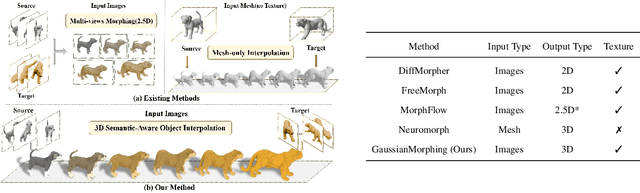
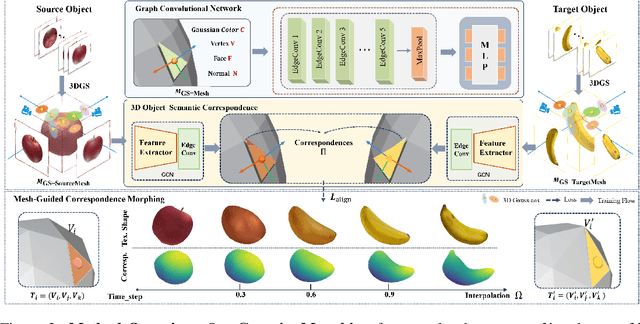
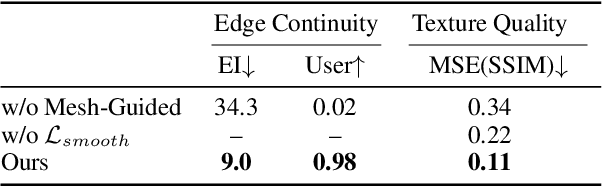
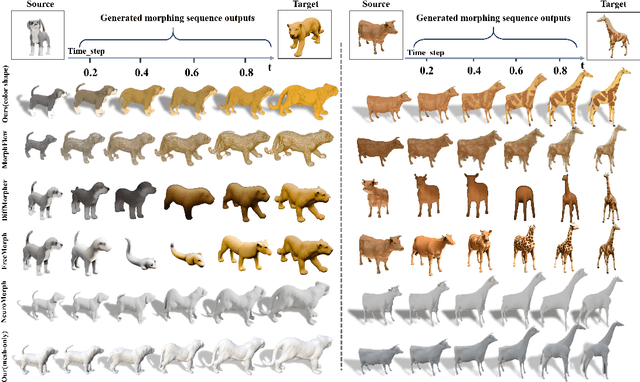
We introduce GaussianMorphing, a novel framework for semantic-aware 3D shape and texture morphing from multi-view images. Previous approaches usually rely on point clouds or require pre-defined homeomorphic mappings for untextured data. Our method overcomes these limitations by leveraging mesh-guided 3D Gaussian Splatting (3DGS) for high-fidelity geometry and appearance modeling. The core of our framework is a unified deformation strategy that anchors 3DGaussians to reconstructed mesh patches, ensuring geometrically consistent transformations while preserving texture fidelity through topology-aware constraints. In parallel, our framework establishes unsupervised semantic correspondence by using the mesh topology as a geometric prior and maintains structural integrity via physically plausible point trajectories. This integrated approach preserves both local detail and global semantic coherence throughout the morphing process with out requiring labeled data. On our proposed TexMorph benchmark, GaussianMorphing substantially outperforms prior 2D/3D methods, reducing color consistency error ($\Delta E$) by 22.2% and EI by 26.2%. Project page: https://baiyunshu.github.io/GAUSSIANMORPHING.github.io/
FilmComposer: LLM-Driven Music Production for Silent Film Clips
Mar 11, 2025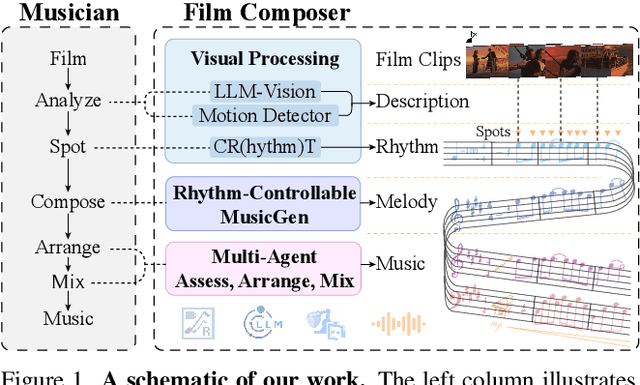
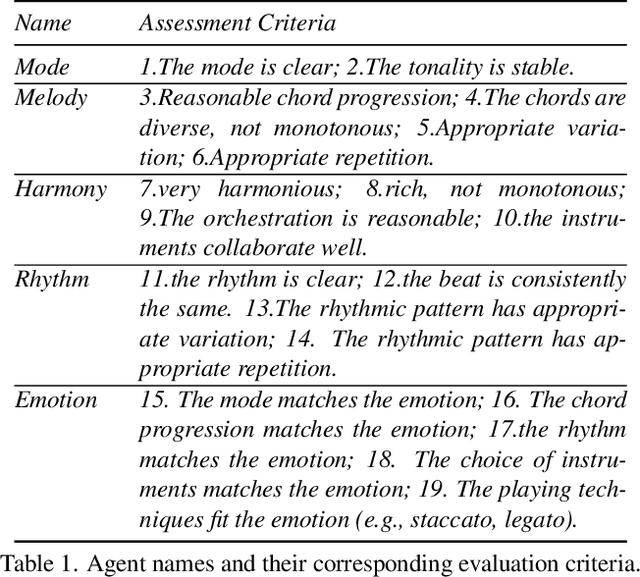
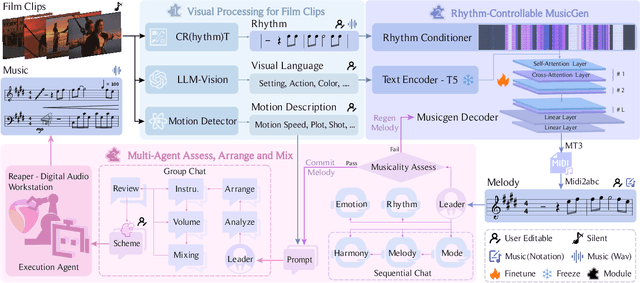
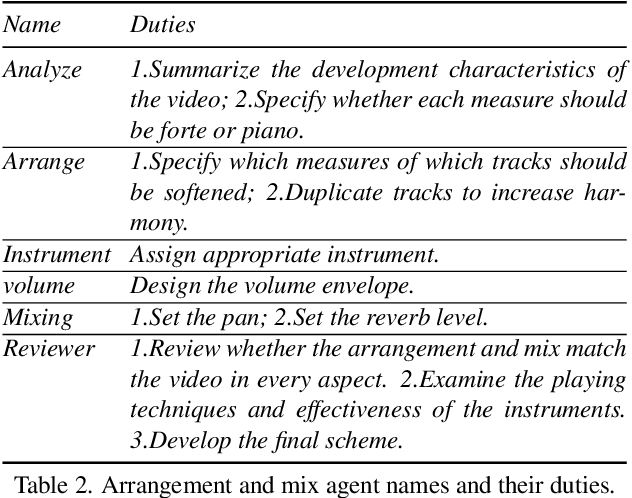
In this work, we implement music production for silent film clips using LLM-driven method. Given the strong professional demands of film music production, we propose the FilmComposer, simulating the actual workflows of professional musicians. FilmComposer is the first to combine large generative models with a multi-agent approach, leveraging the advantages of both waveform music and symbolic music generation. Additionally, FilmComposer is the first to focus on the three core elements of music production for film-audio quality, musicality, and musical development-and introduces various controls, such as rhythm, semantics, and visuals, to enhance these key aspects. Specifically, FilmComposer consists of the visual processing module, rhythm-controllable MusicGen, and multi-agent assessment, arrangement and mix. In addition, our framework can seamlessly integrate into the actual music production pipeline and allows user intervention in every step, providing strong interactivity and a high degree of creative freedom. Furthermore, we propose MusicPro-7k which includes 7,418 film clips, music, description, rhythm spots and main melody, considering the lack of a professional and high-quality film music dataset. Finally, both the standard metrics and the new specialized metrics we propose demonstrate that the music generated by our model achieves state-of-the-art performance in terms of quality, consistency with video, diversity, musicality, and musical development. Project page: https://apple-jun.github.io/FilmComposer.github.io/
AniGaussian: Animatable Gaussian Avatar with Pose-guided Deformation
Feb 24, 2025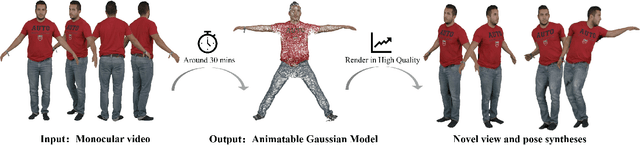
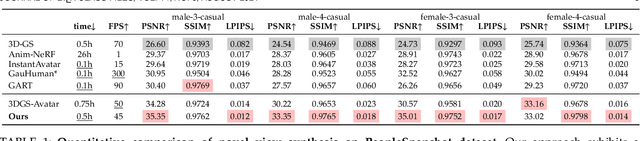
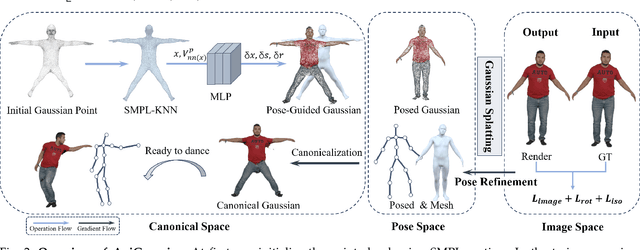
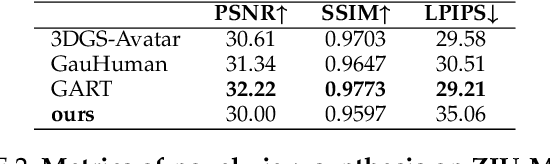
Recent advancements in Gaussian-based human body reconstruction have achieved notable success in creating animatable avatars. However, there are ongoing challenges to fully exploit the SMPL model's prior knowledge and enhance the visual fidelity of these models to achieve more refined avatar reconstructions. In this paper, we introduce AniGaussian which addresses the above issues with two insights. First, we propose an innovative pose guided deformation strategy that effectively constrains the dynamic Gaussian avatar with SMPL pose guidance, ensuring that the reconstructed model not only captures the detailed surface nuances but also maintains anatomical correctness across a wide range of motions. Second, we tackle the expressiveness limitations of Gaussian models in representing dynamic human bodies. We incorporate rigid-based priors from previous works to enhance the dynamic transform capabilities of the Gaussian model. Furthermore, we introduce a split-with-scale strategy that significantly improves geometry quality. The ablative study experiment demonstrates the effectiveness of our innovative model design. Through extensive comparisons with existing methods, AniGaussian demonstrates superior performance in both qualitative result and quantitative metrics.
Infinite Motion: Extended Motion Generation via Long Text Instructions
Jul 11, 2024
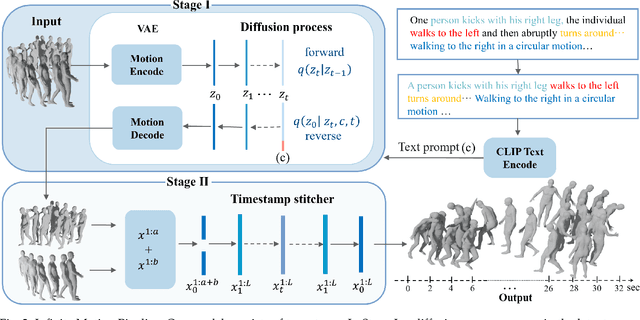
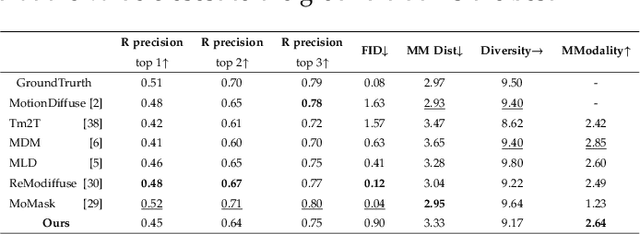
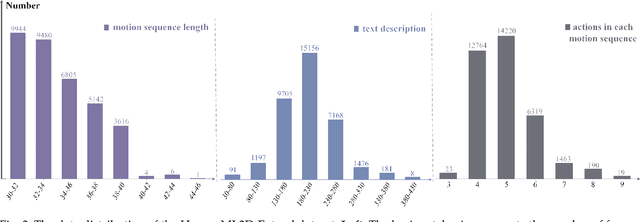
In the realm of motion generation, the creation of long-duration, high-quality motion sequences remains a significant challenge. This paper presents our groundbreaking work on "Infinite Motion", a novel approach that leverages long text to extended motion generation, effectively bridging the gap between short and long-duration motion synthesis. Our core insight is the strategic extension and reassembly of existing high-quality text-motion datasets, which has led to the creation of a novel benchmark dataset to facilitate the training of models for extended motion sequences. A key innovation of our model is its ability to accept arbitrary lengths of text as input, enabling the generation of motion sequences tailored to specific narratives or scenarios. Furthermore, we incorporate the timestamp design for text which allows precise editing of local segments within the generated sequences, offering unparalleled control and flexibility in motion synthesis. We further demonstrate the versatility and practical utility of "Infinite Motion" through three specific applications: natural language interactive editing, motion sequence editing within long sequences and splicing of independent motion sequences. Each application highlights the adaptability of our approach and broadens the spectrum of possibilities for research and development in motion generation. Through extensive experiments, we demonstrate the superior performance of our model in generating long sequence motions compared to existing methods.Project page: https://shuochengzhai.github.io/Infinite-motion.github.io/
PIG: Prompt Images Guidance for Night-Time Scene Parsing
Jun 15, 2024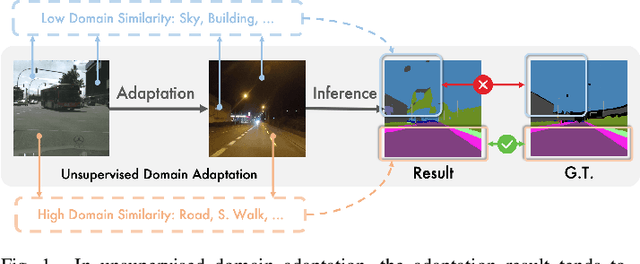
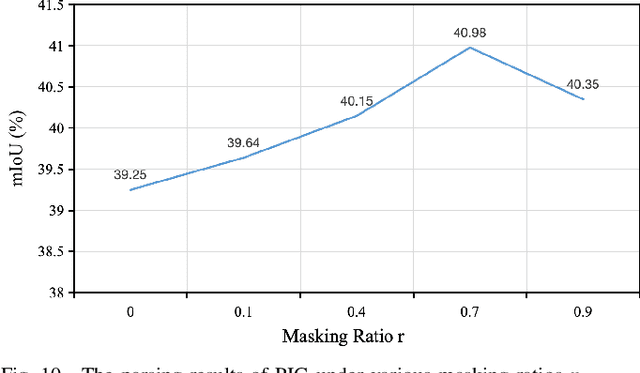
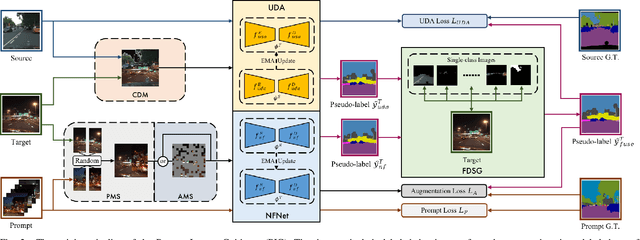
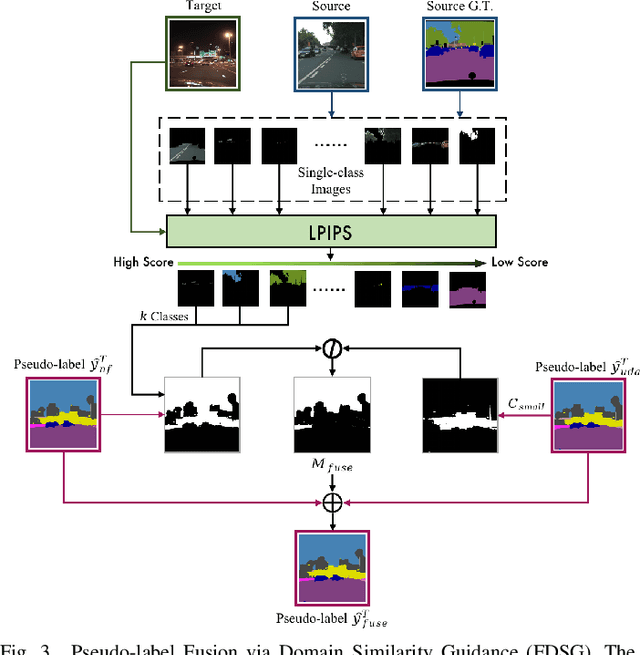
Night-time scene parsing aims to extract pixel-level semantic information in night images, aiding downstream tasks in understanding scene object distribution. Due to limited labeled night image datasets, unsupervised domain adaptation (UDA) has become the predominant method for studying night scenes. UDA typically relies on paired day-night image pairs to guide adaptation, but this approach hampers dataset construction and restricts generalization across night scenes in different datasets. Moreover, UDA, focusing on network architecture and training strategies, faces difficulties in handling classes with few domain similarities. In this paper, we leverage Prompt Images Guidance (PIG) to enhance UDA with supplementary night knowledge. We propose a Night-Focused Network (NFNet) to learn night-specific features from both target domain images and prompt images. To generate high-quality pseudo-labels, we propose Pseudo-label Fusion via Domain Similarity Guidance (FDSG). Classes with fewer domain similarities are predicted by NFNet, which excels in parsing night features, while classes with more domain similarities are predicted by UDA, which has rich labeled semantics. Additionally, we propose two data augmentation strategies: the Prompt Mixture Strategy (PMS) and the Alternate Mask Strategy (AMS), aimed at mitigating the overfitting of the NFNet to a few prompt images. We conduct extensive experiments on four night-time datasets: NightCity, NightCity+, Dark Zurich, and ACDC. The results indicate that utilizing PIG can enhance the parsing accuracy of UDA.
GaussianBody: Clothed Human Reconstruction via 3d Gaussian Splatting
Jan 27, 2024In this work, we propose a novel clothed human reconstruction method called GaussianBody, based on 3D Gaussian Splatting. Compared with the costly neural radiance based models, 3D Gaussian Splatting has recently demonstrated great performance in terms of training time and rendering quality. However, applying the static 3D Gaussian Splatting model to the dynamic human reconstruction problem is non-trivial due to complicated non-rigid deformations and rich cloth details. To address these challenges, our method considers explicit pose-guided deformation to associate dynamic Gaussians across the canonical space and the observation space, introducing a physically-based prior with regularized transformations helps mitigate ambiguity between the two spaces. During the training process, we further propose a pose refinement strategy to update the pose regression for compensating the inaccurate initial estimation and a split-with-scale mechanism to enhance the density of regressed point clouds. The experiments validate that our method can achieve state-of-the-art photorealistic novel-view rendering results with high-quality details for dynamic clothed human bodies, along with explicit geometry reconstruction.