 Add to Chrome
 Add to Firefox
 Add to Edge
FoleyDesigner: Immersive Stereo Foley Generation with Precise Spatio-Temporal Alignment for Film Clips
Apr 07, 2026
Foley art plays a pivotal role in enhancing immersive auditory experiences in film, yet manual creation of spatio-temporally aligned audio remains labor-intensive. We propose FoleyDesigner, a novel framework inspired by professional Foley workflows, integrating film clip analysis, spatio-temporally controllable Foley generation, and professional audio mixing capabilities. FoleyDesigner employs a multi-agent architecture for precise spatio-temporal analysis. It achieves spatio-temporal alignment through latent diffusion models trained on spatio-temporal cues extracted from video frames, combined with large language model (LLM)-driven hybrid mechanisms that emulate post-production practices in film industry. To address the lack of high-quality stereo audio datasets in film, we introduce FilmStereo, the first professional stereo audio dataset containing spatial metadata, precise timestamps, and semantic annotations for eight common Foley categories. For applications, the framework supports interactive user control while maintaining seamless integration with professional pipelines, including 5.1-channel Dolby Atmos systems compliant with ITU-R BS.775 standards, thereby offering extensive creative flexibility. Extensive experiments demonstrate that our method achieves superior spatio-temporal alignment compared to existing baselines, with seamless compatibility with professional film production standards. The project page is available at https://gekiii996.github.io/FoleyDesigner/ .

GardenDesigner: Encoding Aesthetic Principles into Jiangnan Garden Construction via a Chain of Agents
Apr 02, 2026Jiangnan gardens, a prominent style of Chinese classical gardens, hold great potential as digital assets for film and game production and digital tourism. However, manual modeling of Jiangnan gardens heavily relies on expert experience for layout design and asset creation, making the process time-consuming. To address this gap, we propose GardenDesigner, a novel framework that encodes aesthetic principles for Jiangnan garden construction and integrates a chain of agents based on procedural modeling. The water-centric terrain and explorative pathway rules are applied by terrain distribution and road generation agents. Selection and spatial layout of garden assets follow the aesthetic and cultural constraints. Consequently, we propose asset selection and layout optimization agents to select and arrange objects for each area in the garden. Additionally, we introduce GardenVerse for Jiangnan garden construction, including expert-annotated garden knowledge to enhance the asset arrangement process. To enable interaction and editing, we develop an interactive interface and tools in Unity, in which non-expert users can construct Jiangnan gardens via text input within one minute. Experiments and human evaluations demonstrate that GardenDesigner can generate diverse and aesthetically pleasing Jiangnan gardens. Project page is available at https://monad-cube.github.io/GardenDesigner.
VERTIGO: Visual Preference Optimization for Cinematic Camera Trajectory Generation
Apr 02, 2026Cinematic camera control relies on a tight feedback loop between director and cinematographer, where camera motion and framing are continuously reviewed and refined. Recent generative camera systems can produce diverse, text-conditioned trajectories, but they lack this "director in the loop" and have no explicit supervision of whether a shot is visually desirable. This results in in-distribution camera motion but poor framing, off-screen characters, and undesirable visual aesthetics. In this paper, we introduce VERTIGO, the first framework for visual preference optimization of camera trajectory generators. Our framework leverages a real-time graphics engine (Unity) to render 2D visual previews from generated camera motion. A cinematically fine-tuned vision-language model then scores these previews using our proposed cyclic semantic similarity mechanism, which aligns renders with text prompts. This process provides the visual preference signals for Direct Preference Optimization (DPO) post-training. Both quantitative evaluations and user studies on Unity renders and diffusion-based Camera-to-Video pipelines show consistent gains in condition adherence, framing quality, and perceptual realism. Notably, VERTIGO reduces the character off-screen rate from 38% to nearly 0% while preserving the geometric fidelity of camera motion. User study participants further prefer VERTIGO over baselines across composition, consistency, prompt adherence, and aesthetic quality, confirming the perceptual benefits of our visual preference post-training.
Mind-of-Director: Multi-modal Agent-Driven Film Previsualization via Collaborative Decision-Making
Mar 16, 2026We present Mind-of-Director, a multi-modal agent-driven framework for film previz that models the collaborative decision-making process of a film production team. Given a creative idea, Mind-of-Director orchestrates multiple specialized agents to produce previz sequences within the game engine. The framework consists of four cooperative modules: Script Development, where agents draft and refine the screenplay iteratively; Virtual Scene Design, which transforms text into semantically aligned 3D environments; Character Behaviour Control, which determines character blocking and motion; and Camera Planning, which optimizes framing, movement, and composition for cinematic camera effects. A real-time visual editing system built in the game engine further enables interactive inspection and synchronized timeline adjustment across scenes, behaviours, and cameras. Extensive experiments and human evaluations show that Mind-of-Director generates high-quality, semantically grounded previz sequences in approximately 25 minutes per idea, demonstrating the effectiveness of agent collaboration for both automated prototyping and human-in-the-loop filmmaking.
G-STAR: End-to-End Global Speaker-Tracking Attributed Recognition
Mar 11, 2026We study timestamped speaker-attributed ASR for long-form, multi-party speech with overlap, where chunk-wise inference must preserve meeting-level speaker identity consistency while producing time-stamped, speaker-labeled transcripts. Previous Speech-LLM systems tend to prioritize either local diarization or global labeling, but often lack the ability to capture fine-grained temporal boundaries or robust cross-chunk identity linking. We propose G-STAR, an end-to-end system that couples a time-aware speaker-tracking module with a Speech-LLM transcription backbone. The tracker provides structured speaker cues with temporal grounding, and the LLM generates attributed text conditioned on these cues. G-STAR supports both component-wise optimization and joint end-to-end training, enabling flexible learning under heterogeneous supervision and domain shift. Experiments analyze cue fusion, local versus long-context trade-offs and hierarchical objectives.
OmniTransfer: All-in-one Framework for Spatio-temporal Video Transfer
Jan 20, 2026Videos convey richer information than images or text, capturing both spatial and temporal dynamics. However, most existing video customization methods rely on reference images or task-specific temporal priors, failing to fully exploit the rich spatio-temporal information inherent in videos, thereby limiting flexibility and generalization in video generation. To address these limitations, we propose OmniTransfer, a unified framework for spatio-temporal video transfer. It leverages multi-view information across frames to enhance appearance consistency and exploits temporal cues to enable fine-grained temporal control. To unify various video transfer tasks, OmniTransfer incorporates three key designs: Task-aware Positional Bias that adaptively leverages reference video information to improve temporal alignment or appearance consistency; Reference-decoupled Causal Learning separating reference and target branches to enable precise reference transfer while improving efficiency; and Task-adaptive Multimodal Alignment using multimodal semantic guidance to dynamically distinguish and tackle different tasks. Extensive experiments show that OmniTransfer outperforms existing methods in appearance (ID and style) and temporal transfer (camera movement and video effects), while matching pose-guided methods in motion transfer without using pose, establishing a new paradigm for flexible, high-fidelity video generation.
DreamStyle: A Unified Framework for Video Stylization
Jan 06, 2026Video stylization, an important downstream task of video generation models, has not yet been thoroughly explored. Its input style conditions typically include text, style image, and stylized first frame. Each condition has a characteristic advantage: text is more flexible, style image provides a more accurate visual anchor, and stylized first frame makes long-video stylization feasible. However, existing methods are largely confined to a single type of style condition, which limits their scope of application. Additionally, their lack of high-quality datasets leads to style inconsistency and temporal flicker. To address these limitations, we introduce DreamStyle, a unified framework for video stylization, supporting (1) text-guided, (2) style-image-guided, and (3) first-frame-guided video stylization, accompanied by a well-designed data curation pipeline to acquire high-quality paired video data. DreamStyle is built on a vanilla Image-to-Video (I2V) model and trained using a Low-Rank Adaptation (LoRA) with token-specific up matrices that reduces the confusion among different condition tokens. Both qualitative and quantitative evaluations demonstrate that DreamStyle is competent in all three video stylization tasks, and outperforms the competitors in style consistency and video quality.
GaussianMorphing: Mesh-Guided 3D Gaussians for Semantic-Aware Object Morphing
Oct 02, 2025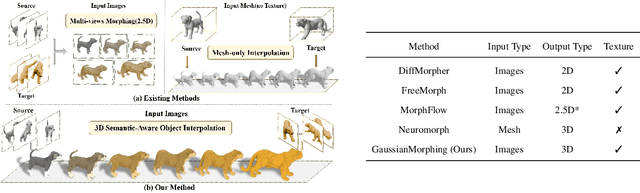
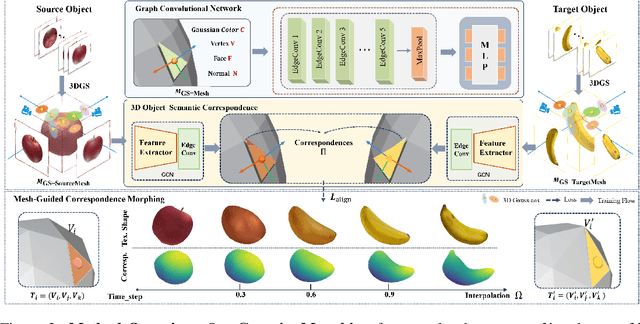
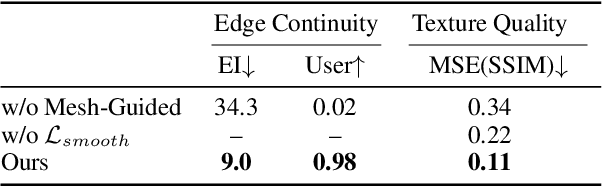
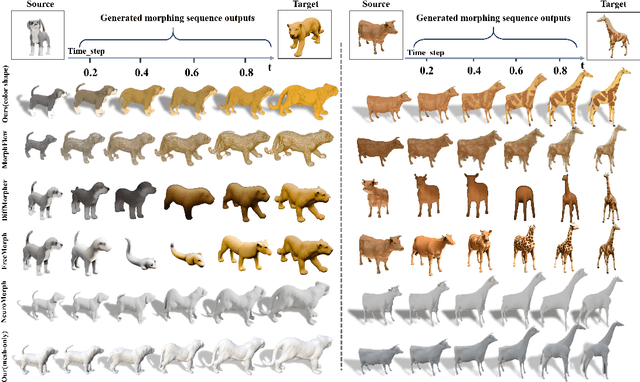
We introduce GaussianMorphing, a novel framework for semantic-aware 3D shape and texture morphing from multi-view images. Previous approaches usually rely on point clouds or require pre-defined homeomorphic mappings for untextured data. Our method overcomes these limitations by leveraging mesh-guided 3D Gaussian Splatting (3DGS) for high-fidelity geometry and appearance modeling. The core of our framework is a unified deformation strategy that anchors 3DGaussians to reconstructed mesh patches, ensuring geometrically consistent transformations while preserving texture fidelity through topology-aware constraints. In parallel, our framework establishes unsupervised semantic correspondence by using the mesh topology as a geometric prior and maintains structural integrity via physically plausible point trajectories. This integrated approach preserves both local detail and global semantic coherence throughout the morphing process with out requiring labeled data. On our proposed TexMorph benchmark, GaussianMorphing substantially outperforms prior 2D/3D methods, reducing color consistency error ($\Delta E$) by 22.2% and EI by 26.2%. Project page: https://baiyunshu.github.io/GAUSSIANMORPHING.github.io/
GTAD: Global Temporal Aggregation Denoising Learning for 3D Semantic Occupancy Prediction
Jul 28, 2025Accurately perceiving dynamic environments is a fundamental task for autonomous driving and robotic systems. Existing methods inadequately utilize temporal information, relying mainly on local temporal interactions between adjacent frames and failing to leverage global sequence information effectively. To address this limitation, we investigate how to effectively aggregate global temporal features from temporal sequences, aiming to achieve occupancy representations that efficiently utilize global temporal information from historical observations. For this purpose, we propose a global temporal aggregation denoising network named GTAD, introducing a global temporal information aggregation framework as a new paradigm for holistic 3D scene understanding. Our method employs an in-model latent denoising network to aggregate local temporal features from the current moment and global temporal features from historical sequences. This approach enables the effective perception of both fine-grained temporal information from adjacent frames and global temporal patterns from historical observations. As a result, it provides a more coherent and comprehensive understanding of the environment. Extensive experiments on the nuScenes and Occ3D-nuScenes benchmark and ablation studies demonstrate the superiority of our method.
DreamO: A Unified Framework for Image Customization
Apr 23, 2025Recently, extensive research on image customization (e.g., identity, subject, style, background, etc.) demonstrates strong customization capabilities in large-scale generative models. However, most approaches are designed for specific tasks, restricting their generalizability to combine different types of condition. Developing a unified framework for image customization remains an open challenge. In this paper, we present DreamO, an image customization framework designed to support a wide range of tasks while facilitating seamless integration of multiple conditions. Specifically, DreamO utilizes a diffusion transformer (DiT) framework to uniformly process input of different types. During training, we construct a large-scale training dataset that includes various customization tasks, and we introduce a feature routing constraint to facilitate the precise querying of relevant information from reference images. Additionally, we design a placeholder strategy that associates specific placeholders with conditions at particular positions, enabling control over the placement of conditions in the generated results. Moreover, we employ a progressive training strategy consisting of three stages: an initial stage focused on simple tasks with limited data to establish baseline consistency, a full-scale training stage to comprehensively enhance the customization capabilities, and a final quality alignment stage to correct quality biases introduced by low-quality data. Extensive experiments demonstrate that the proposed DreamO can effectively perform various image customization tasks with high quality and flexibly integrate different types of control conditions.