 Add to Chrome
 Add to Firefox
 Add to Edge
Zero-shot 3D Map Generation with LLM Agents: A Dual-Agent Architecture for Procedural Content Generation
Dec 12, 2025
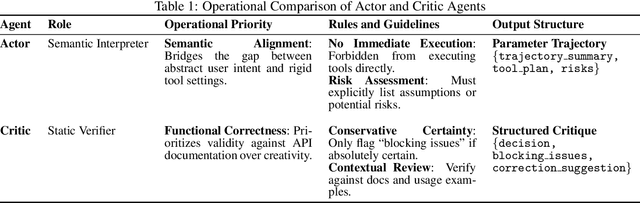
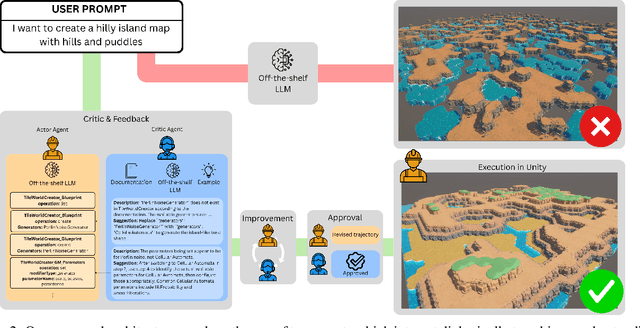
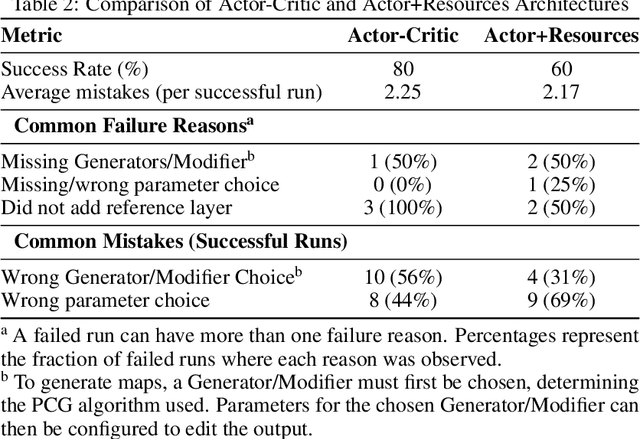
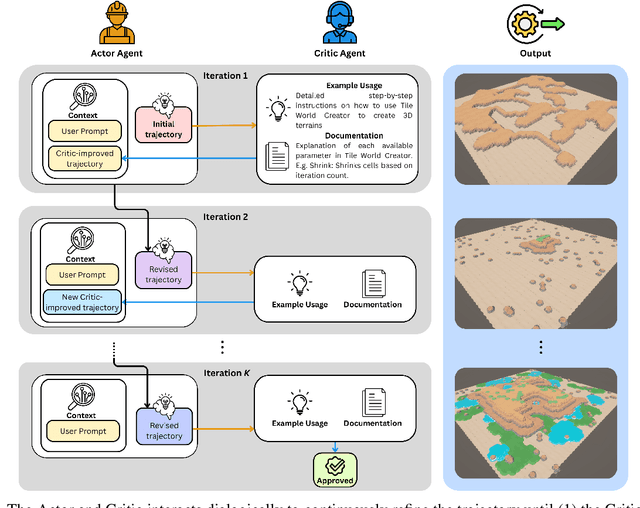
Procedural Content Generation (PCG) offers scalable methods for algorithmically creating complex, customizable worlds. However, controlling these pipelines requires the precise configuration of opaque technical parameters. We propose a training-free architecture that utilizes LLM agents for zero-shot PCG parameter configuration. While Large Language Models (LLMs) promise a natural language interface for PCG tools, off-the-shelf models often fail to bridge the semantic gap between abstract user instructions and strict parameter specifications. Our system pairs an Actor agent with a Critic agent, enabling an iterative workflow where the system autonomously reasons over tool parameters and refines configurations to progressively align with human design preferences. We validate this approach on the generation of various 3D maps, establishing a new benchmark for instruction-following in PCG. Experiments demonstrate that our approach outperforms single-agent baselines, producing diverse and structurally valid environments from natural language descriptions. These results demonstrate that off-the-shelf LLMs can be effectively repurposed as generalized agents for arbitrary PCG tools. By shifting the burden from model training to architectural reasoning, our method offers a scalable framework for mastering complex software without task-specific fine-tuning.

GaussianMorphing: Mesh-Guided 3D Gaussians for Semantic-Aware Object Morphing
Oct 02, 2025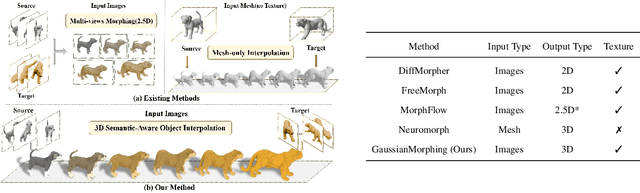
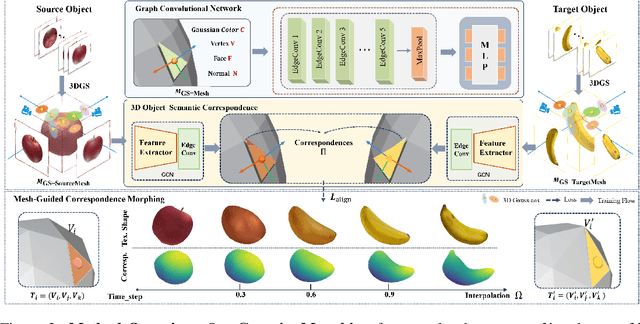
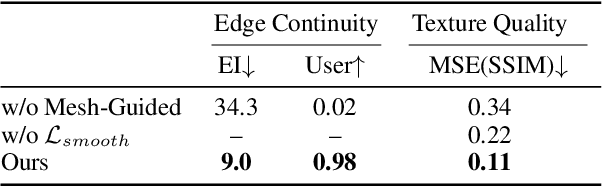
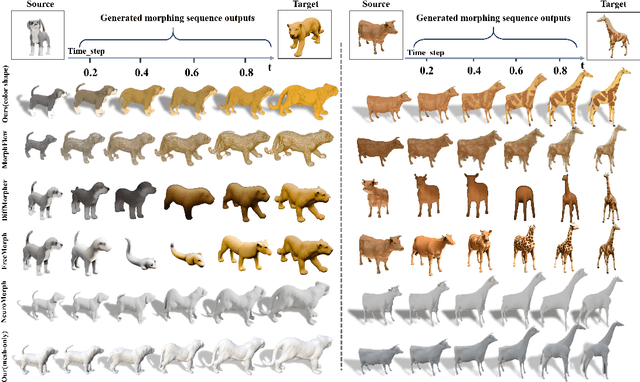
We introduce GaussianMorphing, a novel framework for semantic-aware 3D shape and texture morphing from multi-view images. Previous approaches usually rely on point clouds or require pre-defined homeomorphic mappings for untextured data. Our method overcomes these limitations by leveraging mesh-guided 3D Gaussian Splatting (3DGS) for high-fidelity geometry and appearance modeling. The core of our framework is a unified deformation strategy that anchors 3DGaussians to reconstructed mesh patches, ensuring geometrically consistent transformations while preserving texture fidelity through topology-aware constraints. In parallel, our framework establishes unsupervised semantic correspondence by using the mesh topology as a geometric prior and maintains structural integrity via physically plausible point trajectories. This integrated approach preserves both local detail and global semantic coherence throughout the morphing process with out requiring labeled data. On our proposed TexMorph benchmark, GaussianMorphing substantially outperforms prior 2D/3D methods, reducing color consistency error ($\Delta E$) by 22.2% and EI by 26.2%. Project page: https://baiyunshu.github.io/GAUSSIANMORPHING.github.io/