 Add to Chrome
 Add to Firefox
 Add to Edge
CalliMaster: Mastering Page-level Chinese Calligraphy via Layout-guided Spatial Planning
Mar 12, 2026
Page-level calligraphy synthesis requires balancing glyph precision with layout composition. Existing character models lack spatial context, while page-level methods often compromise brushwork detail. In this paper, we present \textbf{CalliMaster}, a unified framework for controllable generation and editing that resolves this conflict by decoupling spatial planning from content synthesis. Inspired by the human cognitive process of ``planning before writing'', we introduce a coarse-to-fine pipeline \textbf{(Text $\rightarrow$ Layout $\rightarrow$ Image)} to tackle the combinatorial complexity of page-scale synthesis. Operating within a single Multimodal Diffusion Transformer, a spatial planning stage first predicts character bounding boxes to establish the global spatial arrangement. This intermediate layout then serves as a geometric prompt for the content synthesis stage, where the same network utilizes flow-matching to render high-fidelity brushwork. Beyond achieving state-of-the-art generation quality, this disentanglement supports versatile downstream capabilities. By treating the layout as a modifiable constraint, CalliMaster enables controllable semantic re-planning: users can resize or reposition characters while the model automatically harmonizes the surrounding void space and brush momentum. Furthermore, we demonstrate the framework's extensibility to artifact restoration and forensic analysis, providing a comprehensive tool for digital cultural heritage.

Motion Forcing: A Decoupled Framework for Robust Video Generation in Motion Dynamics
Mar 11, 2026The ultimate goal of video generation is to satisfy a fundamental trilemma: achieving high visual quality, maintaining rigorous physical consistency, and enabling precise controllability. While recent models can maintain this balance in simple, isolated scenarios, we observe that this equilibrium is fragile and often breaks down as scene complexity increases (e.g., involving collisions or dense traffic). To address this, we introduce \textbf{Motion Forcing}, a framework designed to stabilize this trilemma even in complex generative tasks. Our key insight is to explicitly decouple physical reasoning from visual synthesis via a hierarchical \textbf{``Point-Shape-Appearance''} paradigm. This approach decomposes generation into verifiable stages: modeling complex dynamics as sparse geometric anchors (\textbf{Point}), expanding them into dynamic depth maps that explicitly resolve 3D geometry (\textbf{Shape}), and finally rendering high-fidelity textures (\textbf{Appearance}). Furthermore, to foster robust physical understanding, we employ a \textbf{Masked Point Recovery} strategy. By randomly masking input anchors during training and enforcing the reconstruction of complete dynamic depth, the model is compelled to move beyond passive pattern matching and learn latent physical laws (e.g., inertia) to infer missing trajectories. Extensive experiments on autonomous driving benchmarks show that Motion Forcing significantly outperforms state-of-the-art baselines, maintaining trilemma stability across complex scenes. Evaluations on physics and robotics further confirm our framework's generality.
VideoMemory: Toward Consistent Video Generation via Memory Integration
Jan 07, 2026Maintaining consistent characters, props, and environments across multiple shots is a central challenge in narrative video generation. Existing models can produce high-quality short clips but often fail to preserve entity identity and appearance when scenes change or when entities reappear after long temporal gaps. We present VideoMemory, an entity-centric framework that integrates narrative planning with visual generation through a Dynamic Memory Bank. Given a structured script, a multi-agent system decomposes the narrative into shots, retrieves entity representations from memory, and synthesizes keyframes and videos conditioned on these retrieved states. The Dynamic Memory Bank stores explicit visual and semantic descriptors for characters, props, and backgrounds, and is updated after each shot to reflect story-driven changes while preserving identity. This retrieval-update mechanism enables consistent portrayal of entities across distant shots and supports coherent long-form generation. To evaluate this setting, we construct a 54-case multi-shot consistency benchmark covering character-, prop-, and background-persistent scenarios. Extensive experiments show that VideoMemory achieves strong entity-level coherence and high perceptual quality across diverse narrative sequences.
LLM-Optic: Unveiling the Capabilities of Large Language Models for Universal Visual Grounding
May 28, 2024Visual grounding is an essential tool that links user-provided text queries with query-specific regions within an image. Despite advancements in visual grounding models, their ability to comprehend complex queries remains limited. To overcome this limitation, we introduce LLM-Optic, an innovative method that utilizes Large Language Models (LLMs) as an optical lens to enhance existing visual grounding models in comprehending complex text queries involving intricate text structures, multiple objects, or object spatial relationships, situations that current models struggle with. LLM-Optic first employs an LLM as a Text Grounder to interpret complex text queries and accurately identify objects the user intends to locate. Then a pre-trained visual grounding model is used to generate candidate bounding boxes given the refined query by the Text Grounder. After that, LLM-Optic annotates the candidate bounding boxes with numerical marks to establish a connection between text and specific image regions, thereby linking two distinct modalities. Finally, it employs a Large Multimodal Model (LMM) as a Visual Grounder to select the marked candidate objects that best correspond to the original text query. Through LLM-Optic, we have achieved universal visual grounding, which allows for the detection of arbitrary objects specified by arbitrary human language input. Importantly, our method achieves this enhancement without requiring additional training or fine-tuning. Extensive experiments across various challenging benchmarks demonstrate that LLM-Optic achieves state-of-the-art zero-shot visual grounding capabilities. Project Page: https://haoyu-zhao.github.io/LLM-Optic.github.io/.
Not All Steps are Created Equal: Selective Diffusion Distillation for Image Manipulation
Jul 17, 2023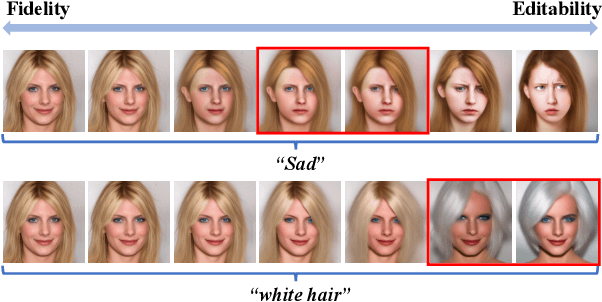

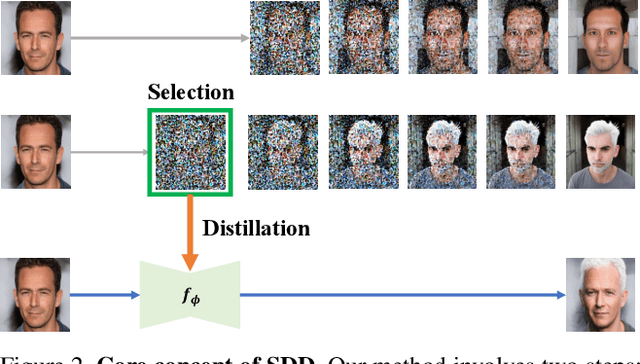

Conditional diffusion models have demonstrated impressive performance in image manipulation tasks. The general pipeline involves adding noise to the image and then denoising it. However, this method faces a trade-off problem: adding too much noise affects the fidelity of the image while adding too little affects its editability. This largely limits their practical applicability. In this paper, we propose a novel framework, Selective Diffusion Distillation (SDD), that ensures both the fidelity and editability of images. Instead of directly editing images with a diffusion model, we train a feedforward image manipulation network under the guidance of the diffusion model. Besides, we propose an effective indicator to select the semantic-related timestep to obtain the correct semantic guidance from the diffusion model. This approach successfully avoids the dilemma caused by the diffusion process. Our extensive experiments demonstrate the advantages of our framework. Code is released at https://github.com/AndysonYs/Selective-Diffusion-Distillation.
Decompose and Realign: Tackling Condition Misalignment in Text-to-Image Diffusion Models
Jun 26, 2023Text-to-image diffusion models have advanced towards more controllable generation via supporting various image conditions (e.g., depth map) beyond text. However, these models are learned based on the premise of perfect alignment between the text and image conditions. If this alignment is not satisfied, the final output could be either dominated by one condition, or ambiguity may arise, failing to meet user expectations. To address this issue, we present a training-free approach called "Decompose and Realign'' to further improve the controllability of existing models when provided with partially aligned conditions. The ``Decompose'' phase separates conditions based on pair relationships, computing scores individually for each pair. This ensures that each pair no longer has conflicting conditions. The "Realign'' phase aligns these independently calculated scores via a cross-attention mechanism to avoid new conflicts when combing them back. Both qualitative and quantitative results demonstrate the effectiveness of our approach in handling unaligned conditions, which performs favorably against recent methods and more importantly adds flexibility to the controllable image generation process.
Rethinking Rendering in Generalizable Neural Surface Reconstruction: A Learning-based Solution
May 30, 2023Generalizable neural surface reconstruction techniques have attracted great attention in recent years. However, they encounter limitations of low confidence depth distribution and inaccurate surface reasoning due to the oversimplified volume rendering process employed. In this paper, we present Reconstruction TRansformer (ReTR), a novel framework that leverages the transformer architecture to redesign the rendering process, enabling complex photon-particle interaction modeling. It introduces a learnable meta-ray token and utilizes the cross-attention mechanism to simulate the interaction of photons with sampled points and render the observed color. Meanwhile, by operating within a high-dimensional feature space rather than the color space, ReTR mitigates sensitivity to projected colors in source views. Such improvements result in accurate surface assessment with high confidence. We demonstrate the effectiveness of our approach on various datasets, showcasing how our method outperforms the current state-of-the-art approaches in terms of reconstruction quality and generalization ability.