 Add to Chrome
 Add to Firefox
 Add to Edge
Learning Versatile Humanoid Manipulation with Touch Dreaming
Apr 14, 2026
Humanoid robots promise general-purpose assistance, yet real-world humanoid loco-manipulation remains challenging because it requires whole-body stability, dexterous hands, and contact-aware perception under frequent contact changes. In this work, we study dexterous, contact-rich humanoid loco-manipulation. We first develop an RL-based whole-body controller that provides stable lower-body and torso execution during complex manipulation. Built on this controller, we develop a whole-body humanoid data collection system that combines VR-based teleoperation with human-to-humanoid motion mapping, enabling efficient collection of real-world demonstrations. We then propose Humanoid Transformer with Touch Dreaming (HTD), a multimodal encoder--decoder Transformer that models touch as a core modality alongside multi-view vision and proprioception. HTD is trained in a single stage with behavioral cloning augmented by touch dreaming: in addition to predicting action chunks, the policy predicts future hand-joint forces and future tactile latents, encouraging the shared Transformer trunk to learn contact-aware representations for dexterous interaction. Across five contact-rich tasks, Insert-T, Book Organization, Towel Folding, Cat Litter Scooping, and Tea Serving, HTD achieves a 90.9% relative improvement in average success rate over the stronger baseline. Ablation results further show that latent-space tactile prediction is more effective than raw tactile prediction, yielding a 30% relative gain in success rate. These results demonstrate that combining robust whole-body execution, scalable humanoid data collection, and predictive touch-centered learning enables versatile, high-dexterity humanoid manipulation in the real world. Project webpage: humanoid-touch-dream.github.io.

Efficient and Versatile Quadrupedal Skating: Optimal Co-design via Reinforcement Learning and Bayesian Optimization
Mar 19, 2026In this paper, we present a hardware-control co-design approach that enables efficient and versatile roller skating on quadrupedal robots equipped with passive wheels. Passive-wheel skating reduces leg inertia and improves energy efficiency, particularly at high speeds. However, the absence of direct wheel actuation tightly couples mechanical design and control. To unlock the full potential of this modality, we formulate a bilevel optimization framework: an upper-level Bayesian Optimization searches the mechanical design space, while a lower-level Reinforcement Learning trains a motor control policy for each candidate design. The resulting design-policy pairs not only outperform human-engineered baselines, but also exhibit versatile behaviors such as hockey stop (rapid braking by turning sideways to maximize friction) and self-aligning motion (automatic reorientation to improve energy efficiency in the direction of travel), offering the first system-level study of dynamic skating motion on quadrupedal robots.
A Cascading Cooperative Multi-agent Framework for On-ramp Merging Control Integrating Large Language Models
Mar 11, 2025Traditional Reinforcement Learning (RL) suffers from replicating human-like behaviors, generalizing effectively in multi-agent scenarios, and overcoming inherent interpretability issues.These tasks are compounded when deep environment understanding, agent coordination and dynamic optimization are required. While Large Language Model (LLM) enhanced methods have shown promise in generalization and interoperability, they often neglect necessary multi-agent coordination. Therefore, we introduce the Cascading Cooperative Multi-agent (CCMA) framework, integrating RL for individual interactions, a fine-tuned LLM for regional cooperation, a reward function for global optimization, and the Retrieval-augmented Generation mechanism to dynamically optimize decision-making across complex driving scenarios. Our experiments demonstrate that the CCMA outperforms existing RL methods, demonstrating significant improvements in both micro and macro-level performance in complex driving environments.
Enhanced Safety in Autonomous Driving: Integrating Latent State Diffusion Model for End-to-End Navigation
Jul 10, 2024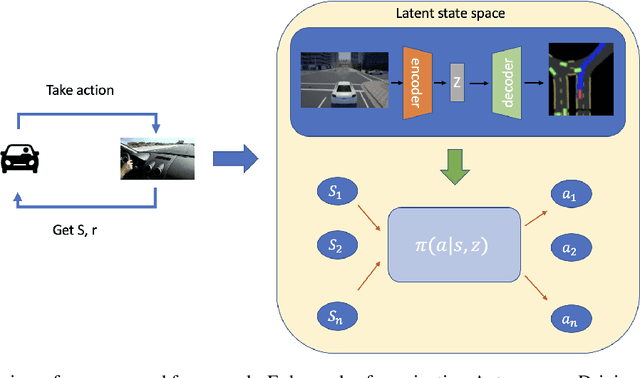
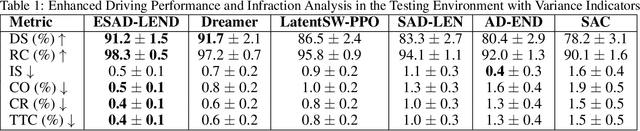
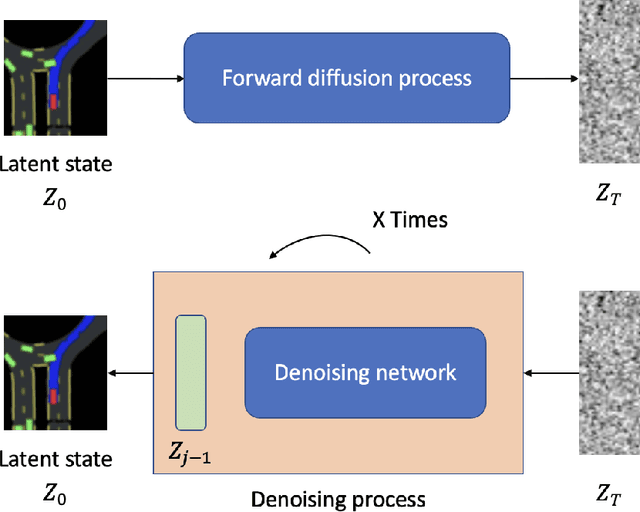
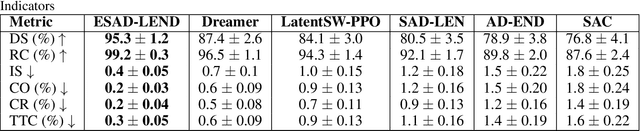
With the advancement of autonomous driving, ensuring safety during motion planning and navigation is becoming more and more important. However, most end-to-end planning methods suffer from a lack of safety. This research addresses the safety issue in the control optimization problem of autonomous driving, formulated as Constrained Markov Decision Processes (CMDPs). We propose a novel, model-based approach for policy optimization, utilizing a conditional Value-at-Risk based Soft Actor Critic to manage constraints in complex, high-dimensional state spaces effectively. Our method introduces a worst-case actor to guide safe exploration, ensuring rigorous adherence to safety requirements even in unpredictable scenarios. The policy optimization employs the Augmented Lagrangian method and leverages latent diffusion models to predict and simulate future trajectories. This dual approach not only aids in navigating environments safely but also refines the policy's performance by integrating distribution modeling to account for environmental uncertainties. Empirical evaluations conducted in both simulated and real environment demonstrate that our approach outperforms existing methods in terms of safety, efficiency, and decision-making capabilities.