 Add to Chrome
 Add to Firefox
 Add to Edge
BinaryAttention: One-Bit QK-Attention for Vision and Diffusion Transformers
Mar 10, 2026
Transformers have achieved widespread and remarkable success, while the computational complexity of their attention modules remains a major bottleneck for vision tasks. Existing methods mainly employ 8-bit or 4-bit quantization to balance efficiency and accuracy. In this paper, with theoretical justification, we indicate that binarization of attention preserves the essential similarity relationships, and propose BinaryAttention, an effective method for fast and accurate 1-bit qk-attention. Specifically, we retain only the sign of queries and keys in computing the attention, and replace the floating dot products with bit-wise operations, significantly reducing the computational cost. We mitigate the inherent information loss under 1-bit quantization by incorporating a learnable bias, and enable end-to-end acceleration. To maintain the accuracy of attention, we adopt quantization-aware training and self-distillation techniques, mitigating quantization errors while ensuring sign-aligned similarity. BinaryAttention is more than 2x faster than FlashAttention2 on A100 GPUs. Extensive experiments on vision transformer and diffusion transformer benchmarks demonstrate that BinaryAttention matches or even exceeds full-precision attention, validating its effectiveness. Our work provides a highly efficient and effective alternative to full-precision attention, pushing the frontier of low-bit vision and diffusion transformers. The codes and models can be found at https://github.com/EdwardChasel/BinaryAttention.

Pretraining A Large Language Model using Distributed GPUs: A Memory-Efficient Decentralized Paradigm
Feb 12, 2026Pretraining large language models (LLMs) typically requires centralized clusters with thousands of high-memory GPUs (e.g., H100/A100). Recent decentralized training methods reduce communication overhead by employing federated optimization; however, they still need to train the entire model on each node, remaining constrained by GPU memory limitations. In this work, we propose SParse Expert Synchronization (SPES), a memory-efficient decentralized framework for pretraining mixture-of-experts (MoE) LLMs. SPES trains only a subset of experts per node, substantially lowering the memory footprint. Each node updates its local experts and periodically synchronizes with other nodes, eliminating full-parameter transmission while ensuring efficient knowledge sharing. To accelerate convergence, we introduce an expert-merging warm-up strategy, where experts exchange knowledge early in training, to rapidly establish foundational capabilities. With SPES, we train a 2B-parameter MoE LLM using 16 standalone 48GB GPUs over internet connections, which achieves competitive performance with centrally trained LLMs under similar computational budgets. We further demonstrate scalability by training a 7B model from scratch and a 9B model upcycled from a dense checkpoint, both of which match prior centralized baselines. Our code is available at https://github.com/zjr2000/SPES.
Spatial-Mamba: Effective Visual State Space Models via Structure-Aware State Fusion
Oct 19, 2024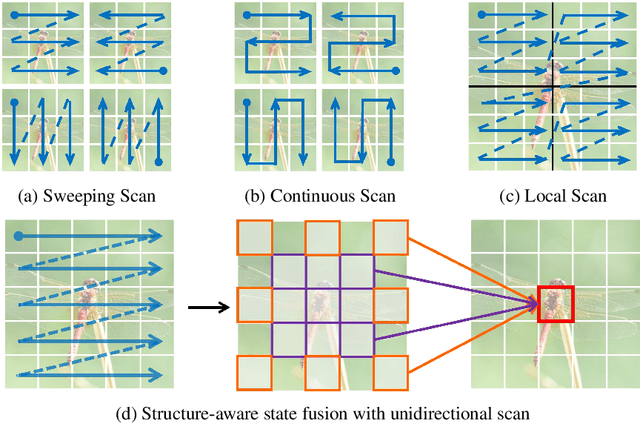
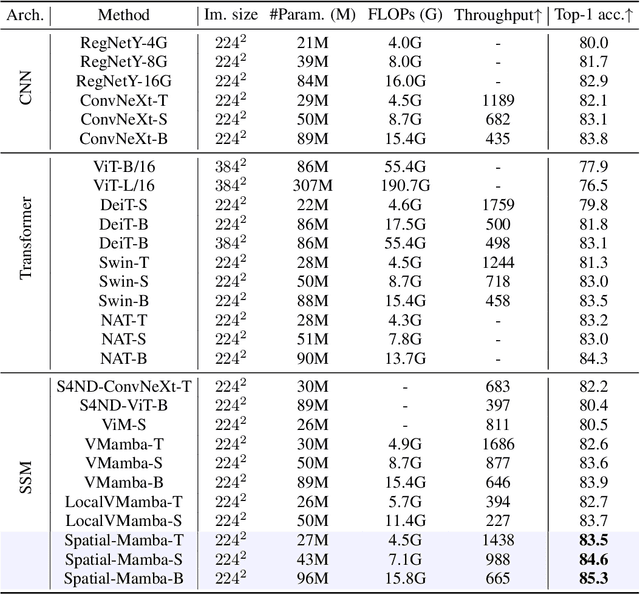
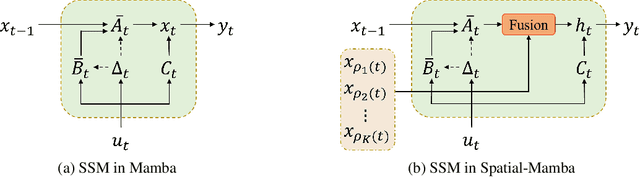
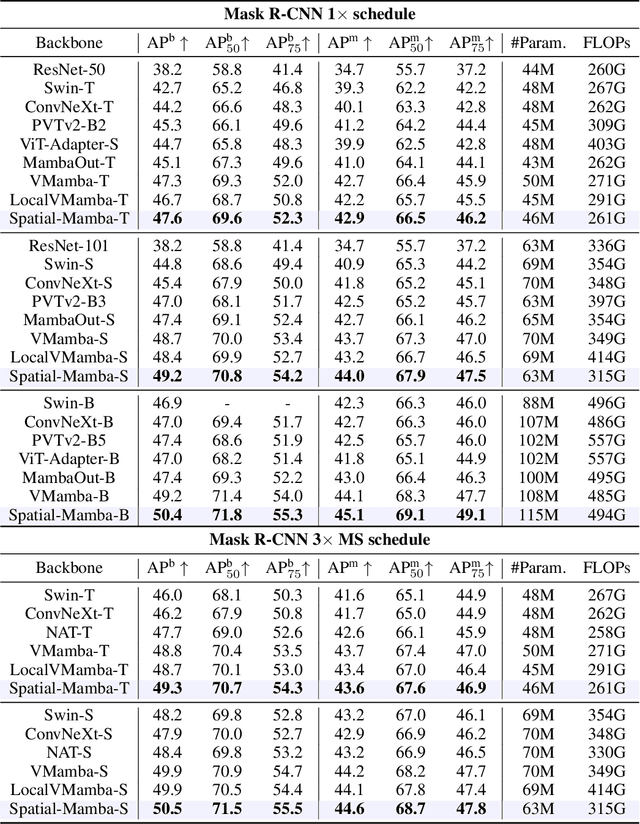
Selective state space models (SSMs), such as Mamba, highly excel at capturing long-range dependencies in 1D sequential data, while their applications to 2D vision tasks still face challenges. Current visual SSMs often convert images into 1D sequences and employ various scanning patterns to incorporate local spatial dependencies. However, these methods are limited in effectively capturing the complex image spatial structures and the increased computational cost caused by the lengthened scanning paths. To address these limitations, we propose Spatial-Mamba, a novel approach that establishes neighborhood connectivity directly in the state space. Instead of relying solely on sequential state transitions, we introduce a structure-aware state fusion equation, which leverages dilated convolutions to capture image spatial structural dependencies, significantly enhancing the flow of visual contextual information. Spatial-Mamba proceeds in three stages: initial state computation in a unidirectional scan, spatial context acquisition through structure-aware state fusion, and final state computation using the observation equation. Our theoretical analysis shows that Spatial-Mamba unifies the original Mamba and linear attention under the same matrix multiplication framework, providing a deeper understanding of our method. Experimental results demonstrate that Spatial-Mamba, even with a single scan, attains or surpasses the state-of-the-art SSM-based models in image classification, detection and segmentation. Source codes and trained models can be found at $\href{https://github.com/EdwardChasel/Spatial-Mamba}{\text{this https URL}}$.