 Add to Chrome
 Add to Firefox
 Add to Edge
Reproducing human biases in route choice using large language models: Toward scalable behavioral modeling
Jul 13, 2026
Human choice behavior, including route choice, exhibits systematic behavioral biases that deviate from the assumptions of full rationality. Cumulative prospect theory (CPT) has been widely recognized as an effective framework for characterizing such behavioral patterns. However, its large-scale application, particularly in simulation and agent-based modeling, critically depends on specifying individual-level CPT parameters, which remain a major bottleneck. Conventional approaches typically rely on surveys and controlled experiments to calibrate CPT parameters, yet these methods are difficult to generalize and often fail to capture the full diversity of human decision-making. To address this challenge, this paper investigates whether large language models (LLMs) can reproduce human behavioral biases in choice-making without explicit specification of prospect-theoretic parameters. Using route choice as a representative scenario, we design a behavioral evaluation framework and systematically compare LLM-generated decisions with established human behavioral patterns predicted by CPT. Experimental results demonstrate that LLMs are capable of reproducing non-rational human choice biases and can exhibit decision behaviors consistent with prospect-theoretic effects under uncertainty. These findings suggest that generative AI models may provide a scalable alternative for modeling human decision processes and offer a promising foundation for next-generation large-scale agent-based simulation and AI-driven behavioral research.

Locker-based Truck-Drone Routing with Integrated Considerations of Pickups, Deliveries, and No-Fly Zones
Jun 26, 2026Truck-drone delivery is an emerging last-mile logistics mode combining the long-haul capacity of trucks with the flexible service capability of drones. In locker-based operations, smart lockers serve not only as temporary parcel storage facilities but also as automated drone docking and service nodes. These automated nodes support drone takeoff, landing, parcel handover, and battery replacement, thereby significantly extending the service range and operational flexibility of drone-assisted delivery networks. However, practical locker-based delivery systems face complex real-world challenges, requiring the integrated coordination of not only parcel delivery, return pickup, battery-constrained and load-dependent drone flights, but also necessary detours around restricted airspace. To address this practical and multifaceted challenge, this paper introduces a locker-based truck-drone routing problem with integrated considerations of pickups, deliveries, and no-fly zones (LTDRP-PDNF), with the objective of minimizing the total operational cost of a fleet of drone-equipped trucks. We formulate the route construction process as a Markov Decision Process and develop a two-stage deep reinforcement learning-based neural heuristic. The first stage utilizes an attention-based encoder and a Bidirectional Gated Recurrent Unit decoder to solve the truck-only routing problem, formulated as a capacitated vehicle routing problem. The second stage combines a policy-transfer strategy with a hybrid dispatch assignment heuristic to construct fully coordinated truck and drone routes for LTDRP-PDNF. Experiments on instances of different scales demonstrate that the proposed method outperforms metaheuristic and neural heuristic baselines in most cases while maintaining exceptionally short computation times, offering an effective, scalable solution framework under practical operational constraints.
Transforming Policy-Car Swerving for Mitigating Stop-and-Go Traffic Waves: A Practice-Oriented Jam-Absorption Driving Strategy
Feb 12, 2026Stop-and-go waves, as a major form of freeway traffic congestion, cause severe and long-lasting adverse effects, including reduced traffic efficiency, increased driving risks, and higher vehicle emissions. Amongst the highway traffic management strategies, jam-absorption driving (JAD), in which a dedicated vehicle performs "slow-in" and "fast-out" maneuvers before being captured by a stop-and-go wave, has been proposed as a potential method for preventing the propagation of such waves. However, most existing JAD strategies remain impractical mainly due to the lack of discussion regarding implementation vehicles and operational conditions. Inspired by real-world observations of police-car swerving behavior, this paper first introduces a Single-Vehicle Two-Detector Jam-Absorption Driving (SVDD-JAD) problem, and then proposes a practical JAD strategy that transforms such behavior into a maneuver capable of suppressing the propagation of an isolated stop-and-go wave. Five key parameters that significantly affect the proposed strategy, namely, JAD speed, inflow traffic speed, wave width, wave speed, and in-wave speed, are identified and systematically analyzed. Using a SUMO-based simulation as an illustrative example, we further demonstrate how these parameters can be measured in practice with two stationary roadside traffic detectors. The results show that the proposed JAD strategy successfully suppresses the propagation of a stop-and-go wave, without triggering a secondary wave. This paper is expected to take a significant step toward making JAD practical, advancing it from a theoretical concept to a feasible and implementable strategy. To promote reproducibility in the transportation domain, we have also open-sourced all the code on our GitHub repository https://github.com/gotrafficgo.
Probability-Aware Parking Selection
Jan 02, 2026Current parking navigation systems often underestimate total travel time by failing to account for the time spent searching for a parking space, which significantly affects user experience, mode choice, congestion, and emissions. To address this issue, this paper introduces the probability-aware parking selection problem, which aims to direct drivers to the best parking location rather than straight to their destination. An adaptable dynamic programming framework is proposed for decision-making based on probabilistic information about parking availability at the parking lot level. Closed-form analysis determines when it is optimal to target a specific parking lot or explore alternatives, as well as the expected time cost. Sensitivity analysis and three illustrative cases are examined, demonstrating the model's ability to account for the dynamic nature of parking availability. Acknowledging the financial costs of permanent sensing infrastructure, the paper provides analytical and empirical assessments of errors incurred when leveraging stochastic observations to estimate parking availability. Experiments with real-world data from the US city of Seattle indicate this approach's viability, with mean absolute error decreasing from 7% to below 2% as observation frequency grows. In data-based simulations, probability-aware strategies demonstrate time savings up to 66% relative to probability-unaware baselines, yet still take up to 123% longer than direct-to-destination estimates.
ROAR: Robust Accident Recognition and Anticipation for Autonomous Driving
Nov 09, 2025
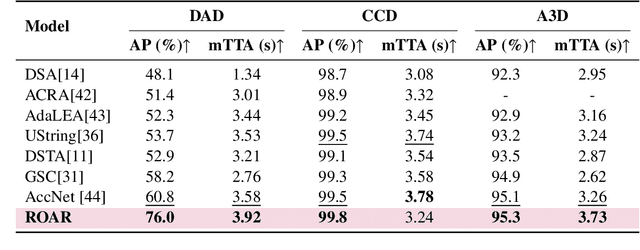
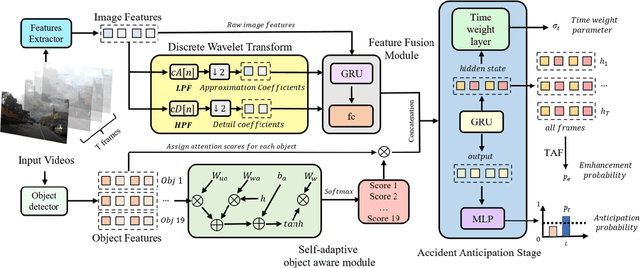
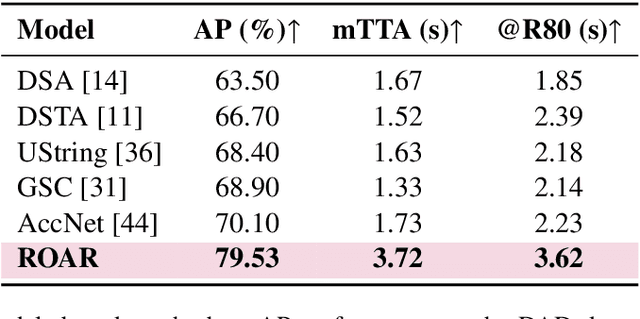
Accurate accident anticipation is essential for enhancing the safety of autonomous vehicles (AVs). However, existing methods often assume ideal conditions, overlooking challenges such as sensor failures, environmental disturbances, and data imperfections, which can significantly degrade prediction accuracy. Additionally, previous models have not adequately addressed the considerable variability in driver behavior and accident rates across different vehicle types. To overcome these limitations, this study introduces ROAR, a novel approach for accident detection and prediction. ROAR combines Discrete Wavelet Transform (DWT), a self adaptive object aware module, and dynamic focal loss to tackle these challenges. The DWT effectively extracts features from noisy and incomplete data, while the object aware module improves accident prediction by focusing on high-risk vehicles and modeling the spatial temporal relationships among traffic agents. Moreover, dynamic focal loss mitigates the impact of class imbalance between positive and negative samples. Evaluated on three widely used datasets, Dashcam Accident Dataset (DAD), Car Crash Dataset (CCD), and AnAn Accident Detection (A3D), our model consistently outperforms existing baselines in key metrics such as Average Precision (AP) and mean Time to Accident (mTTA). These results demonstrate the model's robustness in real-world conditions, particularly in handling sensor degradation, environmental noise, and imbalanced data distributions. This work offers a promising solution for reliable and accurate accident anticipation in complex traffic environments.
When Context Is Not Enough: Modeling Unexplained Variability in Car-Following Behavior
Jul 09, 2025Modeling car-following behavior is fundamental to microscopic traffic simulation, yet traditional deterministic models often fail to capture the full extent of variability and unpredictability in human driving. While many modern approaches incorporate context-aware inputs (e.g., spacing, speed, relative speed), they frequently overlook structured stochasticity that arises from latent driver intentions, perception errors, and memory effects -- factors that are not directly observable from context alone. To fill the gap, this study introduces an interpretable stochastic modeling framework that captures not only context-dependent dynamics but also residual variability beyond what context can explain. Leveraging deep neural networks integrated with nonstationary Gaussian processes (GPs), our model employs a scenario-adaptive Gibbs kernel to learn dynamic temporal correlations in acceleration decisions, where the strength and duration of correlations between acceleration decisions evolve with the driving context. This formulation enables a principled, data-driven quantification of uncertainty in acceleration, speed, and spacing, grounded in both observable context and latent behavioral variability. Comprehensive experiments on the naturalistic vehicle trajectory dataset collected from the German highway, i.e., the HighD dataset, demonstrate that the proposed stochastic simulation method within this framework surpasses conventional methods in both predictive performance and interpretable uncertainty quantification. The integration of interpretability and accuracy makes this framework a promising tool for traffic analysis and safety-critical applications.
A Survey on Data-Driven Modeling of Human Drivers' Lane-Changing Decisions
May 10, 2025Lane-changing (LC) behavior, a critical yet complex driving maneuver, significantly influences driving safety and traffic dynamics. Traditional analytical LC decision (LCD) models, while effective in specific environments, often oversimplify behavioral heterogeneity and complex interactions, limiting their capacity to capture real LCD. Data-driven approaches address these gaps by leveraging rich empirical data and machine learning to decode latent decision-making patterns, enabling adaptive LCD modeling in dynamic environments. In light of the rapid development of artificial intelligence and the demand for data-driven models oriented towards connected vehicles and autonomous vehicles, this paper presents a comprehensive survey of data-driven LCD models, with a particular focus on human drivers LC decision-making. It systematically reviews the modeling framework, covering data sources and preprocessing, model inputs and outputs, objectives, structures, and validation methods. This survey further discusses the opportunities and challenges faced by data-driven LCD models, including driving safety, uncertainty, as well as the integration and improvement of technical frameworks.
MM-STFlowNet: A Transportation Hub-Oriented Multi-Mode Passenger Flow Prediction Method via Spatial-Temporal Dynamic Graph Modeling
Apr 08, 2025Accurate and refined passenger flow prediction is essential for optimizing the collaborative management of multiple collection and distribution modes in large-scale transportation hubs. Traditional methods often focus only on the overall passenger volume, neglecting the interdependence between different modes within the hub. To address this limitation, we propose MM-STFlowNet, a comprehensive multi-mode prediction framework grounded in dynamic spatial-temporal graph modeling. Initially, an integrated temporal feature processing strategy is implemented using signal decomposition and convolution techniques to address data spikes and high volatility. Subsequently, we introduce the Spatial-Temporal Dynamic Graph Convolutional Recurrent Network (STDGCRN) to capture detailed spatial-temporal dependencies across multiple traffic modes, enhanced by an adaptive channel attention mechanism. Finally, the self-attention mechanism is applied to incorporate various external factors, further enhancing prediction accuracy. Experiments on a real-world dataset from Guangzhounan Railway Station in China demonstrate that MM-STFlowNet achieves state-of-the-art performance, particularly during peak periods, providing valuable insight for transportation hub management.
Estimating City-wide operating mode Distribution of Light-Duty Vehicles: A Neural Network-based Approach
Mar 28, 2025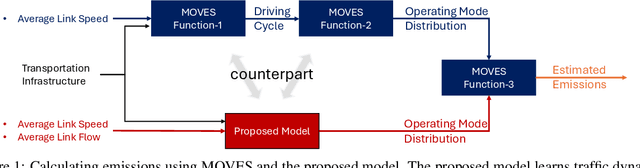
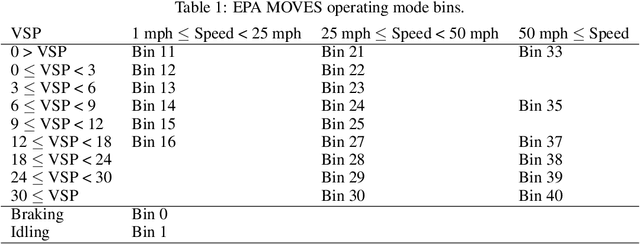
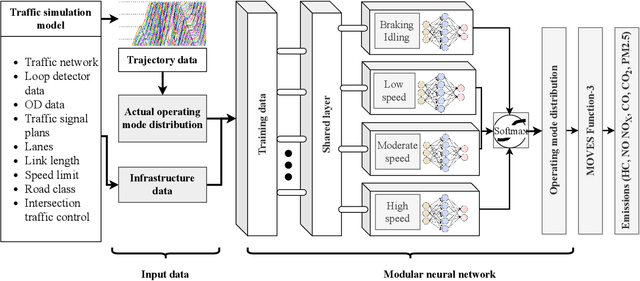

Driving cycles are a set of driving conditions and are crucial for the existing emission estimation model to evaluate vehicle performance, fuel efficiency, and emissions, by matching them with average speed to calculate the operating modes, such as braking, idling, and cruising. While existing emission estimation models, such as the Motor Vehicle Emission Simulator (MOVES), are powerful tools, their reliance on predefined driving cycles can be limiting, as these cycles often do not accurately represent regional driving conditions, making the models less effective for city-wide analyses. To solve this problem, this paper proposes a modular neural network (NN)-based framework to estimate operating mode distributions bypassing the driving cycle development phase, utilizing macroscopic variables such as speed, flow, and link infrastructure attributes. The proposed method is validated using a well-calibrated microsimulation model of Brookline MA, the United States. The results indicate that the proposed framework outperforms the operating mode distribution calculated by MOVES based on default driving cycles, providing a closer match to the actual operating mode distribution derived from trajectory data. Specifically, the proposed model achieves an average RMSE of 0.04 in predicting operating mode distribution, compared to 0.08 for MOVES. The average error in emission estimation across pollutants is 8.57% for the proposed method, lower than the 32.86% error for MOVES. In particular, for the estimation of CO2, the proposed method has an error of just 4%, compared to 35% for MOVES. The proposed model can be utilized for real-time emissions monitoring by providing rapid and accurate emissions estimates with easily accessible inputs.
CoT-Drive: Efficient Motion Forecasting for Autonomous Driving with LLMs and Chain-of-Thought Prompting
Mar 10, 2025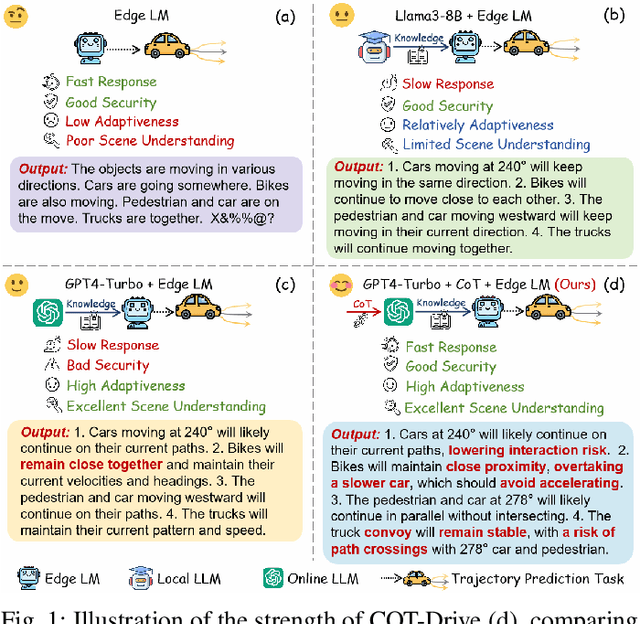
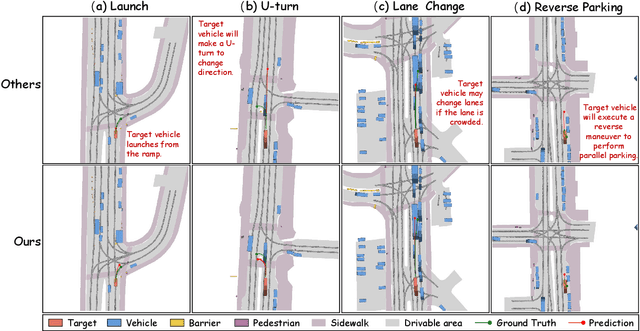
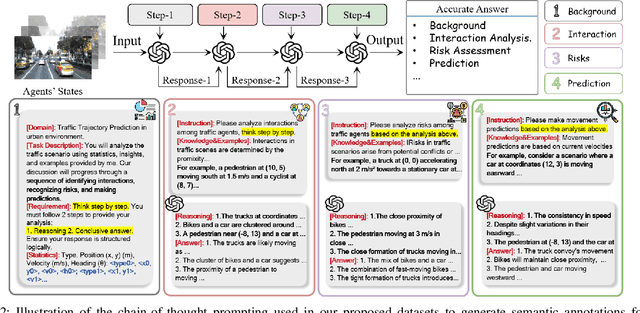
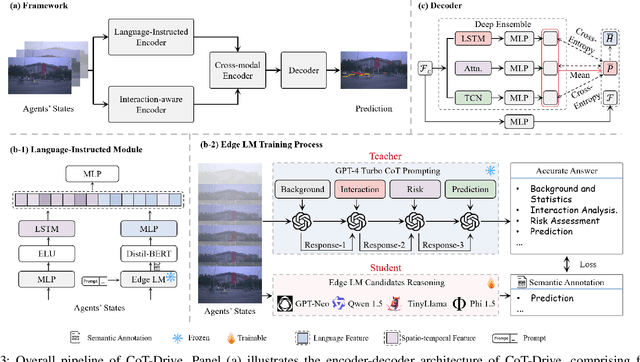
Accurate motion forecasting is crucial for safe autonomous driving (AD). This study proposes CoT-Drive, a novel approach that enhances motion forecasting by leveraging large language models (LLMs) and a chain-of-thought (CoT) prompting method. We introduce a teacher-student knowledge distillation strategy to effectively transfer LLMs' advanced scene understanding capabilities to lightweight language models (LMs), ensuring that CoT-Drive operates in real-time on edge devices while maintaining comprehensive scene understanding and generalization capabilities. By leveraging CoT prompting techniques for LLMs without additional training, CoT-Drive generates semantic annotations that significantly improve the understanding of complex traffic environments, thereby boosting the accuracy and robustness of predictions. Additionally, we present two new scene description datasets, Highway-Text and Urban-Text, designed for fine-tuning lightweight LMs to generate context-specific semantic annotations. Comprehensive evaluations of five real-world datasets demonstrate that CoT-Drive outperforms existing models, highlighting its effectiveness and efficiency in handling complex traffic scenarios. Overall, this study is the first to consider the practical application of LLMs in this field. It pioneers the training and use of a lightweight LLM surrogate for motion forecasting, setting a new benchmark and showcasing the potential of integrating LLMs into AD systems.