 Add to Chrome
 Add to Firefox
 Add to Edge
Chemical Chain-of-Thought Functions as a Hallucination-Prone Molecular Scratchpad
Jul 23, 2026
Chemical reasoning language models are expected to derive molecular answers through faithful chain-of-thought (CoT). However, across four reasoning model families and twelve chemistry tasks, hallucination is widespread and largely decoupled from answer correctness: correct answers often coexist with fabricated structural claims absent from the relevant molecules. Yet this does not make the reasoning trace computationally irrelevant. Attribution analyses suggest a shared scratchpad function expressed in model-specific forms: Chem-R and ether-0 rely on fragmented SMILES drafts, whereas ChemDFM-R emphasizes scaffold, positional, and naming cues. Notably, perturbing Chem-R's SMILES sketches degrades generation, showing that structural drafts can be causally load-bearing even when verbal structural claims are largely inert. Together, these results show that chemical CoT is neither a faithful explanation nor merely a post-hoc rationalization, but a hallucination-prone molecular scratchpad. This finding cautions against treating CoT as direct evidence of faithful reasoning and motivates process-level supervision beyond answer-only evaluation.

SinAE: A Single-Architecture Flow-Matching Autoencoder for Cross-Domain Atomic Systems
Jul 14, 2026Small molecules, crystals, and proteins all reduce to atoms in 3D space, yet their generative pipelines remain fragmented across domains, each with its Small molecules, crystals, and proteins all reduce to atoms in 3D space, yet their generative pipelines remain fragmented across domains, each with its own graph, equivariant, or frame-based architecture. Cross-domain training would mitigate per-domain data scarcity, but direct generation in 3D coordinate space cannot easily handle the heterogeneous structural priors of all three domains, and no prior latent autoencoder is simultaneously lossless and architecturally general across all three. We introduce SinAE, a single-architecture flow-matching autoencoder for molecules, crystals, and proteins, with vanilla Transformer encoder and decoder and no equivariant, graph, or domain-specific operators. Rather than requiring the encoder to capture fine-grained geometry, SinAE shifts the reconstruction burden into an iterative flow-matching decoder, achieving near-lossless reconstruction across domains and reducing reconstruction errors by orders of magnitude relative to prior latent baselines. The same per-token latent supports a standard Diffusion Transformer prior that reaches strong performance on molecular, crystal, and protein generation benchmarks. Joint molecule--crystal training strictly improves both domains, providing direct evidence of cross-domain transfer through a shared atomic latent. Code is available at https://github.com/BlueWhaleLab/SinAE .
MolViBench: Evaluating LLMs on Molecular Vibe Coding
May 05, 2026Molecular Vibe Coding, a paradigm where chemists interact with LLMs to generate executable programs for molecular tasks, has emerged as a flexible alternative to chemical agents with predefined tools, enabling chemists to express arbitrarily complex, customized workflows. Unlike general coding tasks, molecular coding imposes a distinctive challenge that LLMs should jointly equip programming, molecular understanding, and domain-specific reasoning capabilities. However, existing benchmarks remain disconnected. General code generation benchmarks such as HumanEval and SWE-bench require no chemistry knowledge, while chemistry-focused benchmarks such as S^2-Bench and ChemCoTBench evaluate knowledge recall or property prediction rather than executable code generation. To bridge this gap, we introduce MolViBench, the first benchmark tailored for Molecular Vibe Coding. MolViBench comprises 358 curated tasks across five cognitive levels, ranging from single-API recall to end-to-end virtual screening pipeline design, spanning 12 real-world drug discovery workflows. To rigorously assess generated code, we also propose a multi-layered evaluation framework that combines type-aware output comparison and AST-based API-semantic fallback analysis, which jointly measures executability and chemical correctness. We systematically evaluate 9 frontier coding LLMs and compare three real-world Molecular Vibe Coding paradigms, providing a practical and fine-grained testbed for diagnosing LLMs' coding capabilities in AI-accelerated molecular discovery.
Kempe Swap K-Means: A Scalable Near-Optimal Solution for Semi-Supervised Clustering
Mar 28, 2026This paper presents a novel centroid-based heuristic algorithm, termed Kempe Swap K-Means, for constrained clustering under rigid must-link (ML) and cannot-link (CL) constraints. The algorithm employs a dual-phase iterative process: an assignment step that utilizes Kempe chain swaps to refine current clustering in the constrained solution space and a centroid update step that computes optimal cluster centroids. To enhance global search capabilities and avoid local optima, the framework incorporates controlled perturbations during the update phase. Empirical evaluations demonstrate that the proposed method achieves near-optimal partitions while maintaining high computational efficiency and scalability. The results indicate that Kempe Swap K-Means consistently outperforms state-of-the-art benchmarks in both clustering accuracy and algorithmic efficiency for large-scale datasets.
EPO: Diverse and Realistic Protein Ensemble Generation via Energy Preference Optimization
Nov 13, 2025Accurate exploration of protein conformational ensembles is essential for uncovering function but remains hard because molecular-dynamics (MD) simulations suffer from high computational costs and energy-barrier trapping. This paper presents Energy Preference Optimization (EPO), an online refinement algorithm that turns a pretrained protein ensemble generator into an energy-aware sampler without extra MD trajectories. Specifically, EPO leverages stochastic differential equation sampling to explore the conformational landscape and incorporates a novel energy-ranking mechanism based on list-wise preference optimization. Crucially, EPO introduces a practical upper bound to efficiently approximate the intractable probability of long sampling trajectories in continuous-time generative models, making it easily adaptable to existing pretrained generators. On Tetrapeptides, ATLAS, and Fast-Folding benchmarks, EPO successfully generates diverse and physically realistic ensembles, establishing a new state-of-the-art in nine evaluation metrics. These results demonstrate that energy-only preference signals can efficiently steer generative models toward thermodynamically consistent conformational ensembles, providing an alternative to long MD simulations and widening the applicability of learned potentials in structural biology and drug discovery.
Physical Consistency Bridges Heterogeneous Data in Molecular Multi-Task Learning
Oct 14, 2024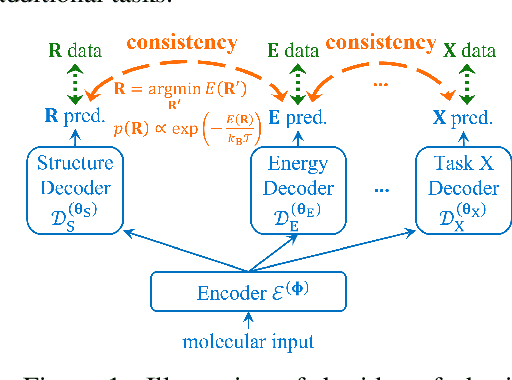
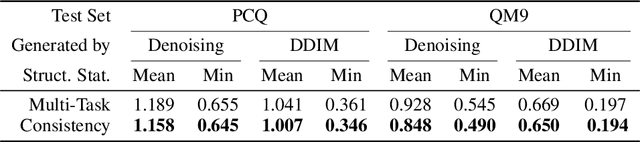
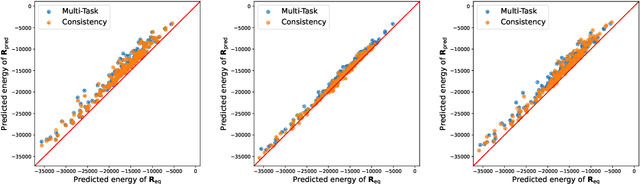

In recent years, machine learning has demonstrated impressive capability in handling molecular science tasks. To support various molecular properties at scale, machine learning models are trained in the multi-task learning paradigm. Nevertheless, data of different molecular properties are often not aligned: some quantities, e.g. equilibrium structure, demand more cost to compute than others, e.g. energy, so their data are often generated by cheaper computational methods at the cost of lower accuracy, which cannot be directly overcome through multi-task learning. Moreover, it is not straightforward to leverage abundant data of other tasks to benefit a particular task. To handle such data heterogeneity challenges, we exploit the specialty of molecular tasks that there are physical laws connecting them, and design consistency training approaches that allow different tasks to exchange information directly so as to improve one another. Particularly, we demonstrate that the more accurate energy data can improve the accuracy of structure prediction. We also find that consistency training can directly leverage force and off-equilibrium structure data to improve structure prediction, demonstrating a broad capability for integrating heterogeneous data.
Neural P$^3$M: A Long-Range Interaction Modeling Enhancer for Geometric GNNs
Sep 26, 2024

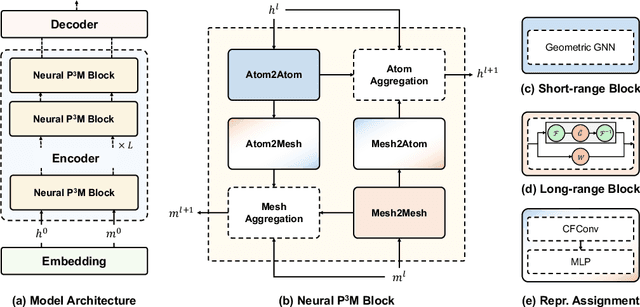

Geometric graph neural networks (GNNs) have emerged as powerful tools for modeling molecular geometry. However, they encounter limitations in effectively capturing long-range interactions in large molecular systems. To address this challenge, we introduce Neural P$^3$M, a versatile enhancer of geometric GNNs to expand the scope of their capabilities by incorporating mesh points alongside atoms and reimaging traditional mathematical operations in a trainable manner. Neural P$^3$M exhibits flexibility across a wide range of molecular systems and demonstrates remarkable accuracy in predicting energies and forces, outperforming on benchmarks such as the MD22 dataset. It also achieves an average improvement of 22% on the OE62 dataset while integrating with various architectures.
QCQP-Net: Reliably Learning Feasible Alternating Current Optimal Power Flow Solutions Under Constraints
Jan 11, 2024
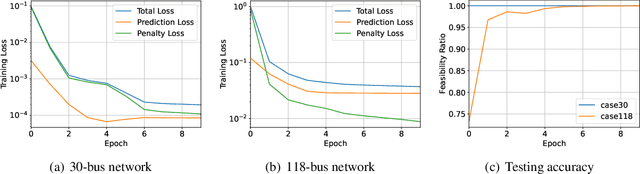
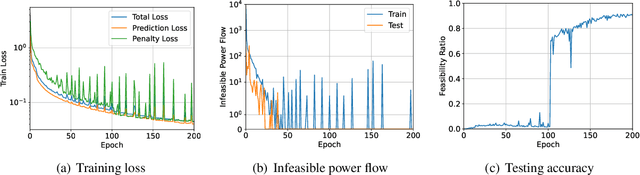
At the heart of power system operations, alternating current optimal power flow (ACOPF) studies the generation of electric power in the most economical way under network-wide load requirement, and can be formulated as a highly structured non-convex quadratically constrained quadratic program (QCQP). Optimization-based solutions to ACOPF (such as ADMM or interior-point method), as the classic approach, require large amount of computation and cannot meet the need to repeatedly solve the problem as load requirement frequently changes. On the other hand, learning-based methods that directly predict the ACOPF solution given the load input incur little computational cost but often generates infeasible solutions (i.e. violate the constraints of ACOPF). In this work, we combine the best of both worlds -- we propose an innovated framework for learning ACOPF, where the input load is mapped to the ACOPF solution through a neural network in a computationally efficient and reliable manner. Key to our innovation is a specific-purpose "activation function" defined implicitly by a QCQP and a novel loss, which enforce constraint satisfaction. We show through numerical simulations that our proposed method achieves superior feasibility rate and generation cost in situations where the existing learning-based approaches fail.