 Add to Chrome
 Add to Firefox
 Add to Edge
Beyond Inter-Item Relations: Dynamic Adaptive Mixture-of-Experts for LLM-Based Sequential Recommendation
Aug 14, 2024
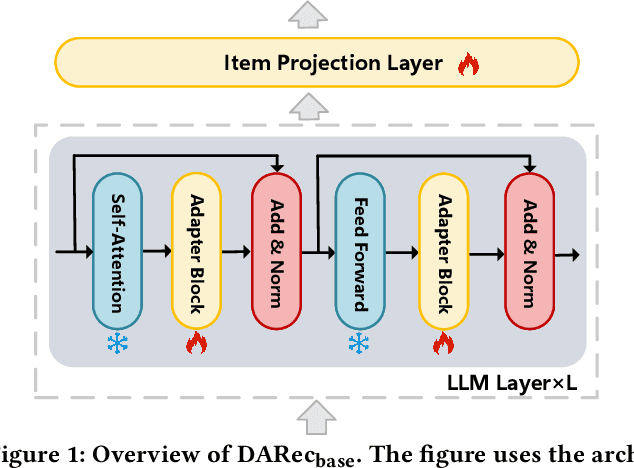
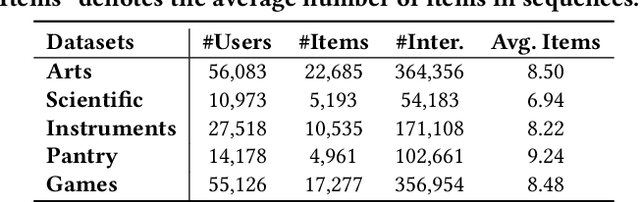
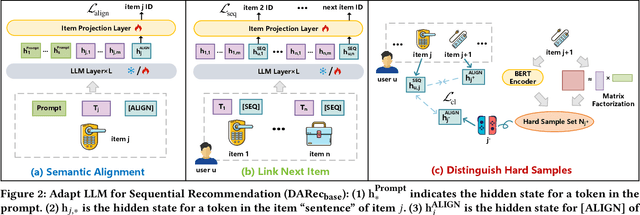
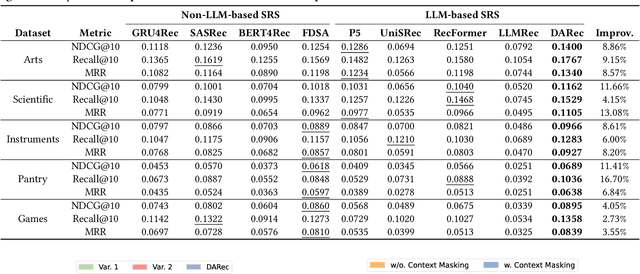
Sequential recommender system (SRS) predicts the next items that users may prefer based on user historical interaction sequences. Inspired by the rise of large language models (LLMs) in various AI applications, there is a surge of work on LLM-based SRS. Despite their attractive performance, existing LLM-based SRS still exhibit some limitations, including neglecting intra-item relations, ignoring long-term collaborative knowledge and using inflexible architecture designs for adaption. To alleviate these issues, we propose an LLM-based SRS named MixRec. Built on top of coarse-grained adaption for capturing inter-item relations, MixRec is further enhanced with (1) context masking that models intra-item relations to help LLM better understand token and item semantics in the context of SRS, (2) collaborative knowledge injection that helps LLM incorporate long-term collaborative knowledge, and (3) a dynamic adaptive mixture-of-experts design that can flexibly choose expert architectures based on Bayesian optimization to better incorporate different sequential information. Extensive experiments demonstrate that MixRec can effectively handle sequential recommendation in a dynamic and adaptive manner.

The Llama 3 Herd of Models
Jul 31, 2024Modern artificial intelligence (AI) systems are powered by foundation models. This paper presents a new set of foundation models, called Llama 3. It is a herd of language models that natively support multilinguality, coding, reasoning, and tool usage. Our largest model is a dense Transformer with 405B parameters and a context window of up to 128K tokens. This paper presents an extensive empirical evaluation of Llama 3. We find that Llama 3 delivers comparable quality to leading language models such as GPT-4 on a plethora of tasks. We publicly release Llama 3, including pre-trained and post-trained versions of the 405B parameter language model and our Llama Guard 3 model for input and output safety. The paper also presents the results of experiments in which we integrate image, video, and speech capabilities into Llama 3 via a compositional approach. We observe this approach performs competitively with the state-of-the-art on image, video, and speech recognition tasks. The resulting models are not yet being broadly released as they are still under development.
Ontology of Belief Diversity: A Community-Based Epistemological Approach
Jul 25, 2024AI applications across classification, fairness, and human interaction often implicitly require ontologies of social concepts. Constructing these well, especially when there are many relevant categories, is a controversial task but is crucial for achieving meaningful inclusivity. Here, we focus on developing a pragmatic ontology of belief systems, which is a complex and often controversial space. By iterating on our community-based design until mutual agreement is reached, we found that epistemological methods were best for categorizing the fundamental ways beliefs differ, maximally respecting our principles of inclusivity and brevity. We demonstrate our methodology's utility and interpretability via user studies in term annotation and sentiment analysis experiments for belief fairness in language models.
SeamPose: Repurposing Seams as Capacitive Sensors in a Shirt for Upper-Body Pose Tracking
Jun 17, 2024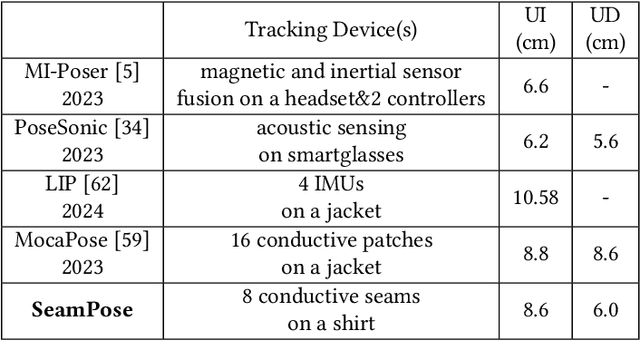
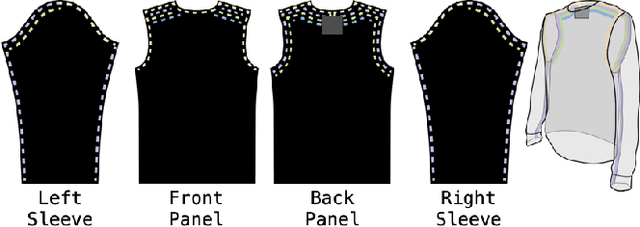
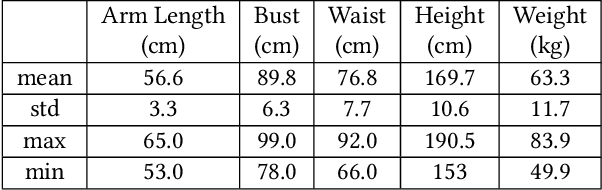
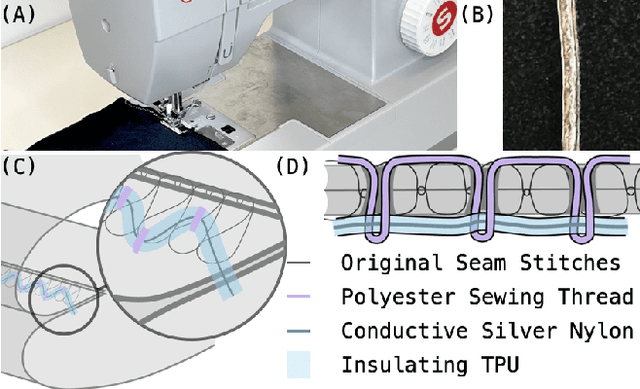
Seams are areas of overlapping fabric formed by stitching two or more pieces of fabric together in the cut-and-sew apparel manufacturing process. In SeamPose, we repurposed seams as capacitive sensors in a shirt for continuous upper-body pose estimation. Compared to previous all-textile motion-capturing garments that place the electrodes on the surface of clothing, our solution leverages existing seams inside of a shirt by machine-sewing insulated conductive threads over the seams. The unique invisibilities and placements of the seams afford the sensing shirt to look and wear the same as a conventional shirt while providing exciting pose-tracking capabilities. To validate this approach, we implemented a proof-of-concept untethered shirt. With eight capacitive sensing seams, our customized deep-learning pipeline accurately estimates the upper-body 3D joint positions relative to the pelvis. With a 12-participant user study, we demonstrated promising cross-user and cross-session tracking performance. SeamPose represents a step towards unobtrusive integration of smart clothing for everyday pose estimation.
Plug-in UL-CSI-Assisted Precoder Upsampling Approach in Cellular FDD Systems
May 31, 2024Acquiring downlink channel state information (CSI) is crucial for optimizing performance in massive Multiple Input Multiple Output (MIMO) systems operating under Frequency-Division Duplexing (FDD). Most cellular wireless communication systems employ codebook-based precoder designs, which offer advantages such as simpler, more efficient feedback mechanisms and reduced feedback overhead. Common codebook-based approaches include Type II and eType II precoding methods defined in the 3GPP standards. Feedback in these systems is typically standardized per subband (SB), allowing user equipment (UE) to select the optimal precoder from the codebook for each SB, thereby reducing feedback overhead. However, this subband-level feedback resolution may not suffice for frequency-selective channels. This paper addresses this issue by introducing an uplink CSI-assisted precoder upsampling module deployed at the gNodeB. This module upsamples SB-level precoders to resource block (RB)-level precoders, acting as a plug-in compatible with existing gNodeB or base stations.
Parameter-Efficient Fine-Tuning for Large Models: A Comprehensive Survey
Mar 21, 2024


Large models represent a groundbreaking advancement in multiple application fields, enabling remarkable achievements across various tasks. However, their unprecedented scale comes with significant computational costs. These models, often consisting of billions of parameters, require vast amounts of computational resources for execution. Especially, the expansive scale and computational demands pose considerable challenges when customizing them for particular downstream tasks, particularly over the hardware platforms constrained by computational capabilities. Parameter Efficient Fine-Tuning (PEFT) provides a practical solution by efficiently adapt the large models over the various downstream tasks. In particular, PEFT refers to the process of adjusting the parameters of a pre-trained large models to adapt it to a specific task while minimizing the number of additional parameters introduced or computational resources required. This approach is particularly important when dealing with large language models with high parameter counts, as fine-tuning these models from scratch can be computationally expensive and resource-intensive, posing considerable challenges in the supporting system platform design. In this survey, we present comprehensive studies of various PEFT algorithms, examining their performance and computational overhead. Moreover, we provide an overview of applications developed using different PEFT algorithms and discuss common techniques employed to mitigate computation costs for PEFT. In addition to the algorithmic perspective, we overview various real-world system designs to investigate the implementation costs associated with different PEFT algorithms. This survey serves as an indispensable resource for researchers aiming to understand both the PEFT algorithm and its system implementation, offering detailed insights into recent advancements and practical applications.
Physics-Inspired Deep Learning Anti-Aliasing Framework in Efficient Channel State Feedback
Mar 12, 2024Acquiring downlink channel state information (CSI) at the base station is vital for optimizing performance in massive Multiple input multiple output (MIMO) Frequency-Division Duplexing (FDD) systems. While deep learning architectures have been successful in facilitating UE-side CSI feedback and gNB-side recovery, the undersampling issue prior to CSI feedback is often overlooked. This issue, which arises from low density pilot placement in current standards, results in significant aliasing effects in outdoor channels and consequently limits CSI recovery performance. To this end, this work introduces a new CSI upsampling framework at the gNB as a post-processing solution to address the gaps caused by undersampling. Leveraging the physical principles of discrete Fourier transform shifting theorem and multipath reciprocity, our framework effectively uses uplink CSI to mitigate aliasing effects. We further develop a learning-based method that integrates the proposed algorithm with the Iterative Shrinkage-Thresholding Algorithm Net (ISTA-Net) architecture, enhancing our approach for non-uniform sampling recovery. Our numerical results show that both our rule-based and deep learning methods significantly outperform traditional interpolation techniques and current state-of-the-art approaches in terms of performance.
3D Beamforming Through Joint Phase-Time Arrays
Jan 01, 2024High-frequency wide-bandwidth cellular communications over mmW and sub-THz offer the opportunity for high data rates, however, it also presents high pathloss, resulting in limited coverage. To mitigate the coverage limitations, high-gain beamforming is essential. Implementation of beamforming involves a large number of antennas, which introduces analog beam constraint, i.e., only one frequency-flat beam is generated per transceiver chain (TRx). Recently introduced joint phase-time array (JPTA) architecture, which utilizes both true time delay (TTD) units and phase shifters (PSs), alleviates analog beam constraint by creating multiple frequency-dependent beams per TRx, for scheduling multiple users at different directions in a frequency-division manner. One class of previous studies offered solutions with "rainbow" beams, which tend to allocate a small bandwidth per beam direction. Another class focused on uniform linear array (ULA) antenna architecture, whose frequency-dependent beams were designed along a single axis of either azimuth or elevation direction. In this paper, we present a novel 3D beamforming codebook design aimed at maximizing beamforming gain to steer radiation toward desired azimuth and elevation directions, as well as across sub-bands partitioned according to scheduled users' bandwidth requirements. We provide both analytical solutions and iterative algorithms to design the PSs and TTD units for a desired subband beam pattern. Through simulations of the beamforming gain, we observe that our proposed solutions outperform the state-of-the-art solutions reported elsewhere.
Joint Phase-Time Arrays: A Paradigm for Frequency-Dependent Analog Beamforming in 6G
Dec 18, 2023Hybrid beamforming is an attractive solution to build cost-effective and energy-efficient transceivers for millimeter-wave and terahertz systems. However, conventional hybrid beamforming techniques rely on analog components that generate a frequency flat response such as phase-shifters and switches, which limits the flexibility of the achievable beam patterns. As a novel alternative, this paper proposes a new class of hybrid beamforming called Joint phase-time arrays (JPTA), that additionally use true-time delay elements in the analog beamforming to create frequency-dependent analog beams. Using as an example two important frequency-dependent beam behaviors, the numerous benefits of such flexibility are exemplified. Subsequently, the JPTA beamformer design problem to generate any desired beam behavior is formulated and near-optimal algorithms to the problem are proposed. Simulations show that the proposed algorithms can outperform heuristics solutions for JPTA beamformer update. Furthermore, it is shown that JPTA can achieve the two exemplified beam behaviors with one radio-frequency chain, while conventional hybrid beamforming requires the radio-frequency chains to scale with the number of antennas to achieve similar performance. Finally, a wide range of problems to further tap into the potential of JPTA are also listed as future directions.
* The paper is a revised version of the IEEE Access paper, that includes the full operation of Algorithms 1-3 to help curtail incorrect implementations
Hardness of Low Rank Approximation of Entrywise Transformed Matrix Products
Nov 03, 2023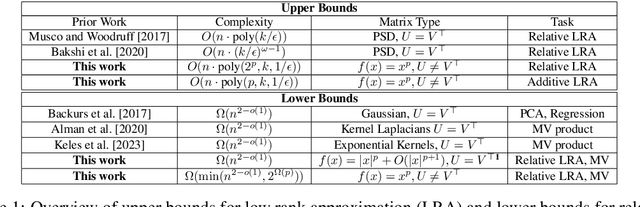
Inspired by fast algorithms in natural language processing, we study low rank approximation in the entrywise transformed setting where we want to find a good rank $k$ approximation to $f(U \cdot V)$, where $U, V^\top \in \mathbb{R}^{n \times r}$ are given, $r = O(\log(n))$, and $f(x)$ is a general scalar function. Previous work in sublinear low rank approximation has shown that if both (1) $U = V^\top$ and (2) $f(x)$ is a PSD kernel function, then there is an $O(nk^{\omega-1})$ time constant relative error approximation algorithm, where $\omega \approx 2.376$ is the exponent of matrix multiplication. We give the first conditional time hardness results for this problem, demonstrating that both conditions (1) and (2) are in fact necessary for getting better than $n^{2-o(1)}$ time for a relative error low rank approximation for a wide class of functions. We give novel reductions from the Strong Exponential Time Hypothesis (SETH) that rely on lower bounding the leverage scores of flat sparse vectors and hold even when the rank of the transformed matrix $f(UV)$ and the target rank are $n^{o(1)}$, and when $U = V^\top$. Furthermore, even when $f(x) = x^p$ is a simple polynomial, we give runtime lower bounds in the case when $U \neq V^\top$ of the form $\Omega(\min(n^{2-o(1)}, \Omega(2^p)))$. Lastly, we demonstrate that our lower bounds are tight by giving an $O(n \cdot \text{poly}(k, 2^p, 1/\epsilon))$ time relative error approximation algorithm and a fast $O(n \cdot \text{poly}(k, p, 1/\epsilon))$ additive error approximation using fast tensor-based sketching. Additionally, since our low rank algorithms rely on matrix-vector product subroutines, our lower bounds extend to show that computing $f(UV)W$, for even a small matrix $W$, requires $\Omega(n^{2-o(1)})$ time.