 Add to Chrome
 Add to Firefox
 Add to Edge
Scalable Heterogeneous Graph Foundation Models for Data-Driven Optimal Power Flow in Smart Grids
May 22, 2026
Fast and reliable optimal power flow (OPF) approximation is essential for reliable smart-grid operation, yet many learning-based surrogates either flatten the native heterogeneous structure of power networks, target a limited set of grid topologies, or lack scalable infrastructure for graph foundation model (GFM) training. This paper presents a scalable heterogeneous graph neural network (GNN) workflow, built on HydraGNN, for data-driven OPF surrogate modeling and OPF-GFM development. The workflow preserves the distinct node and edge types of power grids -- buses, generators, loads, shunts, AC lines, transformers, and device-to-bus couplings -- and supports distributed preprocessing, training, hyperparameter optimization (HPO), and downstream fine-tuning on leadership-class supercomputers. Using three million heterogeneous graph instances spanning ten PGLib-OPF cases, from 14 to 13,659 buses, we conduct DeepHyper-driven HPO on the ORNL Frontier supercomputer. The campaign identifies compact models ($\sim$1.6--1.7M parameters) with the lowest validation losses. Downstream experiments on feasibility classification and N-1 contingency regression show that fine-tuning pretrained OPF GFM improves low-data accuracy, stabilizes training, accelerates convergence, and reduces adaptation cost when partial or head-only fine-tuning is used.

FedQueue: Queue-Aware Federated Learning for Cross-Facility HPC Training
May 04, 2026Federated learning (FL) across multiple HPC facilities faces stochastic admission delays from batch schedulers that dominate wall-clock time. Synchronous FL suffers from severe stragglers, while asynchronous FL accumulates stale updates when queues spike. We propose FedQueue, a queue-aware FL protocol that incorporates scheduler delays directly into training and aggregation, which (i) predicts per-facility queue delays online to budget local work, (ii) applies cutoff-based admission that buffers late arrivals to bound staleness, and (iii) performs staleness-aware aggregation to stabilize heterogeneous local workloads. We prove the convergence for non-convex objectives at rate $\mathcal{O}(1/\sqrt{R})$ under bounded staleness, and show that the admission controls yield bounded staleness with high probability under queue-prediction error. Real-world cross-facility deployment of FedQueue shows 20.5% improvement over baseline algorithms. Controlled queue simulations demonstrate robust improvement over the baselines; in particular, about 34% reduction in time to reach a target accuracy level under high queue variance and non-IID partitions.
LUMINA: A Grid Foundation Model for Benchmarking AC Optimal Power Flow Surrogate Learning
May 04, 2026AC optimal power flow (ACOPF) is foundational yet computationally expensive in power grid operations, driving learning-based surrogates for large-scale grid analysis. These surrogates, however, often fail to generalize across network topologies, a critical gap for deployment on grids not seen during training and for routine operational what-if studies. We introduce LUMINA-Bench, a comprehensive benchmark suite for ACOPF surrogate learning covering multi-topology pretraining, transfer, and adaptation. The benchmark evaluates homogeneous and heterogeneous architectures under single- and multi-topology learning settings using unified metrics that capture both predictive accuracy and physics-informed constraint violations. We additionally compare constraint-aware training objectives, including MSE, augmented Lagrangian, and violation-based Lagrangian losses, to characterize accuracy-robustness trade-offs across settings. Data processing, training, and evaluation frameworks are open-sourced as the LUMINA suite to support reproducibility and accelerate future research on feasibility-aware OPF surrogates.
Towards Systematic Generalization for Power Grid Optimization Problems
May 03, 2026AC Optimal Power Flow (ACOPF) and Security-Constrained Unit Commitment (SCUC) are fundamental optimization problems in power system operations. ACOPF serves as the physical backbone of grid simulation and real-time operation, enforcing nonlinear power flow feasibility and network limits, while SCUC represents a core market-level decision process that schedules generation under operational and security constraints. Although these problems share the same underlying transmission network and physical laws, they differ in decision variables and temporal coupling, and prior learning-based approaches address them in isolation, resulting in disjoint models and representations.We propose a learning framework that jointly models ACOPF and SCUC through a shared graph-based backbone that captures grid topology and physical interactions, coupled with task-specific decoders for static and temporal decision-making. Training includes solver supervision with physics-informed objectives to enforce AC feasibility and inter-temporal operational constraints. To evaluate generalization, we assess cross-case transfer on unseen grid topologies for ACOPF and SCUC without retraining, and systematic generalization on the UC-ACOPF problem using unsupervised, physics-based objectives and a power-dispatch consensus mechanism. Experiments across multiple grid scales demonstrate improved performance and transferability relative to existing learning-based baselines, indicating that the model can support learning across heterogeneous power system optimization problems.
Scalable Cross-Facility Federated Learning for Scientific Foundation Models on Multiple Supercomputers
Mar 20, 2026Artificial Intelligence for scientific applications increasingly requires training large models on data that cannot be centralized due to privacy constraints, data sovereignty, or the sheer volume of data generated. Federated learning (FL) addresses this by enabling collaborative training without centralizing raw data, but scientific applications demand model scales that requires extensive computing resources, typically offered at High Performance Computing (HPC) facilities. Deploying FL experiments across HPC facilities introduces challenges beyond cloud or enterprise settings. We present a comprehensive cross-facility FL framework for heterogeneous HPC environments, built on Advanced Privacy-Preserving Federated Learning (APPFL) framework with Globus Compute and Transfer orchestration, and evaluate it across four U.S. Department of Energy (DOE) leadership-class supercomputers. We demonstrate that FL experiments across HPC facilities are practically achievable, characterize key sources of heterogeneity impacting the training performance, and show that algorithmic choices matter significantly under realistic HPC scheduling conditions. We validate the scientific applicability by fine-tuning a large language model on a chemistry instruction dataset, and identify scheduler-aware algorithm design as a critical open challenge for future deployments.
LUMINA: Foundation Models for Topology Transferable ACOPF
Mar 04, 2026Foundation models in general promise to accelerate scientific computation by learning reusable representations across problem instances, yet constrained scientific systems, where predictions must satisfy physical laws and safety limits, pose unique challenges that stress conventional training paradigms. We derive design principles for constrained scientific foundation models through systematic investigation of AC optimal power flow (ACOPF), a representative optimization problem in power grid operations where power balance equations and operational constraints are non-negotiable. Through controlled experiments spanning architectures, training objectives, and system diversity, we extract three empirically grounded principles governing scientific foundation model design. These principles characterize three design trade-offs: learning physics-invariant representations while respecting system-specific constraints, optimizing accuracy while ensuring constraint satisfaction, and ensuring reliability in high-impact operating regimes. We present the LUMINA framework, including data processing and training pipelines to support reproducible research on physics-informed, feasibility-aware foundation models across scientific applications.
gridfm-datakit-v1: A Python Library for Scalable and Realistic Power Flow and Optimal Power Flow Data Generation
Dec 16, 2025We introduce gridfm-datakit-v1, a Python library for generating realistic and diverse Power Flow (PF) and Optimal Power Flow (OPF) datasets for training Machine Learning (ML) solvers. Existing datasets and libraries face three main challenges: (1) lack of realistic stochastic load and topology perturbations, limiting scenario diversity; (2) PF datasets are restricted to OPF-feasible points, hindering generalization of ML solvers to cases that violate operating limits (e.g., branch overloads or voltage violations); and (3) OPF datasets use fixed generator cost functions, limiting generalization across varying costs. gridfm-datakit addresses these challenges by: (1) combining global load scaling from real-world profiles with localized noise and supporting arbitrary N-k topology perturbations to create diverse yet realistic datasets; (2) generating PF samples beyond operating limits; and (3) producing OPF data with varying generator costs. It also scales efficiently to large grids (up to 10,000 buses). Comparisons with OPFData, OPF-Learn, PGLearn, and PF$Δ$ are provided. Available on GitHub at https://github.com/gridfm/gridfm-datakit under Apache 2.0 and via `pip install gridfm-datakit`.
A Randomized Zeroth-Order Hierarchical Framework for Heterogeneous Federated Learning
Apr 02, 2025


Heterogeneity in federated learning (FL) is a critical and challenging aspect that significantly impacts model performance and convergence. In this paper, we propose a novel framework by formulating heterogeneous FL as a hierarchical optimization problem. This new framework captures both local and global training process through a bilevel formulation and is capable of the following: (i) addressing client heterogeneity through a personalized learning framework; (ii) capturing pre-training process on server's side; (iii) updating global model through nonstandard aggregation; (iv) allowing for nonidentical local steps; and (v) capturing clients' local constraints. We design and analyze an implicit zeroth-order FL method (ZO-HFL), provided with nonasymptotic convergence guarantees for both the server-agent and the individual client-agents, and asymptotic guarantees for both the server-agent and client-agents in an almost sure sense. Notably, our method does not rely on standard assumptions in heterogeneous FL, such as the bounded gradient dissimilarity condition. We implement our method on image classification tasks and compare with other methods under different heterogeneous settings.
Federated Low-Rank Tensor Estimation for Multimodal Image Reconstruction
Feb 04, 2025
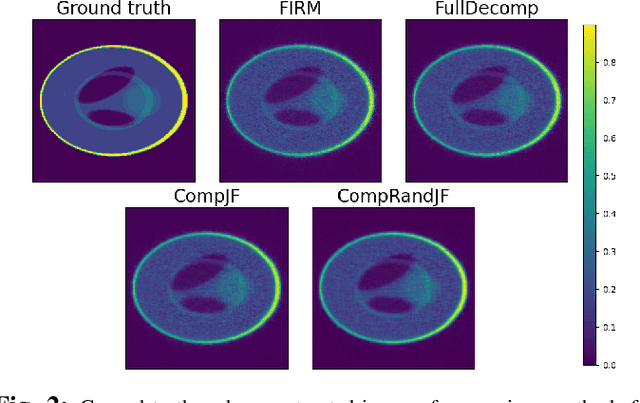
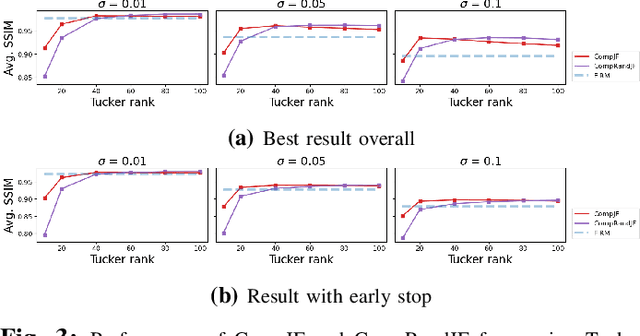
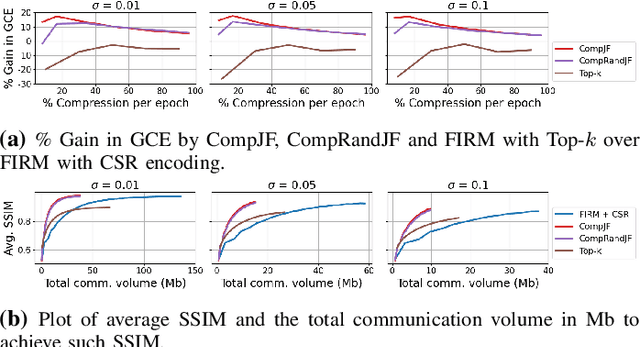
Low-rank tensor estimation offers a powerful approach to addressing high-dimensional data challenges and can substantially improve solutions to ill-posed inverse problems, such as image reconstruction under noisy or undersampled conditions. Meanwhile, tensor decomposition has gained prominence in federated learning (FL) due to its effectiveness in exploiting latent space structure and its capacity to enhance communication efficiency. In this paper, we present a federated image reconstruction method that applies Tucker decomposition, incorporating joint factorization and randomized sketching to manage large-scale, multimodal data. Our approach avoids reconstructing full-size tensors and supports heterogeneous ranks, allowing clients to select personalized decomposition ranks based on prior knowledge or communication capacity. Numerical results demonstrate that our method achieves superior reconstruction quality and communication compression compared to existing approaches, thereby highlighting its potential for multimodal inverse problems in the FL setting.
From RNNs to Foundation Models: An Empirical Study on Commercial Building Energy Consumption
Nov 21, 2024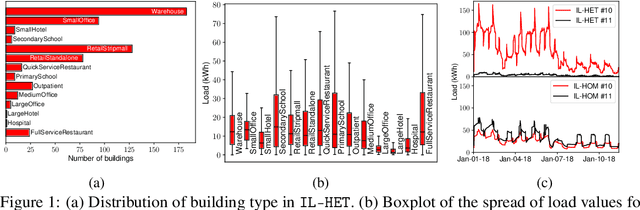
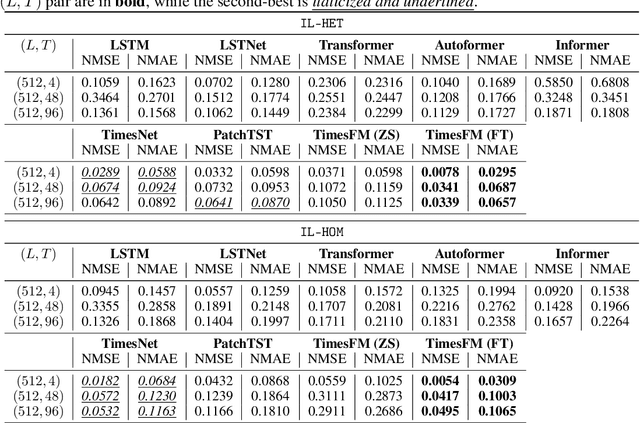

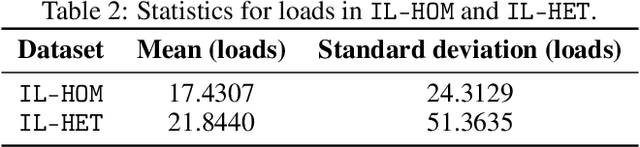
Accurate short-term energy consumption forecasting for commercial buildings is crucial for smart grid operations. While smart meters and deep learning models enable forecasting using past data from multiple buildings, data heterogeneity from diverse buildings can reduce model performance. The impact of increasing dataset heterogeneity in time series forecasting, while keeping size and model constant, is understudied. We tackle this issue using the ComStock dataset, which provides synthetic energy consumption data for U.S. commercial buildings. Two curated subsets, identical in size and region but differing in building type diversity, are used to assess the performance of various time series forecasting models, including fine-tuned open-source foundation models (FMs). The results show that dataset heterogeneity and model architecture have a greater impact on post-training forecasting performance than the parameter count. Moreover, despite the higher computational cost, fine-tuned FMs demonstrate competitive performance compared to base models trained from scratch.