 Add to Chrome
 Add to Firefox
 Add to Edge
InsertFuse: A Unified Framework for Multi-Category Reference-Guided Image Insertion
Aug 06, 2026
We present InsertFuse, a unified framework for multi-category reference-guided image insertion. Its key idea is to decouple category-specific expertise learning from cross-category capability consolidation. InsertFuse first trains specialized experts for different insertion categories and then introduces Insertion On-Policy Distillation (IOPD) to consolidate their capabilities into a single student. By querying the matched expert at states visited by the student, IOPD preserves category-specific insertion behavior while mitigating the cross-category interference caused by direct joint training. To improve spatial control, we propose Token-Aligned Geometry Conditioning (TAGC), which maps mask-derived geometric cues to the visual token grid, and Region-Balanced Flow Matching, which separately normalizes prediction errors inside and outside the insertion region to prevent background-dominated and scale-dependent supervision. We further introduce Reference CFG to isolate and strengthen the guidance induced by the visual reference under fixed scene and geometry conditions, with IOPD transferring this enhanced supervision into the unified student. Extensive experiments on the public AnyInsertion benchmark and our multi-category test set demonstrate state-of-the-art performance on most metrics, showing strong reference fidelity and generation quality across diverse insertion categories.

Leveraging Compressed Frame Sizes For Ultra-Fast Video Classification
Mar 13, 2024
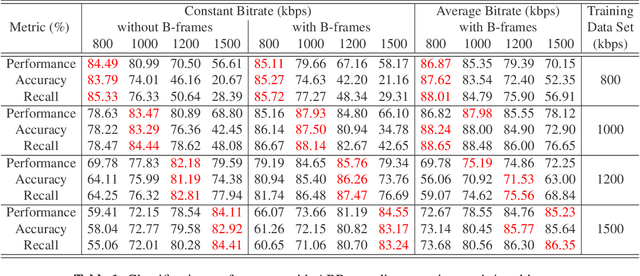
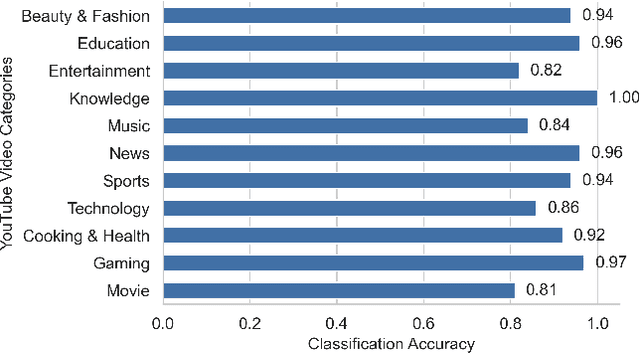
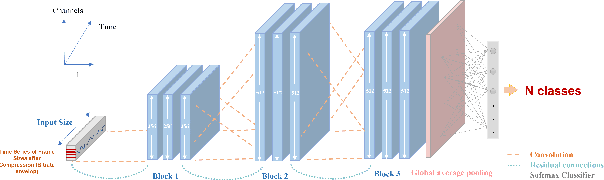
Classifying videos into distinct categories, such as Sport and Music Video, is crucial for multimedia understanding and retrieval, especially when an immense volume of video content is being constantly generated. Traditional methods require video decompression to extract pixel-level features like color, texture, and motion, thereby increasing computational and storage demands. Moreover, these methods often suffer from performance degradation in low-quality videos. We present a novel approach that examines only the post-compression bitstream of a video to perform classification, eliminating the need for bitstream decoding. To validate our approach, we built a comprehensive data set comprising over 29,000 YouTube video clips, totaling 6,000 hours and spanning 11 distinct categories. Our evaluations indicate precision, accuracy, and recall rates consistently above 80%, many exceeding 90%, and some reaching 99%. The algorithm operates approximately 15,000 times faster than real-time for 30fps videos, outperforming traditional Dynamic Time Warping (DTW) algorithm by seven orders of magnitude.
Judging a video by its bitstream cover
Sep 14, 2023Classifying videos into distinct categories, such as Sport and Music Video, is crucial for multimedia understanding and retrieval, especially in an age where an immense volume of video content is constantly being generated. Traditional methods require video decompression to extract pixel-level features like color, texture, and motion, thereby increasing computational and storage demands. Moreover, these methods often suffer from performance degradation in low-quality videos. We present a novel approach that examines only the post-compression bitstream of a video to perform classification, eliminating the need for bitstream. We validate our approach using a custom-built data set comprising over 29,000 YouTube video clips, totaling 6,000 hours and spanning 11 distinct categories. Our preliminary evaluations indicate precision, accuracy, and recall rates well over 80%. The algorithm operates approximately 15,000 times faster than real-time for 30fps videos, outperforming traditional Dynamic Time Warping (DTW) algorithm by six orders of magnitude.