 Add to Chrome
 Add to Firefox
 Add to Edge
Beyond Solution-Centric Search: Adaptive Inquiry and Knowledge Revision for Autonomous ML Engineering
Aug 03, 2026
Long-horizon autonomous research tasks such as machine learning engineering require systems to make interdependent decisions under a limited budget. Existing LLM-based agents typically organize candidate-solution improvement through tree, graph, or chain structures, meaning that the search process determines how information is acquired and managed. We call this design solution-centric search and propose instead the information paradigm, in which an evolving information state represents the system's understanding of the task and guides solution improvement. We instantiate this paradigm in Iris, an inquiry-revision loop. For information acquisition, Iris generates local action plans from the current information state and uses epistemic actions to probe decision-critical unknowns without modifying the retained solution. For information management, Iris synthesizes observations across experiments into task knowledge composed of revisable claims with explicit scope and status. It updates this knowledge as new evidence arrives and constructs each decision context from raw evidence, structured summaries, or task knowledge at the required level of detail. On MLE-Bench, Iris attains a 64.9% any-medal rate under a 12-hour budget, the highest among compared systems. Across four tasks spanning harness engineering and model post-training, Iris also demonstrates cross-domain generalization.

MerchantBench: Benchmarking LLM Agents for Long-Term Coherence in E-Commerce Operations
Jul 31, 2026Large language model agents are increasingly evaluated as autonomous tool users, yet most benchmarks focus on bounded tasks with immediate success criteria. Real-world deployments often require Long-Term Coherence, the capacity to preserve purposeful behavior across extended horizons while adapting decisions to accumulated evidence. Evaluating this capacity requires a persistent environment in which actions constrain future choices, feedback arrives at heterogeneous delays, and incoherent behavior produces measurable cumulative effects. Seller-side e-commerce provides a suitable setting for this evaluation through recurrent and interdependent decisions over Product Sourcing, Listing and Pricing Control, Cash-Flow Management, and Mixed-Latency Feedback Adaptation. We introduce MerchantBench, a 365-day order-level simulation grounded in 98,843 real e-commerce product records and equipped with 26 tools for agent interaction. MerchantBench couples promptly observable Upstream Supplier Events with delayed Downstream Order Outcomes, requiring agents to follow individual order lifecycles and revisit earlier decisions. We evaluate eight LLMs under two agent frameworks in 48 runs, each spanning 365 simulated days. Our results reveal a substantial gap between even the latest LLMs and human participants, with the best LLM configuration attaining only 27.3\% of the mean final net assets achieved by human participants.
SKILL-KD: Contrastive Skill Distillation for LLM Agents
Jul 30, 2026Skill-based prompting has become a practical mechanism for improving large language model (LLM) agents, yet existing skill acquisition methods often treat skills as experience summaries, memory entries, or direct summaries of successful demonstrations. This creates a mismatch for weaker student agents: when a student fails because it lacks task knowledge or operational strategy, its failed trajectory may not contain enough evidence to infer the missing behavior, while the teacher trajectory may be too implicit to be internalized as reusable guidance. We propose SKILL-KD, a contrastive skill distillation framework that treats skills as an explicit distillation medium between agents of different capabilities. Given a student failure and the teacher trajectory on the same task, SKILL-KD distills their actionable discrepancy into a textual skill patch, evaluates the patch by re-running the student, and iteratively refines the patch when the student still fails. To prevent repeated local updates from causing skill drift, SKILL-KD further maintains trace-linked edit histories and performs Drift-Aware Skill Consolidation, deciding whether each patch should add a new rule, delete or modify an existing rule, or be skipped. Across five agent benchmarks and two student settings, SKILL-KD consistently improves frozen student agents over fixed-model adaptation baselines.
HCNet: Hierarchical Context Network for Semantic Segmentation
Oct 20, 2020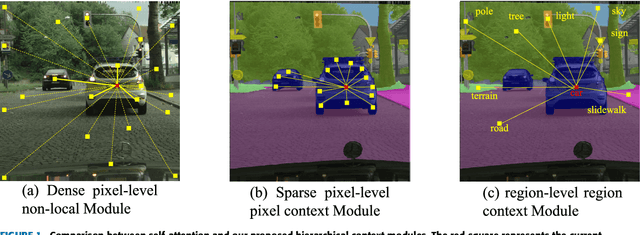
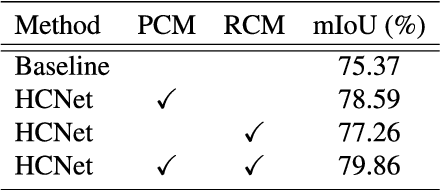
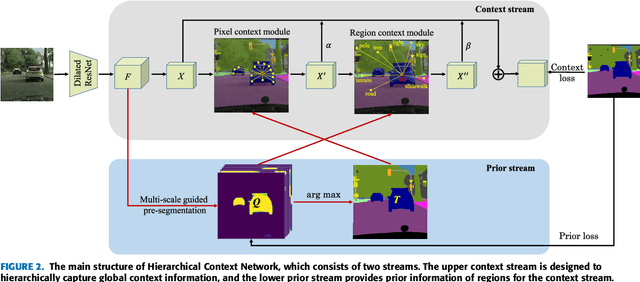
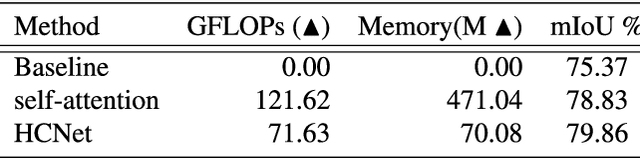
Global context information is vital in visual understanding problems, especially in pixel-level semantic segmentation. The mainstream methods adopt the self-attention mechanism to model global context information. However, pixels belonging to different classes usually have weak feature correlation. Modeling the global pixel-level correlation matrix indiscriminately is extremely redundant in the self-attention mechanism. In order to solve the above problem, we propose a hierarchical context network to differentially model homogeneous pixels with strong correlations and heterogeneous pixels with weak correlations. Specifically, we first propose a multi-scale guided pre-segmentation module to divide the entire feature map into different classed-based homogeneous regions. Within each homogeneous region, we design the pixel context module to capture pixel-level correlations. Subsequently, different from the self-attention mechanism that still models weak heterogeneous correlations in a dense pixel-level manner, the region context module is proposed to model sparse region-level dependencies using a unified representation of each region. Through aggregating fine-grained pixel context features and coarse-grained region context features, our proposed network can not only hierarchically model global context information but also harvest multi-granularity representations to more robustly identify multi-scale objects. We evaluate our approach on Cityscapes and the ISPRS Vaihingen dataset. Without Bells or Whistles, our approach realizes a mean IoU of 82.8% and overall accuracy of 91.4% on Cityscapes and ISPRS Vaihingen test set, achieving state-of-the-art results.
UDD: An Underwater Open-sea Farm Object Detection Dataset for Underwater Robot Picking
Mar 03, 2020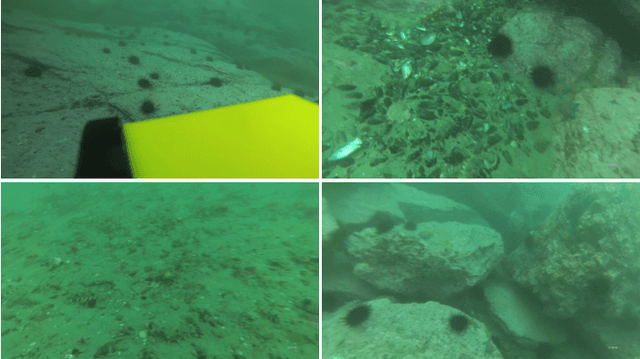
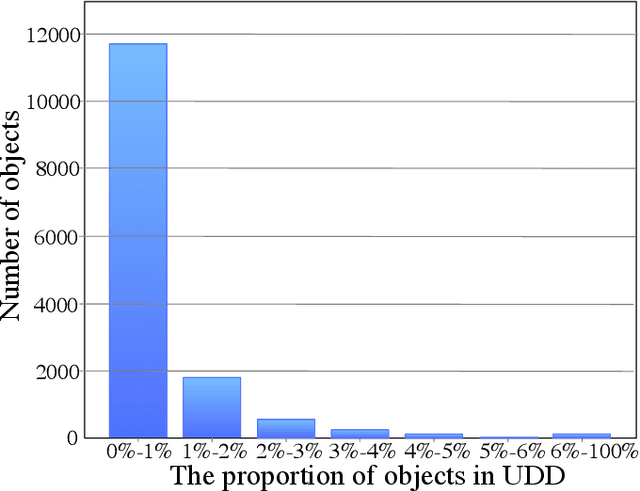
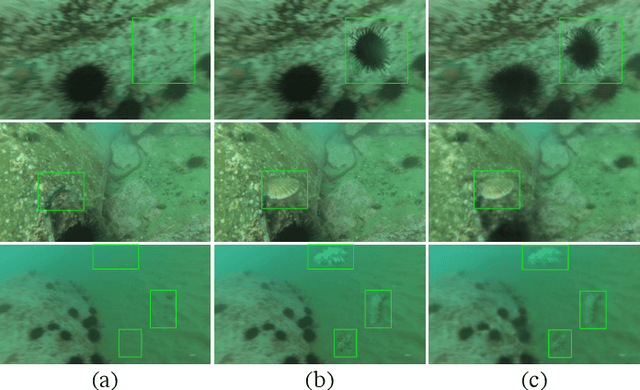
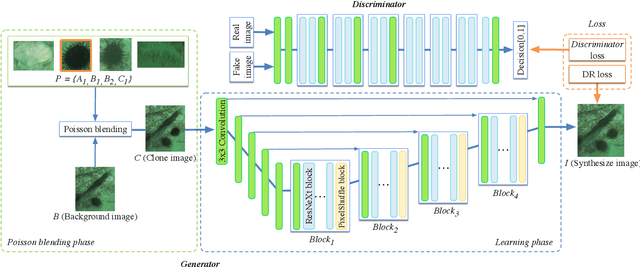
To promote the development of underwater robot picking in sea farms, we propose an underwater open-sea farm object detection dataset called UDD. Concretely, UDD consists of 3 categories (seacucumber, seaurchin, and scallop) with 2227 images. To the best of our knowledge, it's the first dataset collected in a real open-sea farm for underwater robot picking and we also propose a novel Poisson-blending-embedded Generative Adversarial Network (Poisson GAN) to overcome the class-imbalance and massive small objects issues in UDD. By utilizing Poisson GAN to change the number, position, even size of objects in UDD, we construct a large scale augmented dataset (AUDD) containing 18K images. Besides, in order to make the detector better adapted to the underwater picking environment, a dataset (Pre-trained dataset) for pre-training containing 590K images is also proposed. Finally, we design a lightweight network (UnderwaterNet) to address the problems that detecting small objects from cloudy underwater pictures and meeting the efficiency requirements in robots. Specifically, we design a depth-wise-convolution-based Multi-scale Contextual Features Fusion (MFF) block and a Multi-scale Blursampling (MBP) module to reduce the parameters of the network to 1.3M at 48FPS, without any loss on accuracy. Extensive experiments verify the effectiveness of the proposed UnderwaterNet, Poisson GAN, UDD, AUDD, and Pre-trained datasets.