 Add to Chrome
 Add to Firefox
 Add to Edge
When Is a Steerable Concept Representation Real? Measurement Confounds in a Cross-Family Audit of Neuroscience Parallels in LLMs
Aug 08, 2026
Large language models (LLMs) are increasingly reported to exhibit human-like neural and cognitive signatures, including concept cells, mental number lines, and cognitive maps. These claims often rely on linear probing and activation steering applied to a single model, yet both methods are highly sensitive to measurement choices. A reported parallel may therefore reflect the model, the measurement procedure, or both. We audit four representative neuroscience-inspired paradigms across 17 models from five families, spanning $0.6$B to $72$B parameters. Our main experiment examines the causal steerability of concept directions. With raw activation units and a fixed layer and coefficient, steerability appears to increase with model scale, resembling an emergent capability. However, this pattern is produced by an uncalibrated pipeline rather than by a claim established in the steering literature. The trend depends jointly on raw units, the readout metric, and the operating point; correcting any one of these removes it. With residual-norm-comparable interventions and held-out operating-point selection, concept steering remains significant at every scale, but shows no significant trend across the Qwen3 series, although the confidence interval does not rule out a moderate positive slope. The remaining results are mixed. A linear geographic world map is consistently decodable in every tested checkpoint up to $72$B. Number magnitude is strongly encoded, but whether individual neurons appear bell-shaped or monotonic depends on the selection criterion. Language-specific structure is localizable, but the direction of the cross-lingual asymmetry reverses under a different attribution method. These results suggest that the main constraint on AI neuroscience is not a lack of phenomena, but a lack of comparable measurements and adequate controls. We release the protocol, stimuli, and code.

TokenPrint: A Calibrated Token-Space Fingerprint for Language-Model Provenance
Aug 08, 2026Establishing the provenance of a language model---including its base checkpoint and possible overlap in training distributions---is a governance challenge that metadata alone cannot resolve. We introduce a training-free fingerprint based on the top-$k$ vocabulary projections of late hidden states elicited by 250 fixed knowledge probes, compared using Jaccard overlap over decoded token strings. We evaluate the method on 32 open-weight models from nine families (0.6B--32B) with documented relationships. (1)~A \emph{similarity ladder} broadly follows model relatedness: independently trained models on identical data score 0.48 raw (0.35 vocabulary-corrected), followed by shared-base fine-tunes (0.39/0.33), same-developer relatives (0.38/0.28), and models with no documented relationship (0.22/0.17). This identical-data signal persists across three organizations, two tokenizer families, and two architecture classes, and emerges within the first 1\% of training before measurable task competence, suggesting a contribution from shared training data beyond capability convergence. (2)~As a nearest-neighbor \emph{lineage-retrieval} method, the fingerprint ranks the exact documented base among the top two candidates for all five R1 distillations (mean rank 1.8, MRR 0.60), including a math-specialized base not identifiable from coarse metadata. (3)~A \emph{depth ablation} shows that lineage group discrimination strengthens toward the output distribution, with AUC increasing from 0.72 at quarter depth to 0.90 at the output; using only the top 5 output tokens retains AUC 0.87. (4)~The fingerprint remains stable under quantization, with Jaccard similarity of 0.92 under int8 and 0.82--0.85 under int4, compared with a maximum cross-model similarity of 0.81 in the calibration pool. We release the probes, code, and fingerprints.
ProAI: Proactive Multi-Agent Conversational AI with Structured Knowledge Base for Psychiatric Diagnosis
Feb 28, 2025Most LLM-driven conversational AI systems operate reactively, responding to user prompts without guiding the interaction. Most LLM-driven conversational AI systems operate reactively, responding to user prompts without guiding the interaction. However, many real-world applications-such as psychiatric diagnosis, consulting, and interviews-require AI to take a proactive role, asking the right questions and steering conversations toward specific objectives. Using mental health differential diagnosis as an application context, we introduce ProAI, a goal-oriented, proactive conversational AI framework. ProAI integrates structured knowledge-guided memory, multi-agent proactive reasoning, and a multi-faceted evaluation strategy, enabling LLMs to engage in clinician-style diagnostic reasoning rather than simple response generation. Through simulated patient interactions, user experience assessment, and professional clinical validation, we demonstrate that ProAI achieves up to 83.3% accuracy in mental disorder differential diagnosis while maintaining professional and empathetic interaction standards. These results highlight the potential for more reliable, adaptive, and goal-driven AI diagnostic assistants, advancing LLMs beyond reactive dialogue systems.
Towards Understanding Retrieval Accuracy and Prompt Quality in RAG Systems
Nov 29, 2024Retrieval-Augmented Generation (RAG) is a pivotal technique for enhancing the capability of large language models (LLMs) and has demonstrated promising efficacy across a diverse spectrum of tasks. While LLM-driven RAG systems show superior performance, they face unique challenges in stability and reliability. Their complexity hinders developers' efforts to design, maintain, and optimize effective RAG systems. Therefore, it is crucial to understand how RAG's performance is impacted by its design. In this work, we conduct an early exploratory study toward a better understanding of the mechanism of RAG systems, covering three code datasets, three QA datasets, and two LLMs. We focus on four design factors: retrieval document type, retrieval recall, document selection, and prompt techniques. Our study uncovers how each factor impacts system correctness and confidence, providing valuable insights for developing an accurate and reliable RAG system. Based on these findings, we present nine actionable guidelines for detecting defects and optimizing the performance of RAG systems. We hope our early exploration can inspire further advancements in engineering, improving and maintaining LLM-driven intelligent software systems for greater efficiency and reliability.
Beyond Fidelity: Explaining Vulnerability Localization of Learning-based Detectors
Jan 05, 2024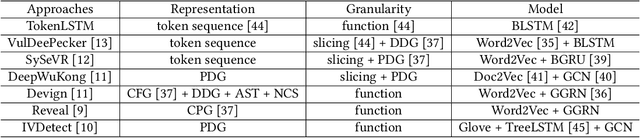
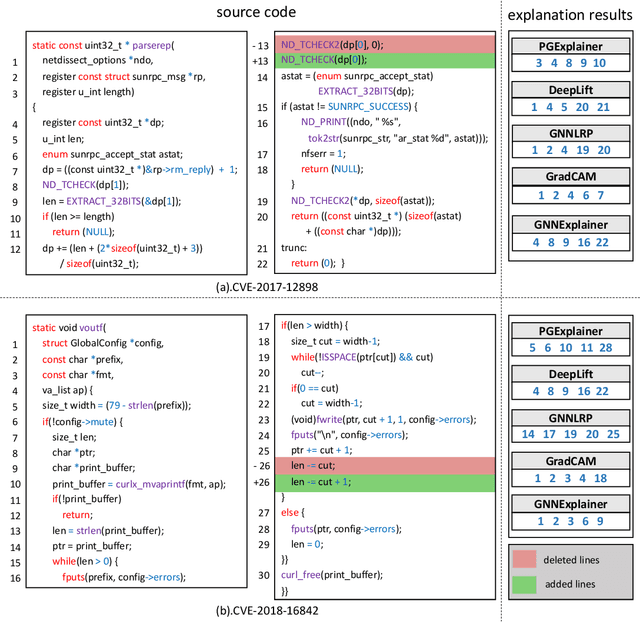
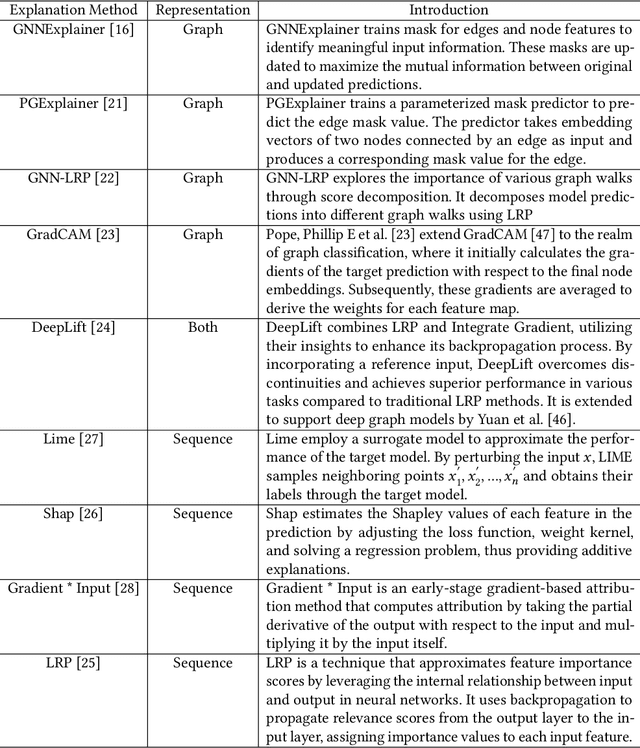
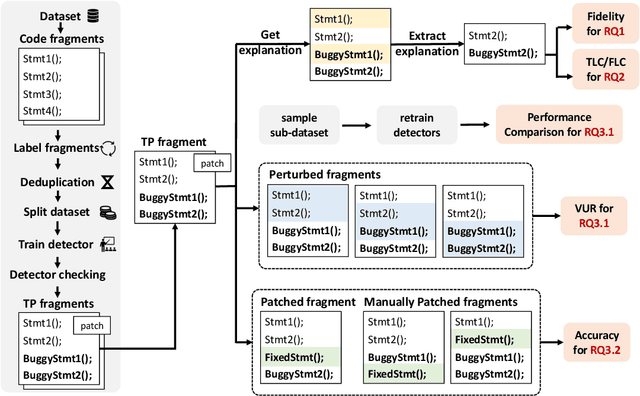
Vulnerability detectors based on deep learning (DL) models have proven their effectiveness in recent years. However, the shroud of opacity surrounding the decision-making process of these detectors makes it difficult for security analysts to comprehend. To address this, various explanation approaches have been proposed to explain the predictions by highlighting important features, which have been demonstrated effective in other domains such as computer vision and natural language processing. Unfortunately, an in-depth evaluation of vulnerability-critical features, such as fine-grained vulnerability-related code lines, learned and understood by these explanation approaches remains lacking. In this study, we first evaluate the performance of ten explanation approaches for vulnerability detectors based on graph and sequence representations, measured by two quantitative metrics including fidelity and vulnerability line coverage rate. Our results show that fidelity alone is not sufficient for evaluating these approaches, as fidelity incurs significant fluctuations across different datasets and detectors. We subsequently check the precision of the vulnerability-related code lines reported by the explanation approaches, and find poor accuracy in this task among all of them. This can be attributed to the inefficiency of explainers in selecting important features and the presence of irrelevant artifacts learned by DL-based detectors.