 Add to Chrome
 Add to Firefox
 Add to Edge
MRT: Masked Region Transformer for Layered Image Generation and Editing at Scale
May 26, 2026
Layered image generation and editing is a fundamental capability that enables layer-wise reuse, editing, and composition of generated visual content, analogous to word-level editing in natural language. Despite its importance, this remains an underexplored area at scale. To address this gap, we present MRT, a 20B-parameter masked region diffusion model tailored for multi-layer transparent image generation and editing, trained on over 10M multilingual design samples spanning diverse aspect ratios and textual prompts. To fully leverage this scale, we make two key technical contributions. First, we unify three complementary tasks including text-to-layers, image-to-layers, and layers-to-layers within a shared masked region diffusion framework, where selective token masking enables flexible layer-wise generation and editing. Second, to enable overflow layer generation, we introduce an overflow-aware canvas layer that handles boundary inconsistencies and supports semi-transparent background synthesis, enabling complete editable layers extending beyond visible canvas boundaries. Additionally, we apply diffusion distillation to achieve 8-step, real-time multi-layer generation with minimal quality degradation. Extensive experiments demonstrate that our framework substantially outperforms prior state-of-the-art approaches, including various commercial systems, across all three tasks, establishing a new benchmark for multi-layer transparent image generation. Notably, our model significantly outperforms the concurrent Qwen-Image-Layered model in image-to-layers quality according to user-study results, while achieving 10-100\times faster inference and reducing activation GPU memory consumption by 50-90\% during image-to-layer inference.

Mobile GUI Agent Privacy Personalization with Trajectory Induced Preference Optimization
Apr 13, 2026Mobile GUI agents powered by Multimodal Large Language Models (MLLMs) can execute complex tasks on mobile devices. Despite this progress, most existing systems still optimize task success or efficiency, neglecting users' privacy personalization. In this paper, we study the often-overlooked problem of agent personalization. We observe that personalization can induce systematic structural heterogeneity in execution trajectories. For example, privacy-first users often prefer protective actions, e.g., refusing permissions, logging out, and minimizing exposure, leading to logically different execution trajectories from utility-first users. Such variable-length and structurally different trajectories make standard preference optimization unstable and less informative. To address this issue, we propose Trajectory Induced Preference Optimization (TIPO), which uses preference-intensity weighting to emphasize key privacy-related steps and padding gating to suppress alignment noise. Results on our Privacy Preference Dataset show that TIPO improves persona alignment and distinction while preserving strong task executability, achieving 65.60% SR, 46.22 Compliance, and 66.67% PD, outperforming existing optimization methods across various GUI tasks. The code and dataset will be publicly released at https://github.com/Zhixin-L/TIPO.
A Utility-preserving De-identification Pipeline for Cross-hospital Radiology Data Sharing
Apr 08, 2026Large-scale radiology data are critical for developing robust medical AI systems. However, sharing such data across hospitals remains heavily constrained by privacy concerns. Existing de-identification research in radiology mainly focus on removing identifiable information to enable compliant data release. Yet whether de-identified radiology data can still preserve sufficient utility for large-scale vision-language model training and cross-hospital transfer remains underexplored. In this paper, we introduce a utility-preserving de-identification pipeline (UPDP) for cross-hospital radiology data sharing. Specifically, we compile a blacklist of privacy-sensitive terms and a whitelist of pathology-related terms. For radiology images, we use a generative filtering mechanism that synthesis a privacy-filtered and pathology-reserved counterparts of the original images. These synthetic image counterparts, together with ID-filtered reports, can then be securely shared across hospitals for downstream model development and evaluation. Experiments on public chest X-ray benchmarks demonstrate that our method effectively removes privacy-sensitive information while preserving diagnostically relevant pathology cues. Models trained on the de-identified data maintain competitive diagnostic accuracy compared with those trained on the original data, while exhibiting a marked decline in identity-related accuracy, confirming effective privacy protection. In the cross-hospital setting, we further show that de-identified data can be combined with local data to yield better performance.
ShieldGemma 2: Robust and Tractable Image Content Moderation
Apr 01, 2025We introduce ShieldGemma 2, a 4B parameter image content moderation model built on Gemma 3. This model provides robust safety risk predictions across the following key harm categories: Sexually Explicit, Violence \& Gore, and Dangerous Content for synthetic images (e.g. output of any image generation model) and natural images (e.g. any image input to a Vision-Language Model). We evaluated on both internal and external benchmarks to demonstrate state-of-the-art performance compared to LlavaGuard \citep{helff2024llavaguard}, GPT-4o mini \citep{hurst2024gpt}, and the base Gemma 3 model \citep{gemma_2025} based on our policies. Additionally, we present a novel adversarial data generation pipeline which enables a controlled, diverse, and robust image generation. ShieldGemma 2 provides an open image moderation tool to advance multimodal safety and responsible AI development.
Enhancing Character-Level Understanding in LLMs through Token Internal Structure Learning
Nov 26, 2024Tokenization techniques such as Byte-Pair Encoding (BPE) and Byte-Level BPE (BBPE) have significantly improved the computational efficiency and vocabulary representation stability of large language models (LLMs) by segmenting text into tokens. However, this segmentation often obscures the internal character structures and sequences within tokens, preventing models from fully learning these intricate details during training. Consequently, LLMs struggle to comprehend the character compositions and positional relationships within tokens, especially when fine-tuned on downstream tasks with limited data. In this paper, we introduce Token Internal Position Awareness (TIPA), a novel approach that enhances LLMs' understanding of internal token structures by training them on reverse character prediction tasks using the tokenizer's own vocabulary. This method enables models to effectively learn and generalize character positions and internal structures. Experimental results demonstrate that LLMs trained with TIPA outperform baseline models in predicting character positions at the token level. Furthermore, when applied to the downstream task of Chinese Spelling Correction (CSC), TIPA not only accelerates model convergence but also significantly improves task performance.
Imagen 3
Aug 13, 2024We introduce Imagen 3, a latent diffusion model that generates high quality images from text prompts. We describe our quality and responsibility evaluations. Imagen 3 is preferred over other state-of-the-art (SOTA) models at the time of evaluation. In addition, we discuss issues around safety and representation, as well as methods we used to minimize the potential harm of our models.
ShieldGemma: Generative AI Content Moderation Based on Gemma
Jul 31, 2024


We present ShieldGemma, a comprehensive suite of LLM-based safety content moderation models built upon Gemma2. These models provide robust, state-of-the-art predictions of safety risks across key harm types (sexually explicit, dangerous content, harassment, hate speech) in both user input and LLM-generated output. By evaluating on both public and internal benchmarks, we demonstrate superior performance compared to existing models, such as Llama Guard (+10.8\% AU-PRC on public benchmarks) and WildCard (+4.3\%). Additionally, we present a novel LLM-based data curation pipeline, adaptable to a variety of safety-related tasks and beyond. We have shown strong generalization performance for model trained mainly on synthetic data. By releasing ShieldGemma, we provide a valuable resource to the research community, advancing LLM safety and enabling the creation of more effective content moderation solutions for developers.
Assessing Model Generalization in Vicinity
Jun 13, 2024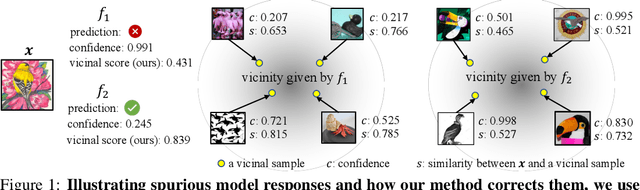
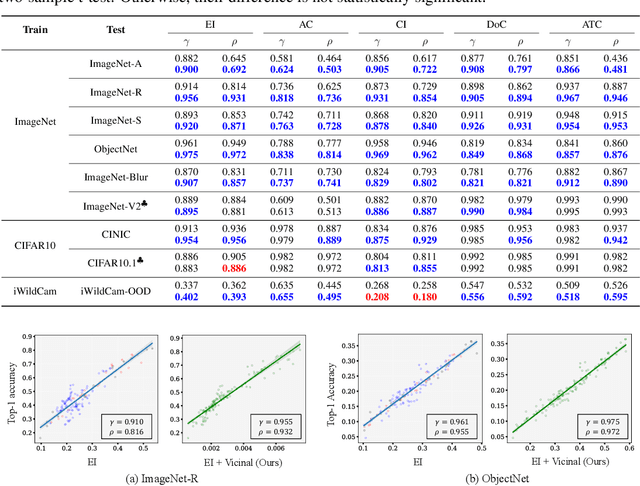
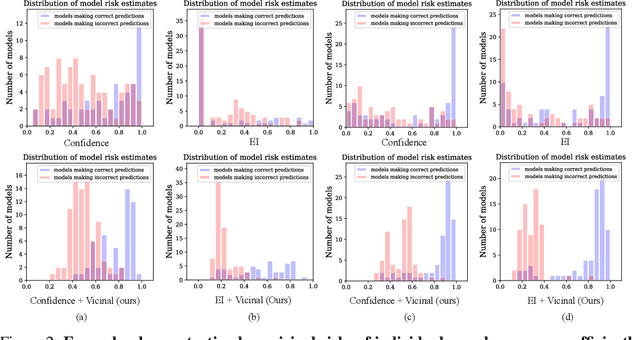
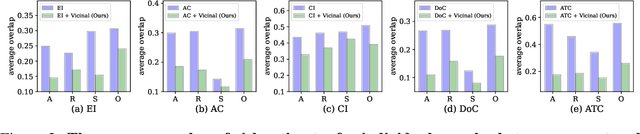
This paper evaluates the generalization ability of classification models on out-of-distribution test sets without depending on ground truth labels. Common approaches often calculate an unsupervised metric related to a specific model property, like confidence or invariance, which correlates with out-of-distribution accuracy. However, these metrics are typically computed for each test sample individually, leading to potential issues caused by spurious model responses, such as overly high or low confidence. To tackle this challenge, we propose incorporating responses from neighboring test samples into the correctness assessment of each individual sample. In essence, if a model consistently demonstrates high correctness scores for nearby samples, it increases the likelihood of correctly predicting the target sample, and vice versa. The resulting scores are then averaged across all test samples to provide a holistic indication of model accuracy. Developed under the vicinal risk formulation, this approach, named vicinal risk proxy (VRP), computes accuracy without relying on labels. We show that applying the VRP method to existing generalization indicators, such as average confidence and effective invariance, consistently improves over these baselines both methodologically and experimentally. This yields a stronger correlation with model accuracy, especially on challenging out-of-distribution test sets.
Towards Hierarchical Multi-Agent Workflows for Zero-Shot Prompt Optimization
May 30, 2024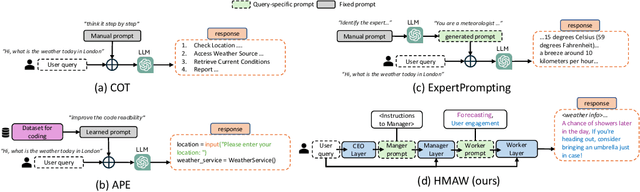


Large language models (LLMs) have shown great progress in responding to user questions, allowing for a multitude of diverse applications. Yet, the quality of LLM outputs heavily depends on the prompt design, where a good prompt might enable the LLM to answer a very challenging question correctly. Therefore, recent works have developed many strategies for improving the prompt, including both manual crafting and in-domain optimization. However, their efficacy in unrestricted scenarios remains questionable, as the former depends on human design for specific questions and the latter usually generalizes poorly to unseen scenarios. To address these problems, we give LLMs the freedom to design the best prompts according to themselves. Specifically, we include a hierarchy of LLMs, first constructing a prompt with precise instructions and accurate wording in a hierarchical manner, and then using this prompt to generate the final answer to the user query. We term this pipeline Hierarchical Multi-Agent Workflow, or HMAW. In contrast with prior works, HMAW imposes no human restriction and requires no training, and is completely task-agnostic while capable of adjusting to the nuances of the underlying task. Through both quantitative and qualitative experiments across multiple benchmarks, we verify that despite its simplicity, the proposed approach can create detailed and suitable prompts, further boosting the performance of current LLMs.
Optimizing Calibration by Gaining Aware of Prediction Correctness
Apr 19, 2024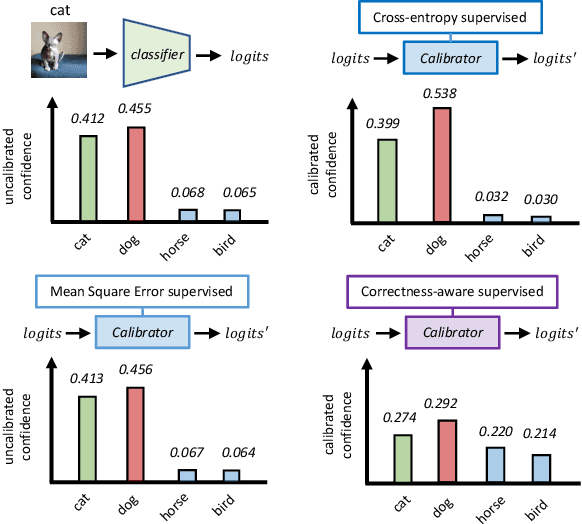
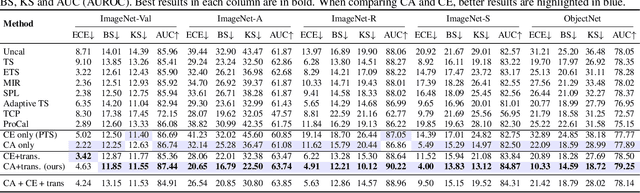

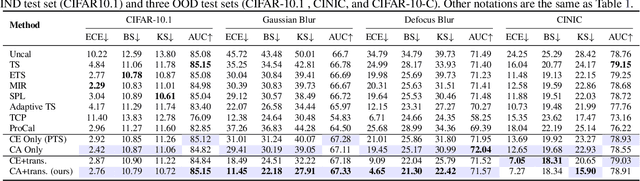
Model calibration aims to align confidence with prediction correctness. The Cross-Entropy CE) loss is widely used for calibrator training, which enforces the model to increase confidence on the ground truth class. However, we find the CE loss has intrinsic limitations. For example, for a narrow misclassification, a calibrator trained by the CE loss often produces high confidence on the wrongly predicted class (e.g., a test sample is wrongly classified and its softmax score on the ground truth class is around 0.4), which is undesirable. In this paper, we propose a new post-hoc calibration objective derived from the aim of calibration. Intuitively, the proposed objective function asks that the calibrator decrease model confidence on wrongly predicted samples and increase confidence on correctly predicted samples. Because a sample itself has insufficient ability to indicate correctness, we use its transformed versions (e.g., rotated, greyscaled and color-jittered) during calibrator training. Trained on an in-distribution validation set and tested with isolated, individual test samples, our method achieves competitive calibration performance on both in-distribution and out-of-distribution test sets compared with the state of the art. Further, our analysis points out the difference between our method and commonly used objectives such as CE loss and mean square error loss, where the latters sometimes deviates from the calibration aim.