 Add to Chrome
 Add to Firefox
 Add to Edge
GST-Bench: Can VLMs Develop Global Spatial Awareness from Video?
Aug 06, 2026
Spatial intelligence is fundamental to embodied agents, yet existing benchmarks focus on local spatial perception from single or few viewpoints, overlooking global spatial awareness over continuous, long-horizon visual streams. To address this limitation, we introduce the Global-Spatial-Temporal Benchmark (GST-Bench), a VQA benchmark for global spatial intelligence in video understanding, comprising human-verified questions derived from 6,790 minutes of synthetically generated video. It requires models to perform accurate spatial inference from novel viewpoints unseen in the input video and to map egocentric observations onto global top-down images. A comprehensive evaluation of 22 state-of-the-art VLMs exposes a striking gap between models and humans: the strongest zero-shot model attains only 42.68, far below the human score of 79.08. To probe the cause of this gap, we construct GST-Bench-Local and find that models, despite strong local spatial understanding under the same task formulation, still fail to consolidate long-horizon observations into a globally consistent scene representation. We further provide GST-Train, a dataset for global spatial reasoning, as a complementary resource to facilitate future research on this challenge.

Not All Patches are Equal: Sampling Matters for Visible-Infrared Pre-Training
Jul 22, 2026Visible-infrared (VIS-IR) alignment is a key pre-training task for robust multi-sensor perception. Most existing methods use uniform patch-wise contrastive learning, but this can be unreliable in VIS-IR data because imaging-physics differences make some spatially paired regions inherently less comparable, and aligning them with equal strength hinders representation learning and downstream transfer. In this paper, we revisit VIS-IR pre-training from a sampling perspective and propose Importance-Aware Sampling (IAS), which adjusts training emphasis based on patch reliability. Specifically, IAS (i) derives patch weights from infrared structural cues and uses them to reweight the contrastive objective; (ii) learns a soft importance mask with a lightweight sampler, optionally warm-started from the hand-crafted prior; and (iii) employs a patch curriculum learning strategy that gradually expands from high-reliability regions to harder patches. It is worth noting that IAS is plug-and-play and works with both patch-/correlation-level alignment (e.g., UNIV-style) and image-level contrastive baselines (e.g., ImageBind-style). Extensive experiments on multiple VIS-IR benchmarks demonstrate consistent improvements over strong baselines, including for IR semantic segmentation, IR object detection and VIS semantic segmentation and cross-modal retrieval task. Code will be released on https://github.com/KlayMa527/IAS.
Tactile-WAM: Touch-Aware World Action Model with Tactile Asymmetric Attention
Jun 25, 2026World Action Models (WAMs) generate actions together with predicted futures, offering a powerful interface for robot decision making. In contact-rich manipulation, however, visually plausible futures can be physically incomplete: insertion, assembly, search, and reorientation often depend on slip, jamming, contact normals, or small alignment errors that are weakly visible or hidden in RGB. A natural solution is to predict future tactile states, however, we identify tactile pollution, a failure mode where unconstrained tactile-token injection degrades video and action prediction by forcing a visual dynamics model to absorb sparse, local, event-driven contact signals. To address this, we propose Tactile-WAM, a touch-aware WAM with a Tactile Asymmetric Attention Mechanism (TAAM). TAAM combines a VideoClean mask, which blocks video-query access to tactile key/value tokens while preserving action-query access, with a touch-aware bias for action attention. The VideoClean mask protects visual prediction while keeping contact information available for action generation; the touch-aware bias is derived from predicted touch changes and modulates action attention to tactile tokens during denoising. On ManiFeel, Tactile-WAM improves the mean success rate by 38.9% overall and by 86% on contact-rich tasks.
A Utility-preserving De-identification Pipeline for Cross-hospital Radiology Data Sharing
Apr 08, 2026Large-scale radiology data are critical for developing robust medical AI systems. However, sharing such data across hospitals remains heavily constrained by privacy concerns. Existing de-identification research in radiology mainly focus on removing identifiable information to enable compliant data release. Yet whether de-identified radiology data can still preserve sufficient utility for large-scale vision-language model training and cross-hospital transfer remains underexplored. In this paper, we introduce a utility-preserving de-identification pipeline (UPDP) for cross-hospital radiology data sharing. Specifically, we compile a blacklist of privacy-sensitive terms and a whitelist of pathology-related terms. For radiology images, we use a generative filtering mechanism that synthesis a privacy-filtered and pathology-reserved counterparts of the original images. These synthetic image counterparts, together with ID-filtered reports, can then be securely shared across hospitals for downstream model development and evaluation. Experiments on public chest X-ray benchmarks demonstrate that our method effectively removes privacy-sensitive information while preserving diagnostically relevant pathology cues. Models trained on the de-identified data maintain competitive diagnostic accuracy compared with those trained on the original data, while exhibiting a marked decline in identity-related accuracy, confirming effective privacy protection. In the cross-hospital setting, we further show that de-identified data can be combined with local data to yield better performance.
HyperLoad: A Cross-Modality Enhanced Large Language Model-Based Framework for Green Data Center Cooling Load Prediction
Dec 22, 2025The rapid growth of artificial intelligence is exponentially escalating computational demand, inflating data center energy use and carbon emissions, and spurring rapid deployment of green data centers to relieve resource and environmental stress. Achieving sub-minute orchestration of renewables, storage, and loads, while minimizing PUE and lifecycle carbon intensity, hinges on accurate load forecasting. However, existing methods struggle to address small-sample scenarios caused by cold start, load distortion, multi-source data fragmentation, and distribution shifts in green data centers. We introduce HyperLoad, a cross-modality framework that exploits pre-trained large language models (LLMs) to overcome data scarcity. In the Cross-Modality Knowledge Alignment phase, textual priors and time-series data are mapped to a common latent space, maximizing the utility of prior knowledge. In the Multi-Scale Feature Modeling phase, domain-aligned priors are injected through adaptive prefix-tuning, enabling rapid scenario adaptation, while an Enhanced Global Interaction Attention mechanism captures cross-device temporal dependencies. The public DCData dataset is released for benchmarking. Under both data sufficient and data scarce settings, HyperLoad consistently surpasses state-of-the-art (SOTA) baselines, demonstrating its practicality for sustainable green data center management.
Bridging VLM and KMP: Enabling Fine-grained robotic manipulation via Semantic Keypoints Representation
Mar 04, 2025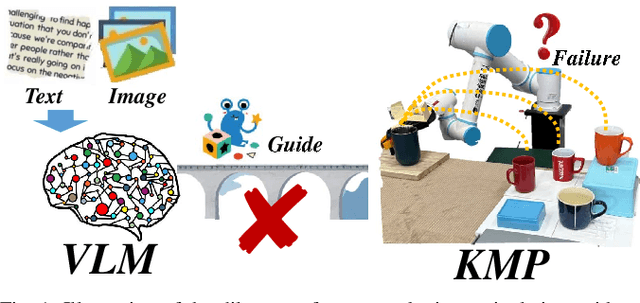
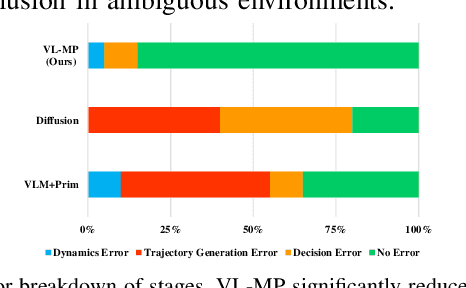
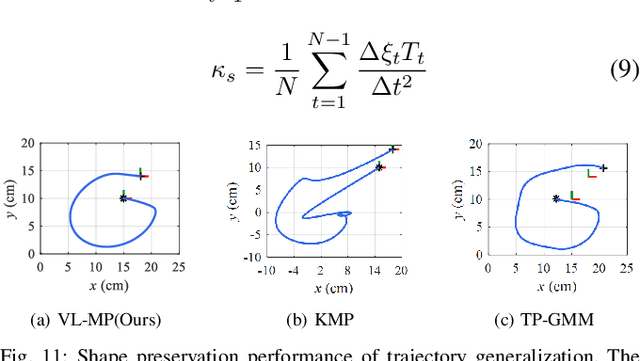
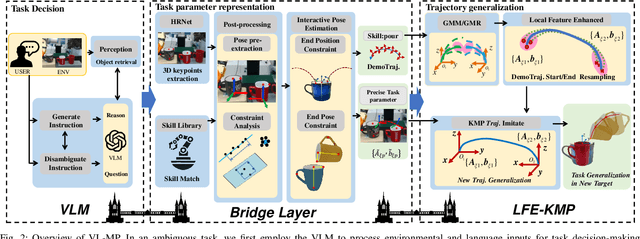
From early Movement Primitive (MP) techniques to modern Vision-Language Models (VLMs), autonomous manipulation has remained a pivotal topic in robotics. As two extremes, VLM-based methods emphasize zero-shot and adaptive manipulation but struggle with fine-grained planning. In contrast, MP-based approaches excel in precise trajectory generalization but lack decision-making ability. To leverage the strengths of the two frameworks, we propose VL-MP, which integrates VLM with Kernelized Movement Primitives (KMP) via a low-distortion decision information transfer bridge, enabling fine-grained robotic manipulation under ambiguous situations. One key of VL-MP is the accurate representation of task decision parameters through semantic keypoints constraints, leading to more precise task parameter generation. Additionally, we introduce a local trajectory feature-enhanced KMP to support VL-MP, thereby achieving shape preservation for complex trajectories. Extensive experiments conducted in complex real-world environments validate the effectiveness of VL-MP for adaptive and fine-grained manipulation.
Graph-Based Cross-Domain Knowledge Distillation for Cross-Dataset Text-to-Image Person Retrieval
Jan 25, 2025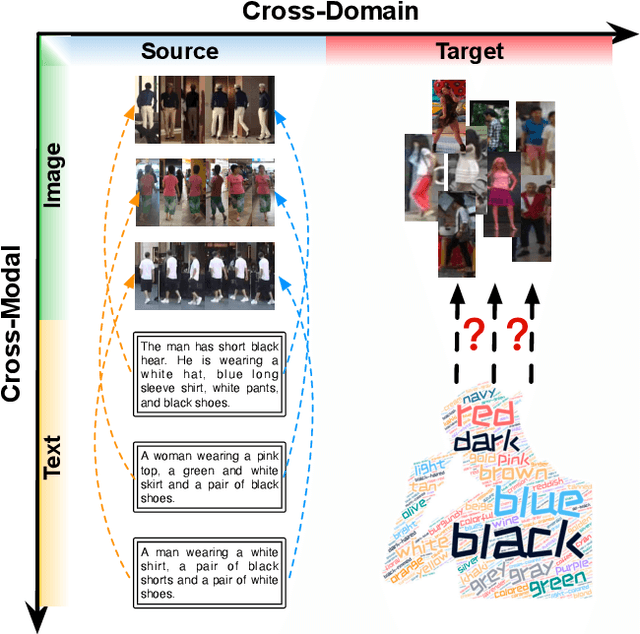
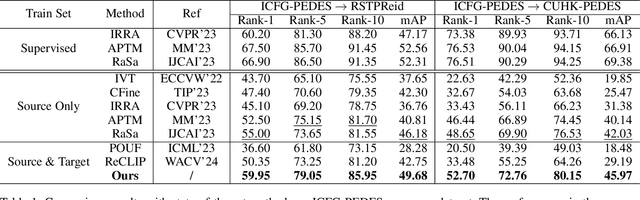
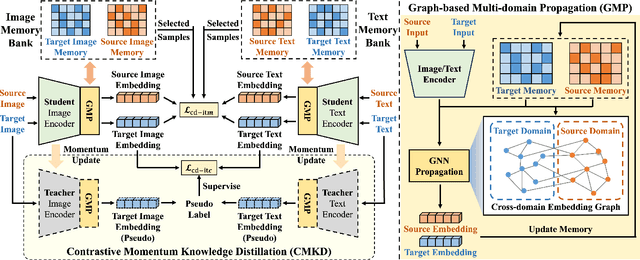
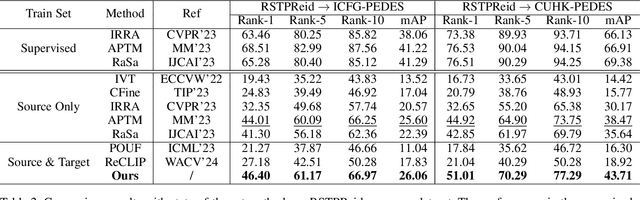
Video surveillance systems are crucial components for ensuring public safety and management in smart city. As a fundamental task in video surveillance, text-to-image person retrieval aims to retrieve the target person from an image gallery that best matches the given text description. Most existing text-to-image person retrieval methods are trained in a supervised manner that requires sufficient labeled data in the target domain. However, it is common in practice that only unlabeled data is available in the target domain due to the difficulty and cost of data annotation, which limits the generalization of existing methods in practical application scenarios. To address this issue, we propose a novel unsupervised domain adaptation method, termed Graph-Based Cross-Domain Knowledge Distillation (GCKD), to learn the cross-modal feature representation for text-to-image person retrieval in a cross-dataset scenario. The proposed GCKD method consists of two main components. Firstly, a graph-based multi-modal propagation module is designed to bridge the cross-domain correlation among the visual and textual samples. Secondly, a contrastive momentum knowledge distillation module is proposed to learn the cross-modal feature representation using the online knowledge distillation strategy. By jointly optimizing the two modules, the proposed method is able to achieve efficient performance for cross-dataset text-to-image person retrieval. acExtensive experiments on three publicly available text-to-image person retrieval datasets demonstrate the effectiveness of the proposed GCKD method, which consistently outperforms the state-of-the-art baselines.
Hypergraph-Guided Disentangled Spectrum Transformer Networks for Near-Infrared Facial Expression Recognition
Dec 10, 2023


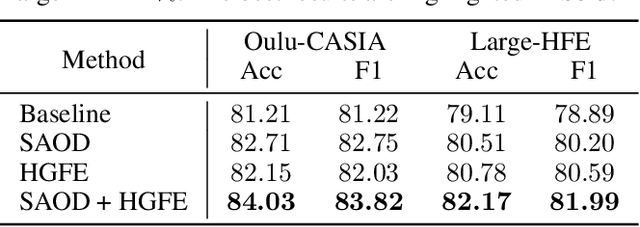
With the strong robusticity on illumination variations, near-infrared (NIR) can be an effective and essential complement to visible (VIS) facial expression recognition in low lighting or complete darkness conditions. However, facial expression recognition (FER) from NIR images presents more challenging problem than traditional FER due to the limitations imposed by the data scale and the difficulty of extracting discriminative features from incomplete visible lighting contents. In this paper, we give the first attempt to deep NIR facial expression recognition and proposed a novel method called near-infrared facial expression transformer (NFER-Former). Specifically, to make full use of the abundant label information in the field of VIS, we introduce a Self-Attention Orthogonal Decomposition mechanism that disentangles the expression information and spectrum information from the input image, so that the expression features can be extracted without the interference of spectrum variation. We also propose a Hypergraph-Guided Feature Embedding method that models some key facial behaviors and learns the structure of the complex correlations between them, thereby alleviating the interference of inter-class similarity. Additionally, we have constructed a large NIR-VIS Facial Expression dataset that includes 360 subjects to better validate the efficiency of NFER-Former. Extensive experiments and ablation studies show that NFER-Former significantly improves the performance of NIR FER and achieves state-of-the-art results on the only two available NIR FER datasets, Oulu-CASIA and Large-HFE.
Multi-Energy Guided Image Translation with Stochastic Differential Equations for Near-Infrared Facial Expression Recognition
Dec 10, 2023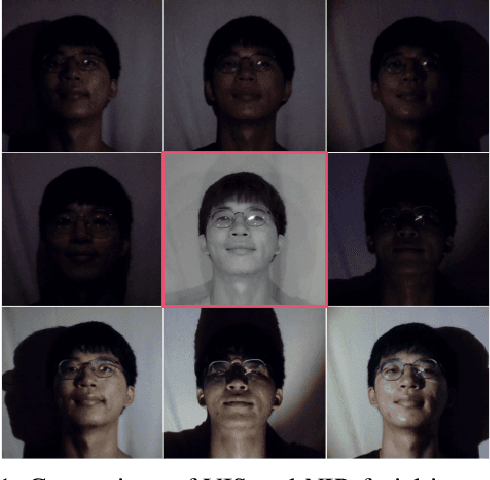
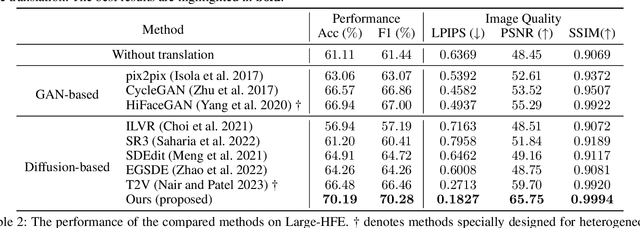

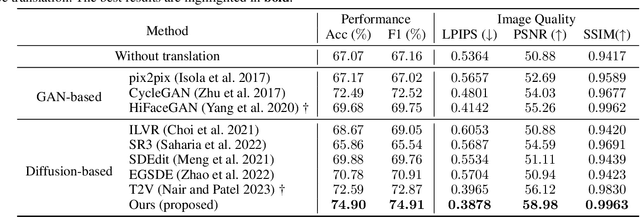
Illumination variation has been a long-term challenge in real-world facial expression recognition(FER). Under uncontrolled or non-visible light conditions, Near-infrared (NIR) can provide a simple and alternative solution to obtain high-quality images and supplement the geometric and texture details that are missing in the visible domain. Due to the lack of existing large-scale NIR facial expression datasets, directly extending VIS FER methods to the NIR spectrum may be ineffective. Additionally, previous heterogeneous image synthesis methods are restricted by low controllability without prior task knowledge. To tackle these issues, we present the first approach, called for NIR-FER Stochastic Differential Equations (NFER-SDE), that transforms face expression appearance between heterogeneous modalities to the overfitting problem on small-scale NIR data. NFER-SDE is able to take the whole VIS source image as input and, together with domain-specific knowledge, guide the preservation of modality-invariant information in the high-frequency content of the image. Extensive experiments and ablation studies show that NFER-SDE significantly improves the performance of NIR FER and achieves state-of-the-art results on the only two available NIR FER datasets, Oulu-CASIA and Large-HFE.
MVP: Meta Visual Prompt Tuning for Few-Shot Remote Sensing Image Scene Classification
Sep 17, 2023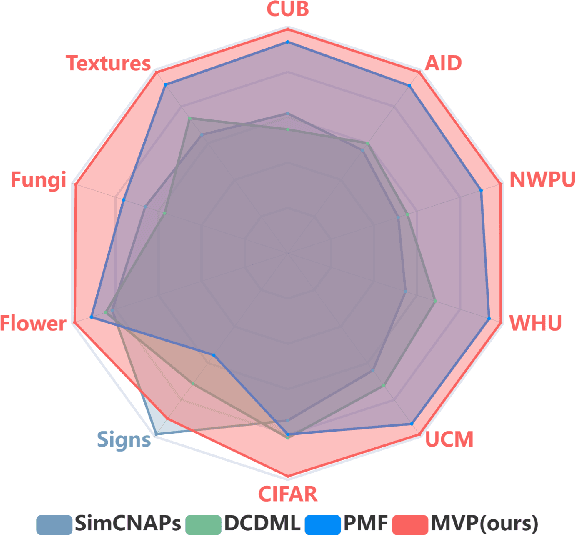
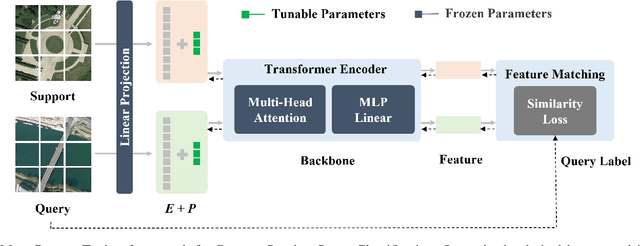

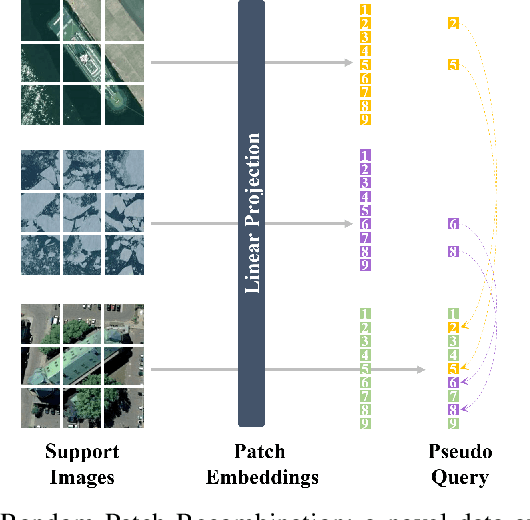
Vision Transformer (ViT) models have recently emerged as powerful and versatile models for various visual tasks. Recently, a work called PMF has achieved promising results in few-shot image classification by utilizing pre-trained vision transformer models. However, PMF employs full fine-tuning for learning the downstream tasks, leading to significant overfitting and storage issues, especially in the remote sensing domain. In order to tackle these issues, we turn to the recently proposed parameter-efficient tuning methods, such as VPT, which updates only the newly added prompt parameters while keeping the pre-trained backbone frozen. Inspired by VPT, we propose the Meta Visual Prompt Tuning (MVP) method. Specifically, we integrate the VPT method into the meta-learning framework and tailor it to the remote sensing domain, resulting in an efficient framework for Few-Shot Remote Sensing Scene Classification (FS-RSSC). Furthermore, we introduce a novel data augmentation strategy based on patch embedding recombination to enhance the representation and diversity of scenes for classification purposes. Experiment results on the FS-RSSC benchmark demonstrate the superior performance of the proposed MVP over existing methods in various settings, such as various-way-various-shot, various-way-one-shot, and cross-domain adaptation.