 Add to Chrome
 Add to Firefox
 Add to Edge
Self-Modifying Lean Proof Agents with Verifier-Grounded Benchmark Coevolution
Jul 19, 2026
Designing effective Lean proof agents is a central challenge in formal mathematical reasoning. Beyond building stronger provers, recent work emphasizes the workflow around Lean: how an agent decomposes proof obligations, uses tools and compiler feedback, diagnoses failures, repairs proofs, and maintains structured proof context. Motivated by code-level self-evolving agents, we study whether such workflows can be evolved rather than hand-designed. We present a self-evolving Lean proof agent in which a small fixed, trusted runtime wraps a fully mutable workspace: the proof workflow, prompts, and tools. Unlike most self-evolving systems, which optimize against a fixed external benchmark, our system coevolves the agent and its benchmark. Between generations, the highest-scoring agent (the champion) revises the active task distribution through a mastery-throttled curriculum update that introduces harder proof obligations only after the current level is mastered, and a single-anchor recalibration re-runs the champion on the updated benchmark to keep scores comparable as difficulty rises. All evolution stays inside a Lean-grounded verification loop: however the agent rewrites itself, a success counts only when its behavior yields Lean-verified proofs under a trusted snapshot, and each attempt must emit a machine-readable, Lean-grounded proof context whose representation may evolve but whose groundedness is enforced. We run the coevolving trajectory and a fixed-benchmark baseline for 15 active generations and compare them on a held-out miniF2F test split. The best coevolving agent reaches a 45.1% held-out solve rate, versus 12.7% for the seed and 32.0% for the best fixed-benchmark agent, showing that verifier-grounded self-evolution can improve Lean proof workflows under a coevolving benchmark.

When AI meets quantum information: A comprehensive review
Jul 01, 2026Artificial intelligence (AI) and quantum information (QI) are rapidly co-evolving. AI is becoming a practical tool for learning, designing, controlling, and verifying quantum systems, while QI offers new computational models, representational structures, and learning-theoretic questions for AI. This survey reviews the interface from both directions. In the AI for QI direction, we organize recent progress around the central tasks of extracting information from limited measurements, training and discovering quantum algorithms, stabilizing noisy hardware, automating experimental and programming workflows, and extending learning-based methods to sensing and networking. In the QI for AI direction, we examine how quantum computation and quantum-inspired structures affect learning through algorithmic speedups, expressivity, trainability, generalization, neural-network design, and tensor-network representations. We close by identifying cross-cutting challenges in reproducibility, scalability, hardware realism, and co-design, arguing that progress will depend on tighter integration of theory, experiment, and hybrid quantum--classical systems.
ContinuousBench: Can Differentially Private Synthetic Text Improve Capabilities?
Jun 01, 2026Differentially private (DP) text synthesis promises to unlock sensitive corpora for model training, but it remains unclear whether DP synthetic data transmits genuinely new knowledge and capabilities present only in those corpora. This is because existing evaluations rely on tasks that are nearly solvable without training, so strong benchmark performance does not establish that DP synthesis can substitute original data access. Thus, we introduce ContinuousBench, a continuously and automatically-regenerated benchmark that measures capability gain from DP synthetic text. Each quarter, a new release pairs a never-before-seen training corpus with a derived QA set, constructed to be: (1) unsolvable sans-corpus; and (2) learnable under DP, as the tested knowledge is supported by hundreds of independent records. Researchers produce DP synthetic data from the training corpus and run our standardized training and evaluation harness on their synthetic data to measure gains. We instantiate two tracks: Geminon, a procedurally-generated dataset about fictional creatures; and News, a stream of newly crawled public news articles. Although standard benchmarks are nearly saturated, on ContinuousBench we find that non-private synthesis transfers substantial knowledge from the original corpus, while state-of-the-art DP synthesis methods generally fail to do so, even at $\varepsilon=100$.
Quantum repeaters enhanced by vacuum beam guides
Apr 22, 2025The development of large-scale quantum communication networks faces critical challenges due to photon loss and decoherence in optical fiber channels. These fundamentally limit transmission distances and demand dense networks of repeater stations. This work investigates using vacuum beam guides (VBGs)-a promising ultra-low-loss transmission platform-as an alternative to traditional fiber links. By incorporating VBGs into repeater-based architectures, we demonstrate that the inter-repeater spacing can be substantially extended, resulting in fewer required nodes and significantly reducing hardware and operational complexity. We perform a cost-function analysis to quantify performance trade-offs across first, second, and third-generation repeaters. Our results show that first-generation repeaters reduce costs dramatically by eliminating entanglement purification. Third-generation repeaters benefit from improved link transmission success, which is crucial for quantum error correction. In contrast, second-generation repeaters exhibit a more nuanced response; although transmission loss is reduced, their performance remains primarily limited by logical gate errors rather than channel loss. These findings highlight that while all repeater generations benefit from reduced photon loss, the magnitude of improvement depends critically on the underlying error mechanisms. Vacuum beam guides thus emerge as a powerful enabler for scalable, high-performance quantum networks, particularly in conjunction with near-term quantum hardware capabilities.
Is Long Context All You Need? Leveraging LLM's Extended Context for NL2SQL
Jan 21, 2025
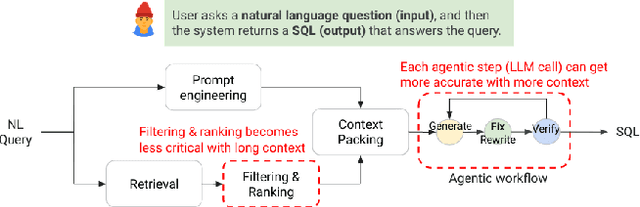
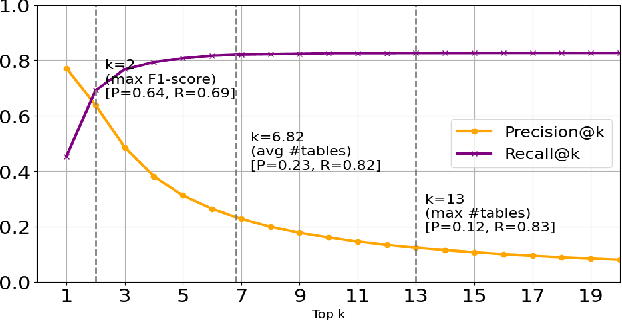

Large Language Models (LLMs) have demonstrated impressive capabilities across a range of natural language processing tasks. In particular, improvements in reasoning abilities and the expansion of context windows have opened new avenues for leveraging these powerful models. NL2SQL is challenging in that the natural language question is inherently ambiguous, while the SQL generation requires a precise understanding of complex data schema and semantics. One approach to this semantic ambiguous problem is to provide more and sufficient contextual information. In this work, we explore the performance and the latency trade-offs of the extended context window (a.k.a., long context) offered by Google's state-of-the-art LLM (\textit{gemini-1.5-pro}). We study the impact of various contextual information, including column example values, question and SQL query pairs, user-provided hints, SQL documentation, and schema. To the best of our knowledge, this is the first work to study how the extended context window and extra contextual information can help NL2SQL generation with respect to both accuracy and latency cost. We show that long context LLMs are robust and do not get lost in the extended contextual information. Additionally, our long-context NL2SQL pipeline based on Google's \textit{gemini-pro-1.5} achieve a strong performance with 67.41\% on BIRD benchmark (dev) without finetuning and expensive self-consistency based techniques.
A Two-Stage Proactive Dialogue Generator for Efficient Clinical Information Collection Using Large Language Model
Oct 02, 2024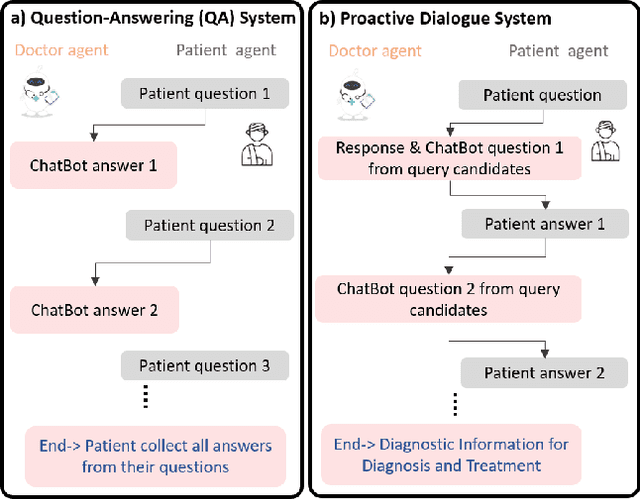

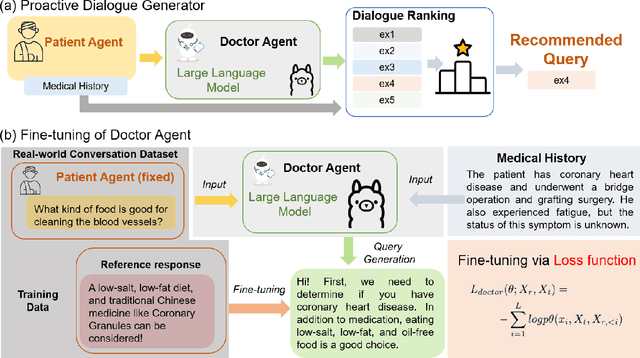
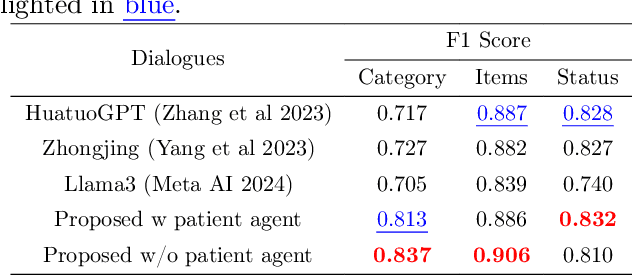
Efficient patient-doctor interaction is among the key factors for a successful disease diagnosis. During the conversation, the doctor could query complementary diagnostic information, such as the patient's symptoms, previous surgery, and other related information that goes beyond medical evidence data (test results) to enhance disease diagnosis. However, this procedure is usually time-consuming and less-efficient, which can be potentially optimized through computer-assisted systems. As such, we propose a diagnostic dialogue system to automate the patient information collection procedure. By exploiting medical history and conversation logic, our conversation agents, particularly the doctor agent, can pose multi-round clinical queries to effectively collect the most relevant disease diagnostic information. Moreover, benefiting from our two-stage recommendation structure, carefully designed ranking criteria, and interactive patient agent, our model is able to overcome the under-exploration and non-flexible challenges in dialogue generation. Our experimental results on a real-world medical conversation dataset show that our model can generate clinical queries that mimic the conversation style of real doctors, with efficient fluency, professionalism, and safety, while effectively collecting relevant disease diagnostic information.
Enhancing Screen Time Identification in Children with a Multi-View Vision Language Model and Screen Time Tracker
Oct 02, 2024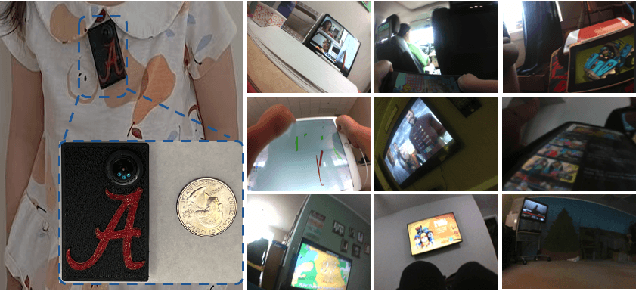

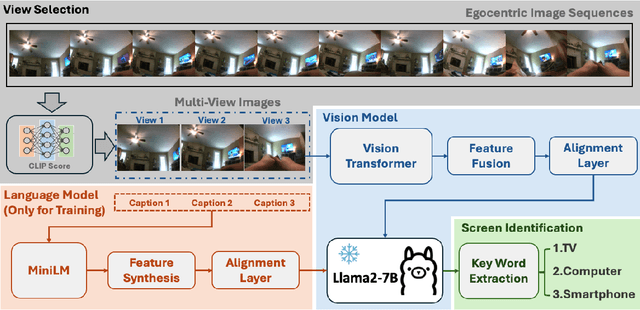

Being able to accurately monitor the screen exposure of young children is important for research on phenomena linked to screen use such as childhood obesity, physical activity, and social interaction. Most existing studies rely upon self-report or manual measures from bulky wearable sensors, thus lacking efficiency and accuracy in capturing quantitative screen exposure data. In this work, we developed a novel sensor informatics framework that utilizes egocentric images from a wearable sensor, termed the screen time tracker (STT), and a vision language model (VLM). In particular, we devised a multi-view VLM that takes multiple views from egocentric image sequences and interprets screen exposure dynamically. We validated our approach by using a dataset of children's free-living activities, demonstrating significant improvement over existing methods in plain vision language models and object detection models. Results supported the promise of this monitoring approach, which could optimize behavioral research on screen exposure in children's naturalistic settings.
CHASE-SQL: Multi-Path Reasoning and Preference Optimized Candidate Selection in Text-to-SQL
Oct 02, 2024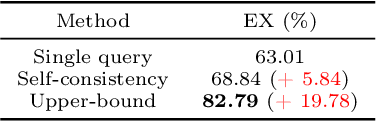
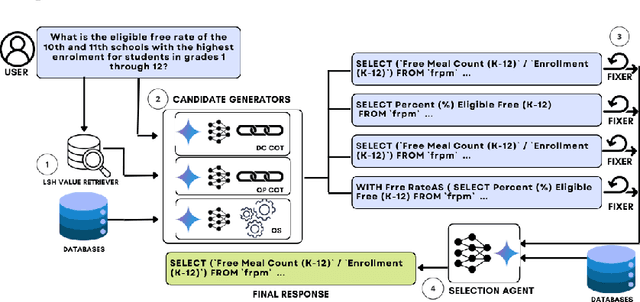
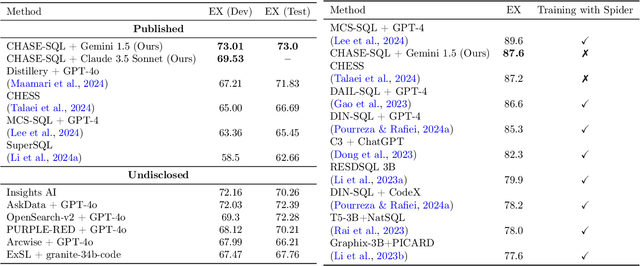
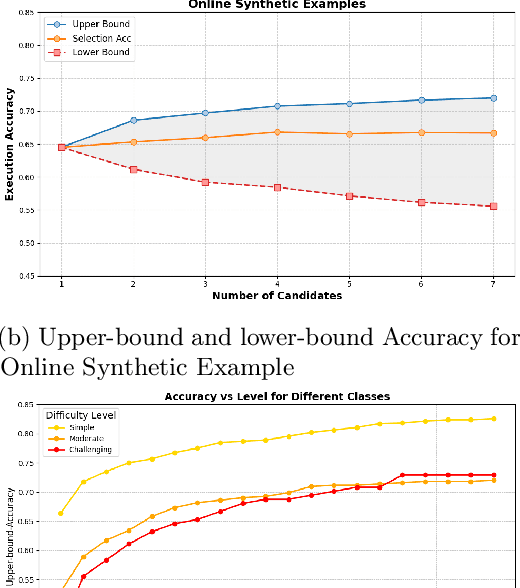
In tackling the challenges of large language model (LLM) performance for Text-to-SQL tasks, we introduce CHASE-SQL, a new framework that employs innovative strategies, using test-time compute in multi-agent modeling to improve candidate generation and selection. CHASE-SQL leverages LLMs' intrinsic knowledge to generate diverse and high-quality SQL candidates using different LLM generators with: (1) a divide-and-conquer method that decomposes complex queries into manageable sub-queries in a single LLM call; (2) chain-of-thought reasoning based on query execution plans, reflecting the steps a database engine takes during execution; and (3) a unique instance-aware synthetic example generation technique, which offers specific few-shot demonstrations tailored to test questions.To identify the best candidate, a selection agent is employed to rank the candidates through pairwise comparisons with a fine-tuned binary-candidates selection LLM. This selection approach has been demonstrated to be more robust over alternatives. The proposed generators-selector framework not only enhances the quality and diversity of SQL queries but also outperforms previous methods. Overall, our proposed CHASE-SQL achieves the state-of-the-art execution accuracy of 73.0% and 73.01% on the test set and development set of the notable BIRD Text-to-SQL dataset benchmark, rendering CHASE-SQL the top submission of the leaderboard (at the time of paper submission).
CardBench: A Benchmark for Learned Cardinality Estimation in Relational Databases
Aug 28, 2024Cardinality estimation is crucial for enabling high query performance in relational databases. Recently learned cardinality estimation models have been proposed to improve accuracy but there is no systematic benchmark or datasets which allows researchers to evaluate the progress made by new learned approaches and even systematically develop new learned approaches. In this paper, we are releasing a benchmark, containing thousands of queries over 20 distinct real-world databases for learned cardinality estimation. In contrast to other initial benchmarks, our benchmark is much more diverse and can be used for training and testing learned models systematically. Using this benchmark, we explored whether learned cardinality estimation can be transferred to an unseen dataset in a zero-shot manner. We trained GNN-based and transformer-based models to study the problem in three setups: 1-) instance-based, 2-) zero-shot, and 3-) fine-tuned. Our results show that while we get promising results for zero-shot cardinality estimation on simple single table queries; as soon as we add joins, the accuracy drops. However, we show that with fine-tuning, we can still utilize pre-trained models for cardinality estimation, significantly reducing training overheads compared to instance specific models. We are open sourcing our scripts to collect statistics, generate queries and training datasets to foster more extensive research, also from the ML community on the important problem of cardinality estimation and in particular improve on recent directions such as pre-trained cardinality estimation.
Push the Boundary of SAM: A Pseudo-label Correction Framework for Medical Segmentation
Aug 02, 2023Segment anything model (SAM) has emerged as the leading approach for zero-shot learning in segmentation, offering the advantage of avoiding pixel-wise annotation. It is particularly appealing in medical image segmentation where annotation is laborious and expertise-demanding. However, the direct application of SAM often yields inferior results compared to conventional fully supervised segmentation networks. While using SAM generated pseudo label could also benefit the training of fully supervised segmentation, the performance is limited by the quality of pseudo labels. In this paper, we propose a novel label corruption to push the boundary of SAM-based segmentation. Our model utilizes a novel noise detection module to distinguish between noisy labels from clean labels. This enables us to correct the noisy labels using an uncertainty-based self-correction module, thereby enriching the clean training set. Finally, we retrain the network with updated labels to optimize its weights for future predictions. One key advantage of our model is its ability to train deep networks using SAM-generated pseudo labels without relying on a subset of expert-level annotations. We demonstrate the effectiveness of our proposed model on both X-ray and lung CT datasets, indicating its ability to improve segmentation accuracy and outperform baseline methods in label correction.