 Add to Chrome
 Add to Firefox
 Add to Edge
A Complexity Measure for Active Learning in Multi-group Mean Estimation
Jun 12, 2026
We study a \emph{max-risk} objective for active learning in a multi-group mean estimation $d$-armed bandits: a learner adaptively allocates a budget of $T$ samples across $d$ groups to minimize the worst-case uncertainty index $\max_{k\in[d]}σ_k^2/n_k$, where $σ_k$ is the standard deviation of the distribution of arm $d$, and $n_k$ is the number of times arm $d$ is sampled. We develop a local minimax framework and prove the first general lower bound for this objective, valid for any finite-variance hypothesis class. The bound separates difficulty into three orthogonal factors: a \emph{budget} term, a \emph{heteroscedasticity} index measuring how unevenly the uncertainty is spread across arms, and a model-dependent complexity measure, the \emph{Variance Local Curvature} ($\mathrm{VLC}$), which captures how much information a local change of variance creates inside the hypothesis class. For smooth classes, the $\mathrm{VLC}$ is a reparametrization of a variance--Fisher information, with closed-form values for common families. Benchmarking against the strongest available upper bound shows near-optimality up to logarithmic factors in broad regimes, and pinpoints a systematic gap in highly heterogeneous instances. Our proof introduces two key ingredients: a loss-induced $\ell_1$ geometry on the decision space, and a representation-based instance generator that reduces hard-instance construction to an explicit random matrix calculation.

ContinuousBench: Can Differentially Private Synthetic Text Improve Capabilities?
Jun 01, 2026Differentially private (DP) text synthesis promises to unlock sensitive corpora for model training, but it remains unclear whether DP synthetic data transmits genuinely new knowledge and capabilities present only in those corpora. This is because existing evaluations rely on tasks that are nearly solvable without training, so strong benchmark performance does not establish that DP synthesis can substitute original data access. Thus, we introduce ContinuousBench, a continuously and automatically-regenerated benchmark that measures capability gain from DP synthetic text. Each quarter, a new release pairs a never-before-seen training corpus with a derived QA set, constructed to be: (1) unsolvable sans-corpus; and (2) learnable under DP, as the tested knowledge is supported by hundreds of independent records. Researchers produce DP synthetic data from the training corpus and run our standardized training and evaluation harness on their synthetic data to measure gains. We instantiate two tracks: Geminon, a procedurally-generated dataset about fictional creatures; and News, a stream of newly crawled public news articles. Although standard benchmarks are nearly saturated, on ContinuousBench we find that non-private synthesis transfers substantial knowledge from the original corpus, while state-of-the-art DP synthesis methods generally fail to do so, even at $\varepsilon=100$.
Integrating Feature Correlation in Differential Privacy with Applications in DP-ERM
May 05, 2026Standard differential privacy imposes uniform privacy constraints across all features, overlooking the inherent distinction between sensitive and insensitive features in practice. In this paper, we introduce a relaxed definition of differential privacy that accounts for such heterogeneity, allowing certain features to be treated as insensitive even when correlated with sensitive ones. We propose a correlation-aware framework, $\textsf{CorrDP}$, which relaxes privacy for insensitive features while accounting for their correlations with sensitive features, with the correlations quantified using total variation distance. We design algorithms for differentially private empirical risk minimization (DP-ERM) under the $\textsf{CorrDP}$ framework, incorporating distance-dependent noise into gradients for improved theoretical utility guarantees. When the correlation distance is unknown, we estimate it from the dataset and show that it achieves a comparable privacy-utility guarantee. We perform experiments on synthetic and real-world datasets and show that $\textsf{CorrDP}$-based DP-ERM algorithms consistently outperform the standard DP framework in the presence of insensitive features.
Beyond Laplace and Gaussian: Exploring the Generalized Gaussian Mechanism for Private Machine Learning
Jun 14, 2025Differential privacy (DP) is obtained by randomizing a data analysis algorithm, which necessarily introduces a tradeoff between its utility and privacy. Many DP mechanisms are built upon one of two underlying tools: Laplace and Gaussian additive noise mechanisms. We expand the search space of algorithms by investigating the Generalized Gaussian mechanism, which samples the additive noise term $x$ with probability proportional to $e^{-\frac{| x |}{\sigma}^{\beta} }$ for some $\beta \geq 1$. The Laplace and Gaussian mechanisms are special cases of GG for $\beta=1$ and $\beta=2$, respectively. In this work, we prove that all members of the GG family satisfy differential privacy, and provide an extension of an existing numerical accountant (the PRV accountant) for these mechanisms. We show that privacy accounting for the GG Mechanism and its variants is dimension independent, which substantially improves computational costs of privacy accounting. We apply the GG mechanism to two canonical tools for private machine learning, PATE and DP-SGD; we show empirically that $\beta$ has a weak relationship with test-accuracy, and that generally $\beta=2$ (Gaussian) is nearly optimal. This provides justification for the widespread adoption of the Gaussian mechanism in DP learning, and can be interpreted as a negative result, that optimizing over $\beta$ does not lead to meaningful improvements in performance.
An active learning framework for multi-group mean estimation
May 20, 2025We study a fundamental learning problem over multiple groups with unknown data distributions, where an analyst would like to learn the mean of each group. Moreover, we want to ensure that this data is collected in a relatively fair manner such that the noise of the estimate of each group is reasonable. In particular, we focus on settings where data are collected dynamically, which is important in adaptive experimentation for online platforms or adaptive clinical trials for healthcare. In our model, we employ an active learning framework to sequentially collect samples with bandit feedback, observing a sample in each period from the chosen group. After observing a sample, the analyst updates their estimate of the mean and variance of that group and chooses the next group accordingly. The analyst's objective is to dynamically collect samples to minimize the collective noise of the estimators, measured by the norm of the vector of variances of the mean estimators. We propose an algorithm, Variance-UCB, that sequentially selects groups according to an upper confidence bound on the variance estimate. We provide a general theoretical framework for providing efficient bounds on learning from any underlying distribution where the variances can be estimated reasonably. This framework yields upper bounds on regret that improve significantly upon all existing bounds, as well as a collection of new results for different objectives and distributions than those previously studied.
ClusterSC: Advancing Synthetic Control with Donor Selection
Mar 27, 2025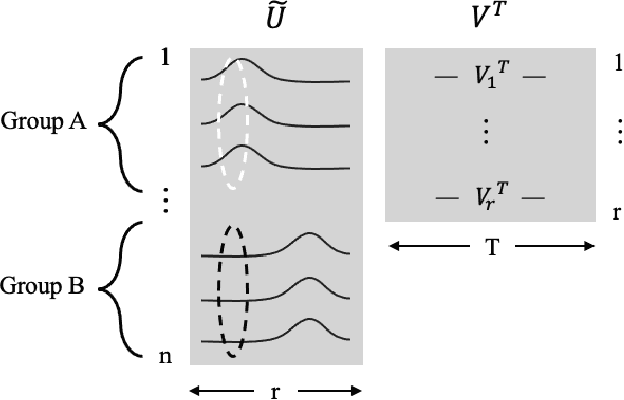
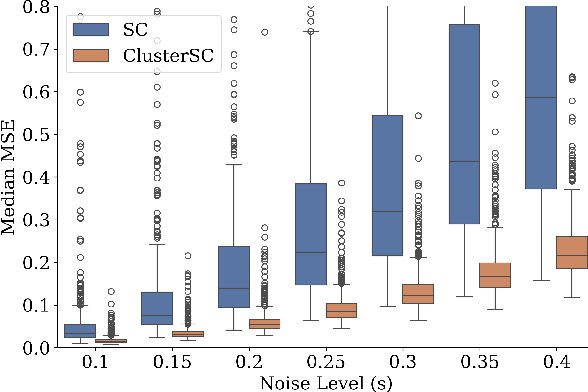
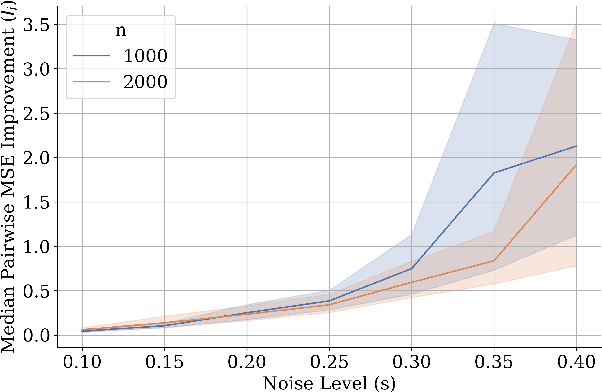
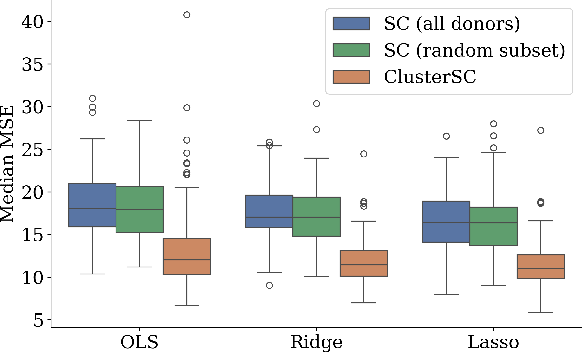
In causal inference with observational studies, synthetic control (SC) has emerged as a prominent tool. SC has traditionally been applied to aggregate-level datasets, but more recent work has extended its use to individual-level data. As they contain a greater number of observed units, this shift introduces the curse of dimensionality to SC. To address this, we propose Cluster Synthetic Control (ClusterSC), based on the idea that groups of individuals may exist where behavior aligns internally but diverges between groups. ClusterSC incorporates a clustering step to select only the relevant donors for the target. We provide theoretical guarantees on the improvements induced by ClusterSC, supported by empirical demonstrations on synthetic and real-world datasets. The results indicate that ClusterSC consistently outperforms classical SC approaches.
Differential Privacy Under Class Imbalance: Methods and Empirical Insights
Nov 08, 2024
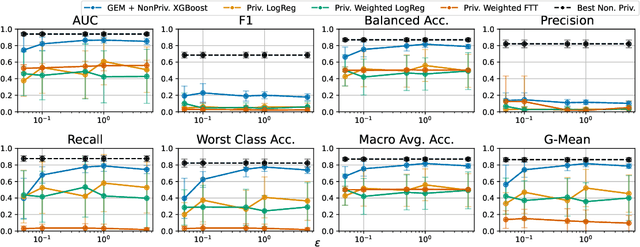
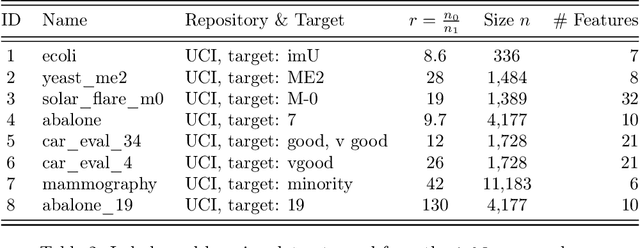
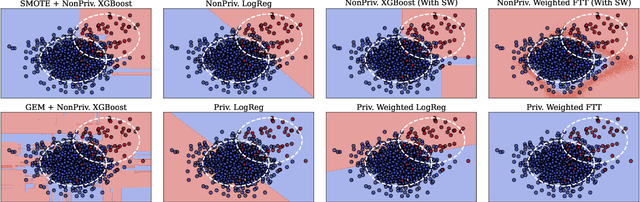
Imbalanced learning occurs in classification settings where the distribution of class-labels is highly skewed in the training data, such as when predicting rare diseases or in fraud detection. This class imbalance presents a significant algorithmic challenge, which can be further exacerbated when privacy-preserving techniques such as differential privacy are applied to protect sensitive training data. Our work formalizes these challenges and provides a number of algorithmic solutions. We consider DP variants of pre-processing methods that privately augment the original dataset to reduce the class imbalance; these include oversampling, SMOTE, and private synthetic data generation. We also consider DP variants of in-processing techniques, which adjust the learning algorithm to account for the imbalance; these include model bagging, class-weighted empirical risk minimization and class-weighted deep learning. For each method, we either adapt an existing imbalanced learning technique to the private setting or demonstrate its incompatibility with differential privacy. Finally, we empirically evaluate these privacy-preserving imbalanced learning methods under various data and distributional settings. We find that private synthetic data methods perform well as a data pre-processing step, while class-weighted ERMs are an alternative in higher-dimensional settings where private synthetic data suffers from the curse of dimensionality.
Thompson Sampling Itself is Differentially Private
Jul 20, 2024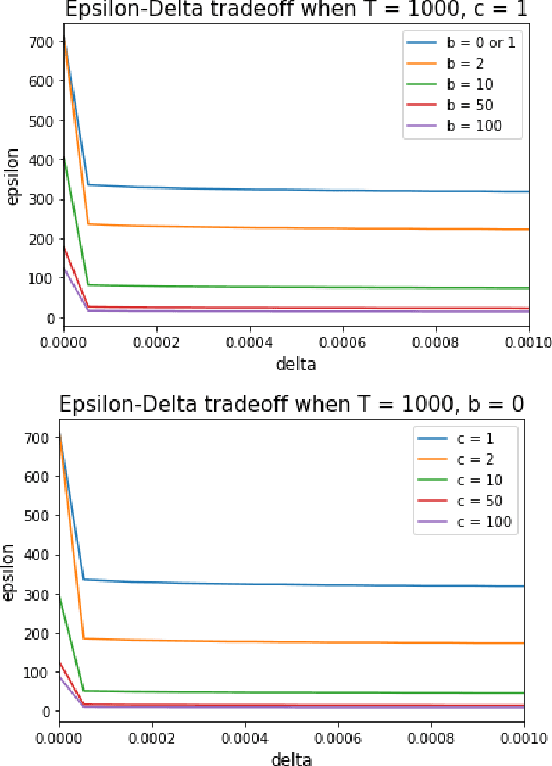
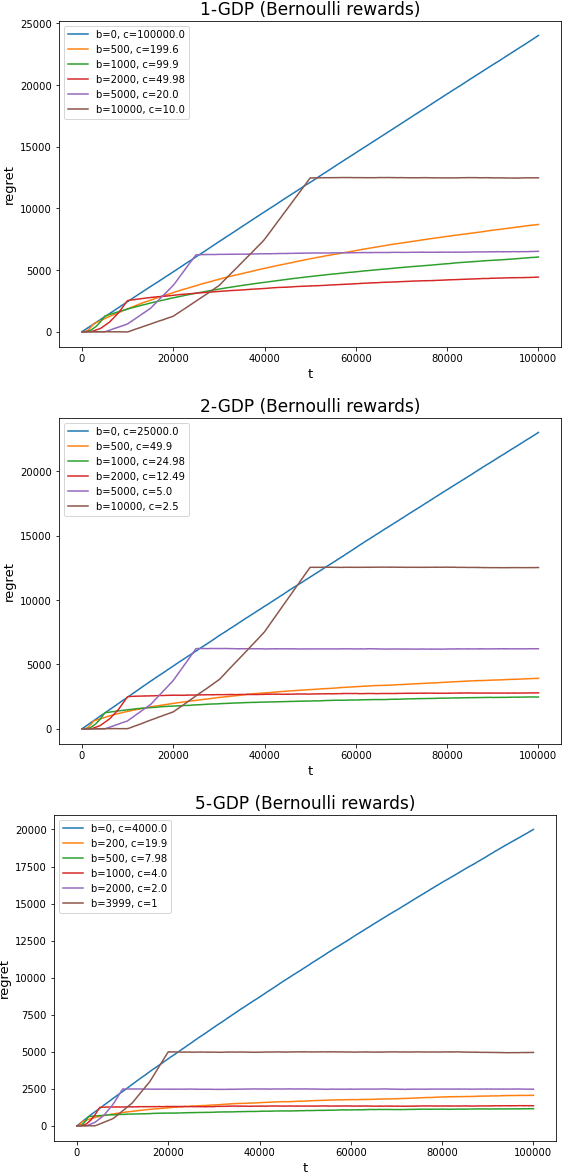
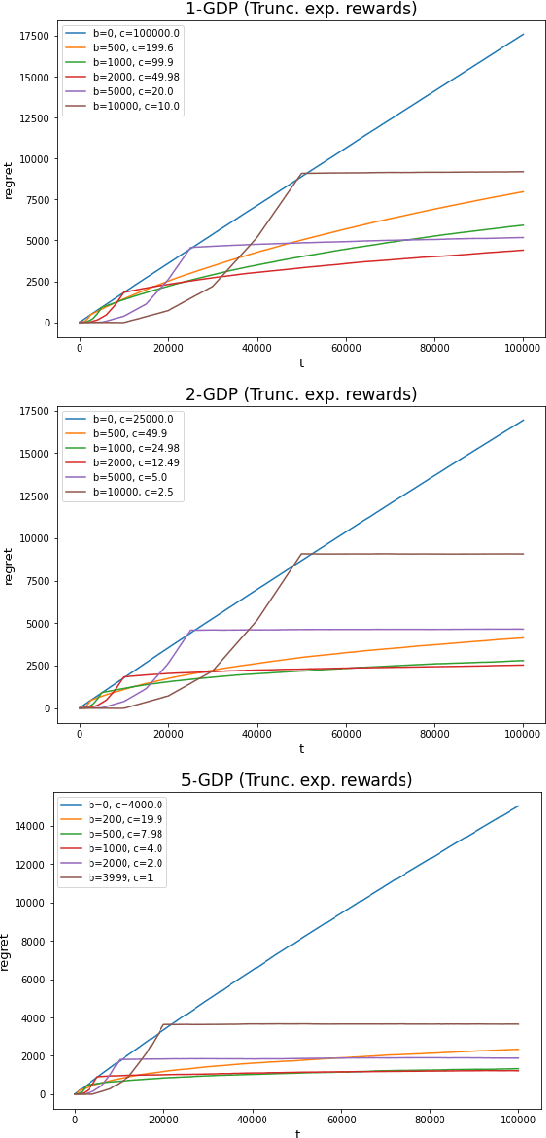
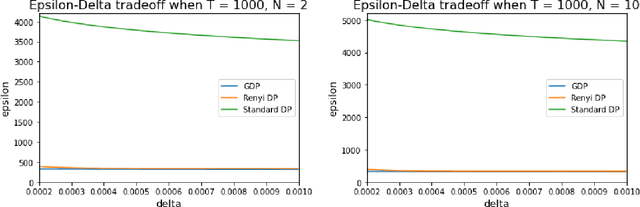
In this work we first show that the classical Thompson sampling algorithm for multi-arm bandits is differentially private as-is, without any modification. We provide per-round privacy guarantees as a function of problem parameters and show composition over $T$ rounds; since the algorithm is unchanged, existing $O(\sqrt{NT\log N})$ regret bounds still hold and there is no loss in performance due to privacy. We then show that simple modifications -- such as pre-pulling all arms a fixed number of times, increasing the sampling variance -- can provide tighter privacy guarantees. We again provide privacy guarantees that now depend on the new parameters introduced in the modification, which allows the analyst to tune the privacy guarantee as desired. We also provide a novel regret analysis for this new algorithm, and show how the new parameters also impact expected regret. Finally, we empirically validate and illustrate our theoretical findings in two parameter regimes and demonstrate that tuning the new parameters substantially improve the privacy-regret tradeoff.
Mean Estimation with User-level Privacy under Data Heterogeneity
Jul 28, 2023A key challenge in many modern data analysis tasks is that user data are heterogeneous. Different users may possess vastly different numbers of data points. More importantly, it cannot be assumed that all users sample from the same underlying distribution. This is true, for example in language data, where different speech styles result in data heterogeneity. In this work we propose a simple model of heterogeneous user data that allows user data to differ in both distribution and quantity of data, and provide a method for estimating the population-level mean while preserving user-level differential privacy. We demonstrate asymptotic optimality of our estimator and also prove general lower bounds on the error achievable in the setting we introduce.
Differentially Private Synthetic Control
Mar 24, 2023
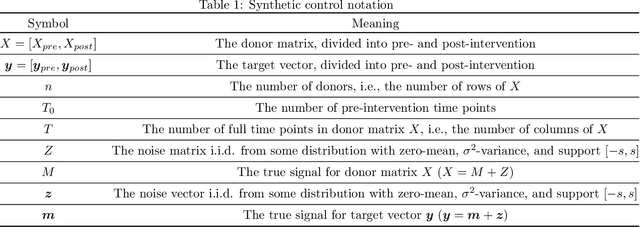
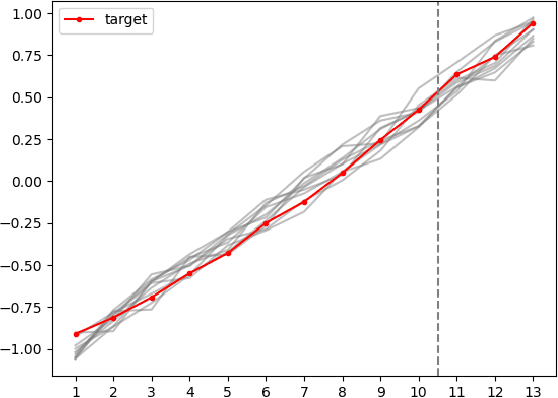
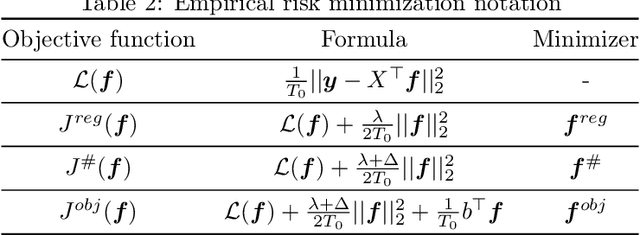
Synthetic control is a causal inference tool used to estimate the treatment effects of an intervention by creating synthetic counterfactual data. This approach combines measurements from other similar observations (i.e., donor pool ) to predict a counterfactual time series of interest (i.e., target unit) by analyzing the relationship between the target and the donor pool before the intervention. As synthetic control tools are increasingly applied to sensitive or proprietary data, formal privacy protections are often required. In this work, we provide the first algorithms for differentially private synthetic control with explicit error bounds. Our approach builds upon tools from non-private synthetic control and differentially private empirical risk minimization. We provide upper and lower bounds on the sensitivity of the synthetic control query and provide explicit error bounds on the accuracy of our private synthetic control algorithms. We show that our algorithms produce accurate predictions for the target unit, and that the cost of privacy is small. Finally, we empirically evaluate the performance of our algorithm, and show favorable performance in a variety of parameter regimes, as well as providing guidance to practitioners for hyperparameter tuning.