 Add to Chrome
 Add to Firefox
 Add to Edge
ContinuousBench: Can Differentially Private Synthetic Text Improve Capabilities?
Jun 01, 2026
Differentially private (DP) text synthesis promises to unlock sensitive corpora for model training, but it remains unclear whether DP synthetic data transmits genuinely new knowledge and capabilities present only in those corpora. This is because existing evaluations rely on tasks that are nearly solvable without training, so strong benchmark performance does not establish that DP synthesis can substitute original data access. Thus, we introduce ContinuousBench, a continuously and automatically-regenerated benchmark that measures capability gain from DP synthetic text. Each quarter, a new release pairs a never-before-seen training corpus with a derived QA set, constructed to be: (1) unsolvable sans-corpus; and (2) learnable under DP, as the tested knowledge is supported by hundreds of independent records. Researchers produce DP synthetic data from the training corpus and run our standardized training and evaluation harness on their synthetic data to measure gains. We instantiate two tracks: Geminon, a procedurally-generated dataset about fictional creatures; and News, a stream of newly crawled public news articles. Although standard benchmarks are nearly saturated, on ContinuousBench we find that non-private synthesis transfers substantial knowledge from the original corpus, while state-of-the-art DP synthesis methods generally fail to do so, even at $\varepsilon=100$.

Engineering Robustness into Personal Agents with the AI Workflow Store
May 11, 2026The dominant paradigm for AI agents is an "on-the-fly" loop in which agents synthesize plans and execute actions within seconds or minutes in response to user prompts. We argue that this paradigm short-circuits disciplined software engineering (SE) processes -- iterative design, rigorous testing, adversarial evaluation, staged deployment, and more -- that have delivered the (relatively) reliable and secure systems we use today. By focusing on rapid, real-time synthesis, are AI agents effectively delivering users improvised prototypes rather than systems fit for high-stakes scenarios in which users may unwittingly apply them? This paper argues for the need to integrate rigorous SE processes into the agentic loop to produce production-grade, hardened, and deterministically-constrained agent *workflows* that substantially outperform the potentially brittle and vulnerable results of on-the-fly synthesis. Doing so may require extra compute and time, and if so, we must amortize the cost of rigor through reuse across a broad user community. We envision an *AI Workflow Store* that consists of hardened and reusable workflows that agents can invoke with far greater reliability and security than improvised tool chains. We outline the research challenges of this vision, which stem from a broader flexibility-robustness tension that we argue requires moving beyond the ``on-the-fly'' paradigm to navigate effectively.
An AI Agent Execution Environment to Safeguard User Data
Apr 21, 2026AI agents promise to serve as general-purpose personal assistants for their users, which requires them to have access to private user data (e.g., personal and financial information). This poses a serious risk to security and privacy. Adversaries may attack the AI model (e.g., via prompt injection) to exfiltrate user data. Furthermore, sharing private data with an AI agent requires users to trust a potentially unscrupulous or compromised AI model provider with their private data. This paper presents GAAP (Guaranteed Accounting for Agent Privacy), an execution environment for AI agents that guarantees confidentiality for private user data. Through dynamic and directed user prompts, GAAP collects permission specifications from users describing how their private data may be shared, and GAAP enforces that the agent's disclosures of private user data, including disclosures to the AI model and its provider, comply with these specifications. Crucially, GAAP provides this guarantee deterministically, without trusting the agent with private user data, and without requiring any AI model or the user prompt to be free of attacks. GAAP enforces the user's permission specification by tracking how the AI agent accesses and uses private user data. It augments Information Flow Control with novel persistent data stores and annotations that enable it to track the flow of private information both across execution steps within a single task, and also over multiple tasks separated in time. Our evaluation confirms that GAAP blocks all data disclosure attacks, including those that make other state-of-the-art systems disclose private user data to untrusted parties, without a significant impact on agent utility.
Context is Key for Agent Security
Jan 29, 2025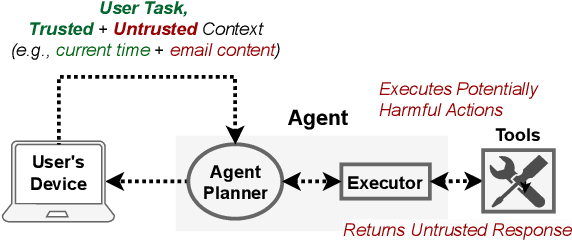
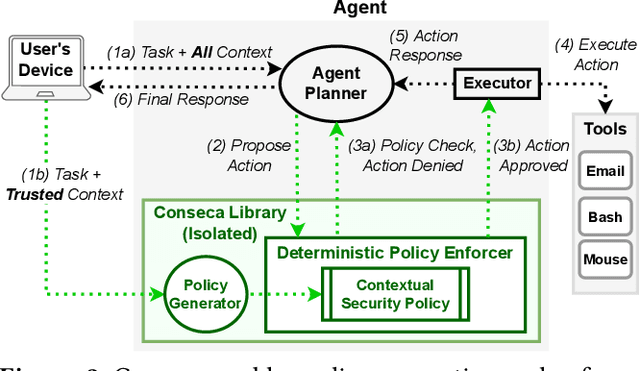
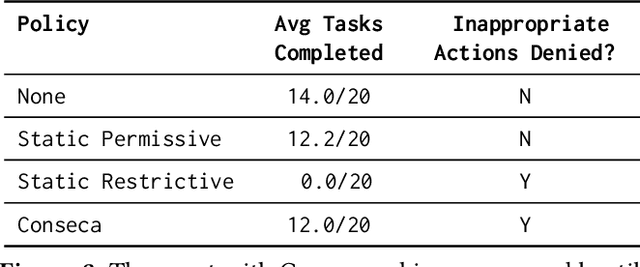
Judging the safety of an action, whether taken by a human or a system, must take into account the context in which the action takes place. For example, deleting an email from a user's mailbox may or may not be appropriate depending on the email's content, the user's goals, or even available space. Systems today that make these judgements -- providing security against harmful or inappropriate actions -- rely on manually-crafted policies or user confirmation for each relevant context. With the upcoming deployment of systems like generalist agents, we argue that we must rethink security designs to adapt to the scale of contexts and capabilities of these systems. As a first step, this paper explores contextual security in the domain of agents and proposes contextual security for agents (Conseca), a framework to generate just-in-time, contextual, and human-verifiable security policies.