 Add to Chrome
 Add to Firefox
 Add to Edge
One Retrieval to Cover Them All: Co-occurrence-Aware Knowledge Base Reorganization for Session-Level RAG
Jun 30, 2026
RAG systems retrieve documents optimized for answering one query at a time. Yet enterprise users arrive with sessions, that is, coherent episodes of related questions that span semantically distant parts of the knowledge base. We show that a single retrieval call over a standard knowledge base covers only 41% of a user's session-level information need. To close this gap, we reorganize the KB offline using co-occurrence-aware clustering and expand retrieval candidates through cluster neighborhoods at query time. On WixQA (6,221 enterprise support articles), our method raises single-query session coverage to 58% (+17% absolute; 95% CI: [14.1, 20.4]), reduces retrieval calls to 70% coverage by 34%, and compresses the KB to 20% of its original size, all consistently across four embedding models and six functional domains. We argue that session-level coverage, not single-query recall, should be the primary metric for enterprise RAG evaluation.

Do LLM Embedding Spaces Recover Expert Structure?
Jun 22, 2026Pretrained text embeddings are increasingly used as representational maps, yet high category separability does not imply that their geometry recovers expert-defined structure. We study this problem in mental-health-related language, where symptom relations provide an external reference and online communities introduce strong domain, affective, stylistic, and discourse confounds. Using 28 Reddit communities, we compare pretrained and supervised fine-tuned Qwen3 embedding spaces at two scales (0.6B and 4B). We construct category prototypes, evaluate their representational dissimilarity matrices against an expert symptom matrix with representational similarity analysis, and complement this global test with prototype-based typicality and multi-baseline confound controls. Pretrained embeddings show measurable alignment with expert structure within the mental-health subset; fine-tuning strengthens this alignment most at the finest category level; and larger scale improves both zero-shot alignment and supervision-induced gains. Residual alignment remains substantial after controlling for VAD, LIWC, lexical style, and topic-distribution structure. These results suggest that LLM embeddings can recover expert-relevant category geometry, but this recovery is level-dependent and should be tested against explicit confounds rather than inferred from classification alone.
VARestorer: One-Step VAR Distillation for Real-World Image Super-Resolution
Apr 23, 2026Recent advancements in visual autoregressive models (VAR) have demonstrated their effectiveness in image generation, highlighting their potential for real-world image super-resolution (Real-ISR). However, adapting VAR for ISR presents critical challenges. The next-scale prediction mechanism, constrained by causal attention, fails to fully exploit global low-quality (LQ) context, resulting in blurry and inconsistent high-quality (HQ) outputs. Additionally, error accumulation in the iterative prediction severely degrades coherence in ISR task. To address these issues, we propose VARestorer, a simple yet effective distillation framework that transforms a pre-trained text-to-image VAR model into a one-step ISR model. By leveraging distribution matching, our method eliminates the need for iterative refinement, significantly reducing error propagation and inference time. Furthermore, we introduce pyramid image conditioning with cross-scale attention, which enables bidirectional scale-wise interactions and fully utilizes the input image information while adapting to the autoregressive mechanism. This prevents later LQ tokens from being overlooked in the transformer. By fine-tuning only 1.2\% of the model parameters through parameter-efficient adapters, our method maintains the expressive power of the original VAR model while significantly enhancing efficiency. Extensive experiments show that VARestorer achieves state-of-the-art performance with 72.32 MUSIQ and 0.7669 CLIPIQA on DIV2K dataset, while accelerating inference by 10 times compared to conventional VAR inference.
Astra: General Interactive World Model with Autoregressive Denoising
Dec 15, 2025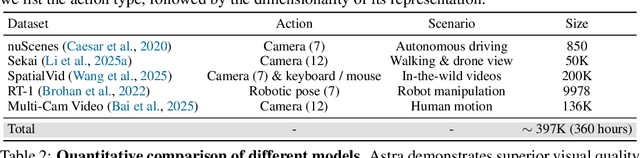
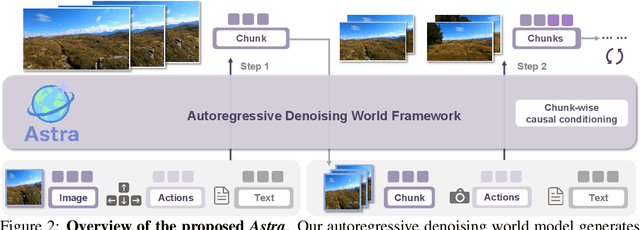

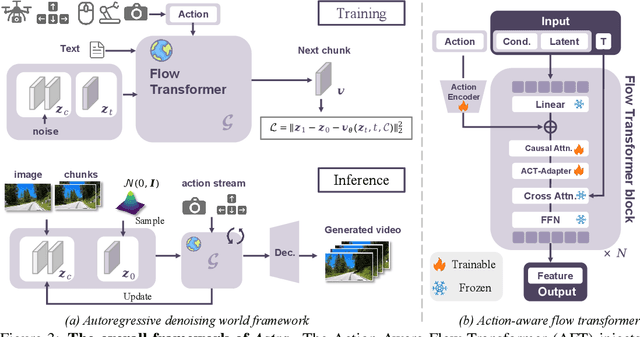
Recent advances in diffusion transformers have empowered video generation models to generate high-quality video clips from texts or images. However, world models with the ability to predict long-horizon futures from past observations and actions remain underexplored, especially for general-purpose scenarios and various forms of actions. To bridge this gap, we introduce Astra, an interactive general world model that generates real-world futures for diverse scenarios (e.g., autonomous driving, robot grasping) with precise action interactions (e.g., camera motion, robot action). We propose an autoregressive denoising architecture and use temporal causal attention to aggregate past observations and support streaming outputs. We use a noise-augmented history memory to avoid over-reliance on past frames to balance responsiveness with temporal coherence. For precise action control, we introduce an action-aware adapter that directly injects action signals into the denoising process. We further develop a mixture of action experts that dynamically route heterogeneous action modalities, enhancing versatility across diverse real-world tasks such as exploration, manipulation, and camera control. Astra achieves interactive, consistent, and general long-term video prediction and supports various forms of interactions. Experiments across multiple datasets demonstrate the improvements of Astra in fidelity, long-range prediction, and action alignment over existing state-of-the-art world models.
ScoreHOI: Physically Plausible Reconstruction of Human-Object Interaction via Score-Guided Diffusion
Sep 09, 2025Joint reconstruction of human-object interaction marks a significant milestone in comprehending the intricate interrelations between humans and their surrounding environment. Nevertheless, previous optimization methods often struggle to achieve physically plausible reconstruction results due to the lack of prior knowledge about human-object interactions. In this paper, we introduce ScoreHOI, an effective diffusion-based optimizer that introduces diffusion priors for the precise recovery of human-object interactions. By harnessing the controllability within score-guided sampling, the diffusion model can reconstruct a conditional distribution of human and object pose given the image observation and object feature. During inference, the ScoreHOI effectively improves the reconstruction results by guiding the denoising process with specific physical constraints. Furthermore, we propose a contact-driven iterative refinement approach to enhance the contact plausibility and improve the reconstruction accuracy. Extensive evaluations on standard benchmarks demonstrate ScoreHOI's superior performance over state-of-the-art methods, highlighting its ability to achieve a precise and robust improvement in joint human-object interaction reconstruction.
FADE: Frequency-Aware Diffusion Model Factorization for Video Editing
Jun 06, 2025Recent advancements in diffusion frameworks have significantly enhanced video editing, achieving high fidelity and strong alignment with textual prompts. However, conventional approaches using image diffusion models fall short in handling video dynamics, particularly for challenging temporal edits like motion adjustments. While current video diffusion models produce high-quality results, adapting them for efficient editing remains difficult due to the heavy computational demands that prevent the direct application of previous image editing techniques. To overcome these limitations, we introduce FADE, a training-free yet highly effective video editing approach that fully leverages the inherent priors from pre-trained video diffusion models via frequency-aware factorization. Rather than simply using these models, we first analyze the attention patterns within the video model to reveal how video priors are distributed across different components. Building on these insights, we propose a factorization strategy to optimize each component's specialized role. Furthermore, we devise spectrum-guided modulation to refine the sampling trajectory with frequency domain cues, preventing information leakage and supporting efficient, versatile edits while preserving the basic spatial and temporal structure. Extensive experiments on real-world videos demonstrate that our method consistently delivers high-quality, realistic and temporally coherent editing results both qualitatively and quantitatively. Code is available at https://github.com/EternalEvan/FADE .
InstaRevive: One-Step Image Enhancement via Dynamic Score Matching
Apr 22, 2025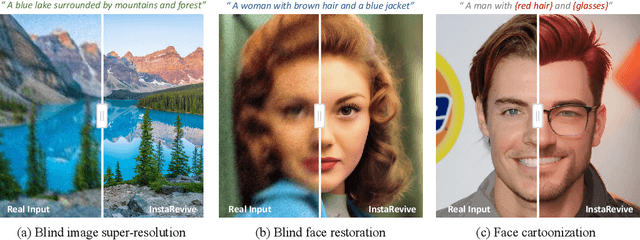
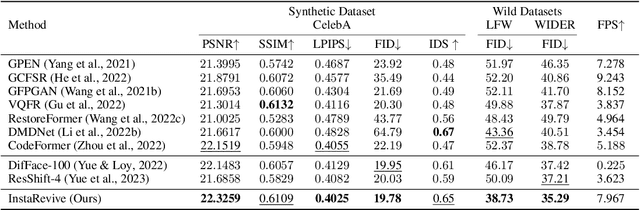
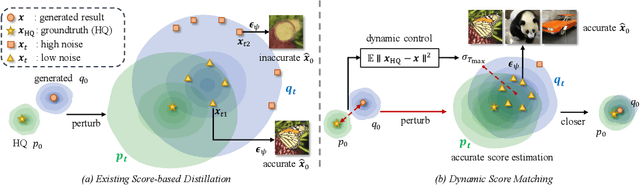
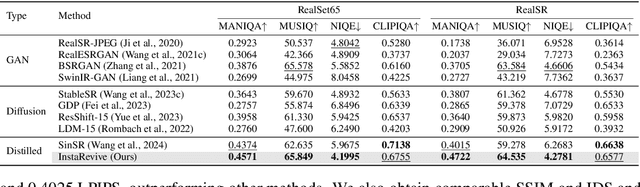
Image enhancement finds wide-ranging applications in real-world scenarios due to complex environments and the inherent limitations of imaging devices. Recent diffusion-based methods yield promising outcomes but necessitate prolonged and computationally intensive iterative sampling. In response, we propose InstaRevive, a straightforward yet powerful image enhancement framework that employs score-based diffusion distillation to harness potent generative capability and minimize the sampling steps. To fully exploit the potential of the pre-trained diffusion model, we devise a practical and effective diffusion distillation pipeline using dynamic control to address inaccuracies in updating direction during score matching. Our control strategy enables a dynamic diffusing scope, facilitating precise learning of denoising trajectories within the diffusion model and ensuring accurate distribution matching gradients during training. Additionally, to enrich guidance for the generative power, we incorporate textual prompts via image captioning as auxiliary conditions, fostering further exploration of the diffusion model. Extensive experiments substantiate the efficacy of our framework across a diverse array of challenging tasks and datasets, unveiling the compelling efficacy and efficiency of InstaRevive in delivering high-quality and visually appealing results. Code is available at https://github.com/EternalEvan/InstaRevive.
FlowIE: Efficient Image Enhancement via Rectified Flow
Jun 01, 2024
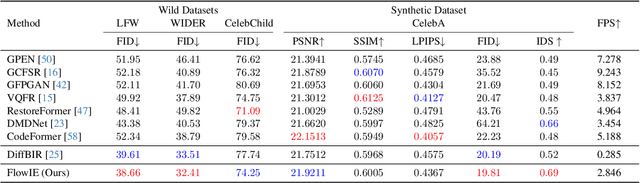
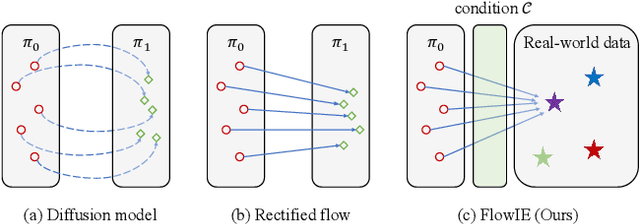

Image enhancement holds extensive applications in real-world scenarios due to complex environments and limitations of imaging devices. Conventional methods are often constrained by their tailored models, resulting in diminished robustness when confronted with challenging degradation conditions. In response, we propose FlowIE, a simple yet highly effective flow-based image enhancement framework that estimates straight-line paths from an elementary distribution to high-quality images. Unlike previous diffusion-based methods that suffer from long-time inference, FlowIE constructs a linear many-to-one transport mapping via conditioned rectified flow. The rectification straightens the trajectories of probability transfer, accelerating inference by an order of magnitude. This design enables our FlowIE to fully exploit rich knowledge in the pre-trained diffusion model, rendering it well-suited for various real-world applications. Moreover, we devise a faster inference algorithm, inspired by Lagrange's Mean Value Theorem, harnessing midpoint tangent direction to optimize path estimation, ultimately yielding visually superior results. Thanks to these designs, our FlowIE adeptly manages a diverse range of enhancement tasks within a concise sequence of fewer than 5 steps. Our contributions are rigorously validated through comprehensive experiments on synthetic and real-world datasets, unveiling the compelling efficacy and efficiency of our proposed FlowIE. Code is available at https://github.com/EternalEvan/FlowIE.
DPMesh: Exploiting Diffusion Prior for Occluded Human Mesh Recovery
Apr 01, 2024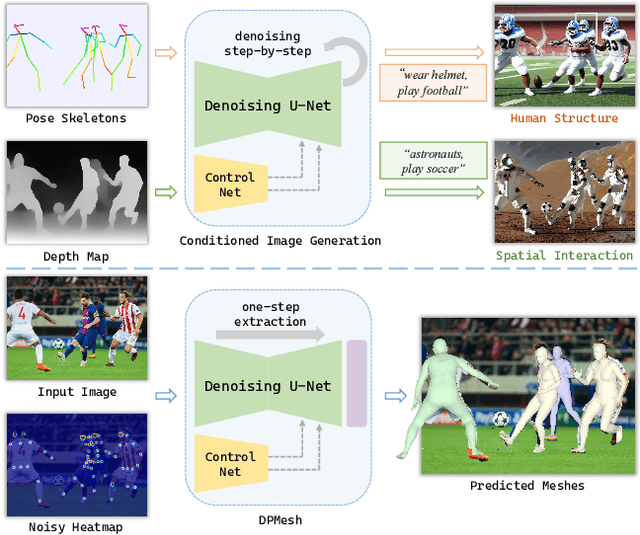
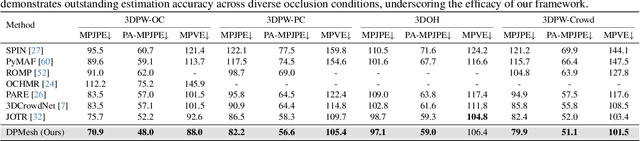
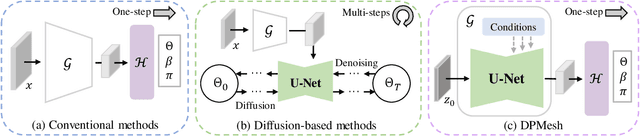
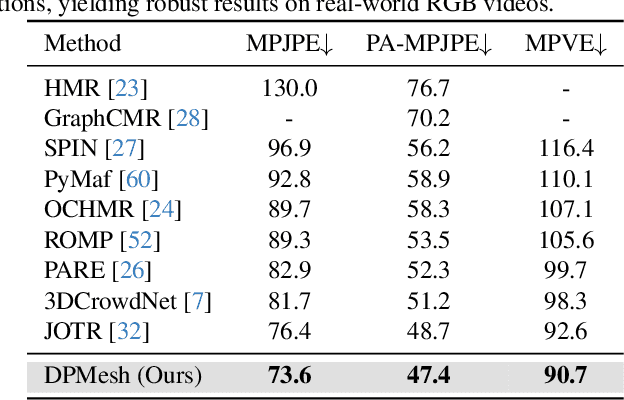
The recovery of occluded human meshes presents challenges for current methods due to the difficulty in extracting effective image features under severe occlusion. In this paper, we introduce DPMesh, an innovative framework for occluded human mesh recovery that capitalizes on the profound diffusion prior about object structure and spatial relationships embedded in a pre-trained text-to-image diffusion model. Unlike previous methods reliant on conventional backbones for vanilla feature extraction, DPMesh seamlessly integrates the pre-trained denoising U-Net with potent knowledge as its image backbone and performs a single-step inference to provide occlusion-aware information. To enhance the perception capability for occluded poses, DPMesh incorporates well-designed guidance via condition injection, which produces effective controls from 2D observations for the denoising U-Net. Furthermore, we explore a dedicated noisy key-point reasoning approach to mitigate disturbances arising from occlusion and crowded scenarios. This strategy fully unleashes the perceptual capability of the diffusion prior, thereby enhancing accuracy. Extensive experiments affirm the efficacy of our framework, as we outperform state-of-the-art methods on both occlusion-specific and standard datasets. The persuasive results underscore its ability to achieve precise and robust 3D human mesh recovery, particularly in challenging scenarios involving occlusion and crowded scenes.
Window Stacking Meta-Models for Clinical EEG Classification
Jan 14, 2024Windowing is a common technique in EEG machine learning classification and other time series tasks. However, a challenge arises when employing this technique: computational expense inhibits learning global relationships across an entire recording or set of recordings. Furthermore, the labels inherited by windows from their parent recordings may not accurately reflect the content of that window in isolation. To resolve these issues, we introduce a multi-stage model architecture, incorporating meta-learning principles tailored to time-windowed data aggregation. We further tested two distinct strategies to alleviate these issues: lengthening the window and utilizing overlapping to augment data. Our methods, when tested on the Temple University Hospital Abnormal EEG Corpus (TUAB), dramatically boosted the benchmark accuracy from 89.8 percent to 99.0 percent. This breakthrough performance surpasses prior performance projections for this dataset and paves the way for clinical applications of machine learning solutions to EEG interpretation challenges. On a broader and more varied dataset from the Temple University Hospital EEG Corpus (TUEG), we attained an accuracy of 86.7%, nearing the assumed performance ceiling set by variable inter-rater agreement on such datasets.