 Add to Chrome
 Add to Firefox
 Add to Edge
FoodMonitor: Benchmarking MLLMs for Explainable Compliance Analysis
May 23, 2026
As AI-powered compliance monitoring becomes increasingly important in public governance and industrial safety, the ability to provide verifiable evidence and traceable accountability signals is essential. However, existing video anomaly detection datasets focus on event-level binary classification, lacking the rule-driven, explainable analysis required for real-world compliance scenarios. We introduce FoodMonitor, a benchmark for explainable compliance analysis in commercial kitchen surveillance. FoodMonitor comprises 477 video clips with 3,307 violation annotations across a dual-channel design covering both person-level and environment-level violations. Each annotation specifies which rule was violated, what non-compliant behavior occurred, and who committed it with frame-level bounding boxes. We establish a unified evaluation protocol with a two-stage matching mechanism that separately assesses spatial localization and semantic understanding, along with a composite metric ($C_{\text{score}}$) that balances environment and person detection performance. Systematic evaluation of several state-of-the-art multimodal large language models reveals that the best-performing model achieves only 0.360 $C_{\text{score}}$, with spatial localization and fine-grained rule understanding emerging as the primary bottlenecks. Our analysis identifies two distinct failure modes: localization-dominated errors and semantics-dominated errors, providing diagnostic insights for future model development.

DDAVS: Disentangled Audio Semantics and Delayed Bidirectional Alignment for Audio-Visual Segmentation
Dec 23, 2025Audio-Visual Segmentation (AVS) aims to localize sound-producing objects at the pixel level by jointly leveraging auditory and visual information. However, existing methods often suffer from multi-source entanglement and audio-visual misalignment, which lead to biases toward louder or larger objects while overlooking weaker, smaller, or co-occurring sources. To address these challenges, we propose DDAVS, a Disentangled Audio Semantics and Delayed Bidirectional Alignment framework. To mitigate multi-source entanglement, DDAVS employs learnable queries to extract audio semantics and anchor them within a structured semantic space derived from an audio prototype memory bank. This is further optimized through contrastive learning to enhance discriminability and robustness. To alleviate audio-visual misalignment, DDAVS introduces dual cross-attention with delayed modality interaction, improving the robustness of multimodal alignment. Extensive experiments on the AVS-Objects and VPO benchmarks demonstrate that DDAVS consistently outperforms existing approaches, exhibiting strong performance across single-source, multi-source, and multi-instance scenarios. These results validate the effectiveness and generalization ability of our framework under challenging real-world audio-visual segmentation conditions. Project page: https://trilarflagz.github.io/DDAVS-page/
InstaRevive: One-Step Image Enhancement via Dynamic Score Matching
Apr 22, 2025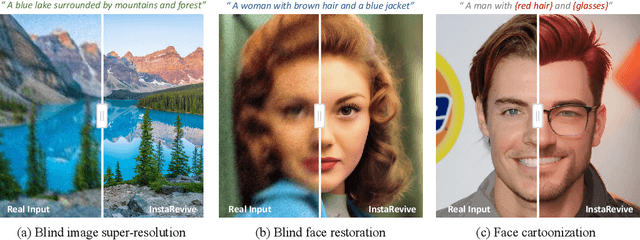
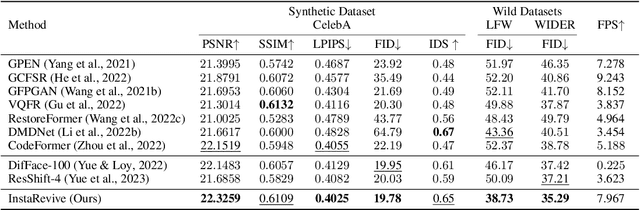
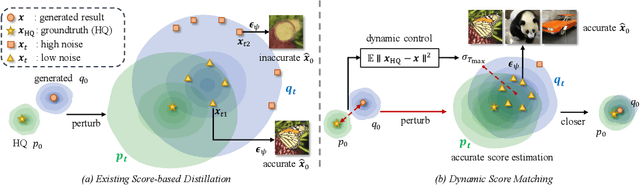
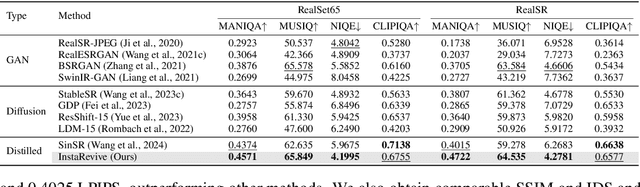
Image enhancement finds wide-ranging applications in real-world scenarios due to complex environments and the inherent limitations of imaging devices. Recent diffusion-based methods yield promising outcomes but necessitate prolonged and computationally intensive iterative sampling. In response, we propose InstaRevive, a straightforward yet powerful image enhancement framework that employs score-based diffusion distillation to harness potent generative capability and minimize the sampling steps. To fully exploit the potential of the pre-trained diffusion model, we devise a practical and effective diffusion distillation pipeline using dynamic control to address inaccuracies in updating direction during score matching. Our control strategy enables a dynamic diffusing scope, facilitating precise learning of denoising trajectories within the diffusion model and ensuring accurate distribution matching gradients during training. Additionally, to enrich guidance for the generative power, we incorporate textual prompts via image captioning as auxiliary conditions, fostering further exploration of the diffusion model. Extensive experiments substantiate the efficacy of our framework across a diverse array of challenging tasks and datasets, unveiling the compelling efficacy and efficiency of InstaRevive in delivering high-quality and visually appealing results. Code is available at https://github.com/EternalEvan/InstaRevive.