 Add to Chrome
 Add to Firefox
 Add to Edge
Geometry-Aware Anisotropic Boundary Correction for Aerodynamic Simulation
Jun 08, 2026
Aerodynamic simulation is a key component of engineering shape design, where core quantities such as the surface pressure coefficient strongly depend on flow dynamics near solid boundaries. Neural operators provide an efficient alternative to expensive Computational Fluid Dynamics (CFD) solvers. However, conventional methods treat the boundary region isotropically, failing to account for the distinct physical behaviors along the boundaries. In reality, the aerodynamic process exhibits anisotropy: along the tangential direction, flow propagates along the wall; along the normal direction, physical quantities are constrained by the wall. To explicitly model the distinct physical behaviors, we propose GeoABC, a geometry-conditioned anisotropic boundary correction framework. GeoABC leverages the boundary geometries to introduce direction-aware boundary correction into the intermediate representations of neural operators, transforming boundary geometry from static input features into a structural prior that modulates physical prediction. On 2D airfoil and 3D car tasks, GeoABC consistently adapts to multiple neural operator backbones, reducing near-boundary relative $L_2$ error by $\sim$38\% on average, narrowing the structural near-wall gap shared by mainstream neural operators, and advancing neural operators toward high-fidelity aerodynamic simulation.

BTTackler: A Diagnosis-based Framework for Efficient Deep Learning Hyperparameter Optimization
Feb 27, 2026Hyperparameter optimization (HPO) is known to be costly in deep learning, especially when leveraging automated approaches. Most of the existing automated HPO methods are accuracy-based, i.e., accuracy metrics are used to guide the trials of different hyperparameter configurations amongst a specific search space. However, many trials may encounter severe training problems, such as vanishing gradients and insufficient convergence, which can hardly be reflected by accuracy metrics in the early stages of the training and often result in poor performance. This leads to an inefficient optimization trajectory because the bad trials occupy considerable computation resources and reduce the probability of finding excellent hyperparameter configurations within a time limitation. In this paper, we propose \textbf{Bad Trial Tackler (BTTackler)}, a novel HPO framework that introduces training diagnosis to identify training problems automatically and hence tackles bad trials. BTTackler diagnoses each trial by calculating a set of carefully designed quantified indicators and triggers early termination if any training problems are detected. Evaluations are performed on representative HPO tasks consisting of three classical deep neural networks (DNN) and four widely used HPO methods. To better quantify the effectiveness of an automated HPO method, we propose two new measurements based on accuracy and time consumption. Results show the advantage of BTTackler on two-fold: (1) it reduces 40.33\% of time consumption to achieve the same accuracy comparable to baseline methods on average and (2) it conducts 44.5\% more top-10 trials than baseline methods on average within a given time budget. We also released an open-source Python library that allows users to easily apply BTTackler to automated HPO processes with minimal code changes.
Neuro-Symbolic Multitasking: A Unified Framework for Discovering Generalizable Solutions to PDE Families
Feb 12, 2026Solving Partial Differential Equations (PDEs) is fundamental to numerous scientific and engineering disciplines. A common challenge arises from solving the PDE families, which are characterized by sharing an identical mathematical structure but varying in specific parameters. Traditional numerical methods, such as the finite element method, need to independently solve each instance within a PDE family, which incurs massive computational cost. On the other hand, while recent advancements in machine learning PDE solvers offer impressive computational speed and accuracy, their inherent ``black-box" nature presents a considerable limitation. These methods primarily yield numerical approximations, thereby lacking the crucial interpretability provided by analytical expressions, which are essential for deeper scientific insight. To address these limitations, we propose a neuro-assisted multitasking symbolic PDE solver framework for PDE family solving, dubbed NMIPS. In particular, we employ multifactorial optimization to simultaneously discover the analytical solutions of PDEs. To enhance computational efficiency, we devise an affine transfer method by transferring learned mathematical structures among PDEs in a family, avoiding solving each PDE from scratch. Experimental results across multiple cases demonstrate promising improvements over existing baselines, achieving up to a $\sim$35.7% increase in accuracy while providing interpretable analytical solutions.
ComposerX: Multi-Agent Symbolic Music Composition with LLMs
Apr 30, 2024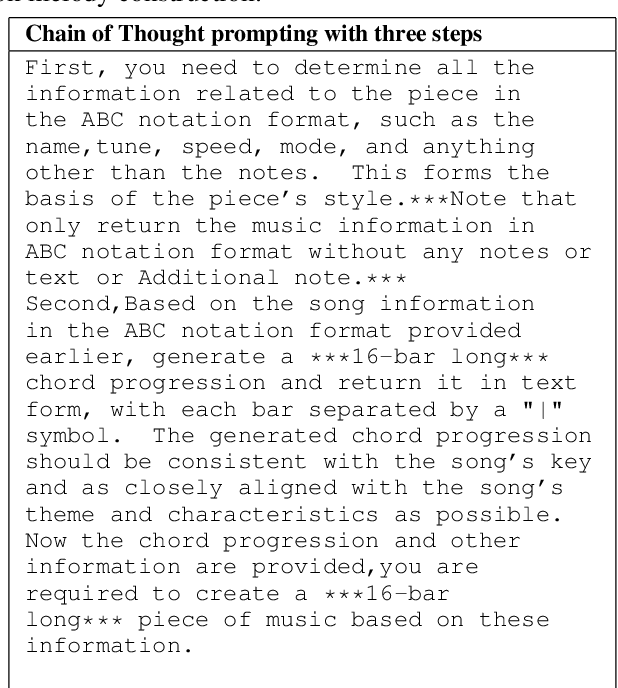
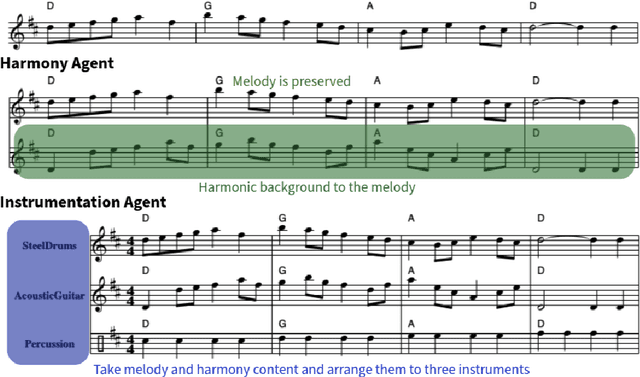
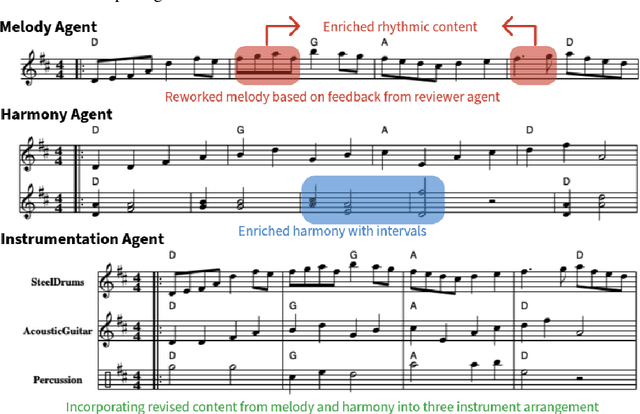
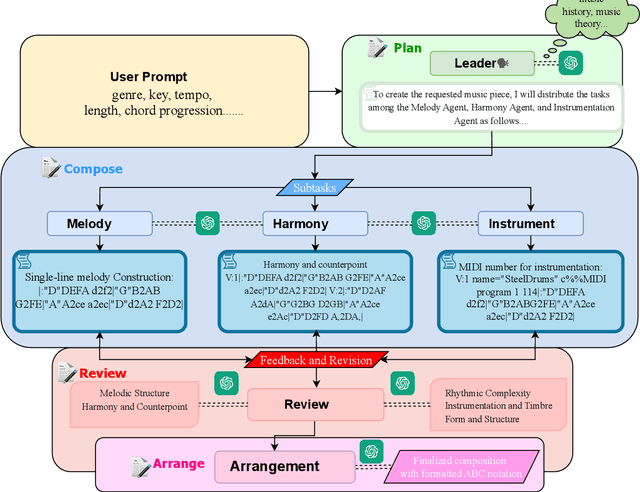
Music composition represents the creative side of humanity, and itself is a complex task that requires abilities to understand and generate information with long dependency and harmony constraints. While demonstrating impressive capabilities in STEM subjects, current LLMs easily fail in this task, generating ill-written music even when equipped with modern techniques like In-Context-Learning and Chain-of-Thoughts. To further explore and enhance LLMs' potential in music composition by leveraging their reasoning ability and the large knowledge base in music history and theory, we propose ComposerX, an agent-based symbolic music generation framework. We find that applying a multi-agent approach significantly improves the music composition quality of GPT-4. The results demonstrate that ComposerX is capable of producing coherent polyphonic music compositions with captivating melodies, while adhering to user instructions.