 Add to Chrome
 Add to Firefox
 Add to Edge
Adversarial Attacks on Monocular Depth Estimation
Mar 23, 2020
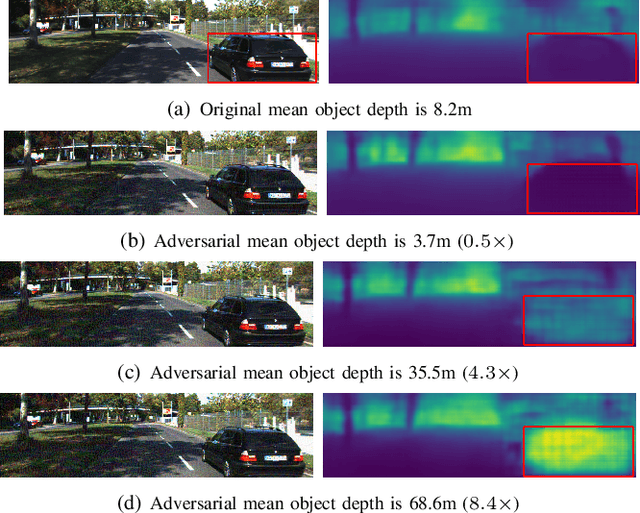
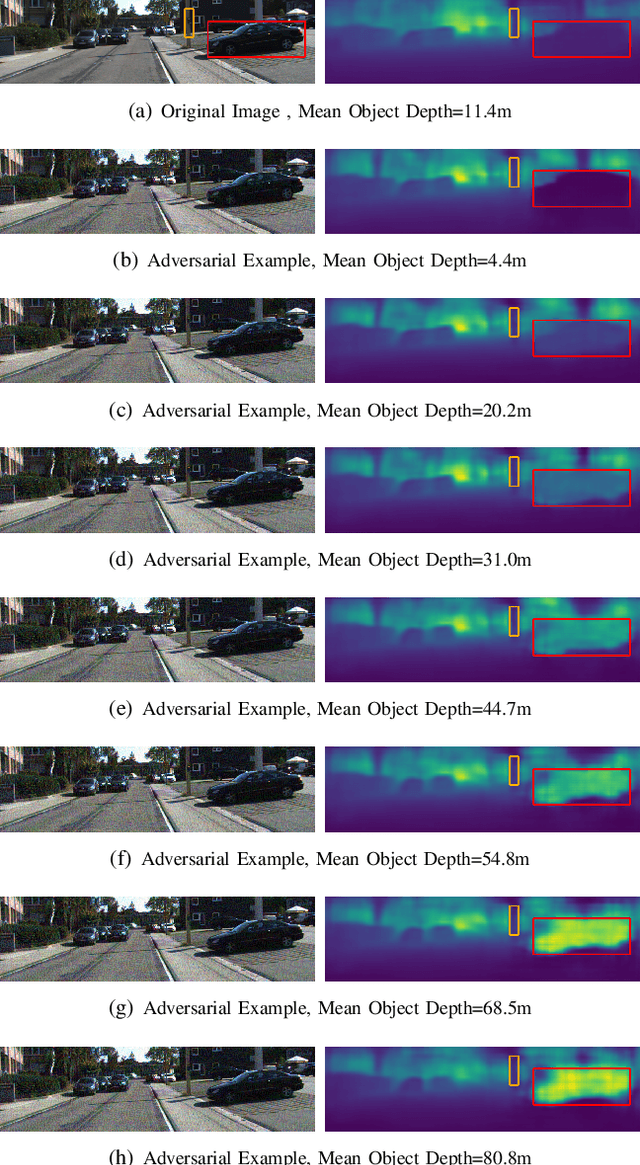
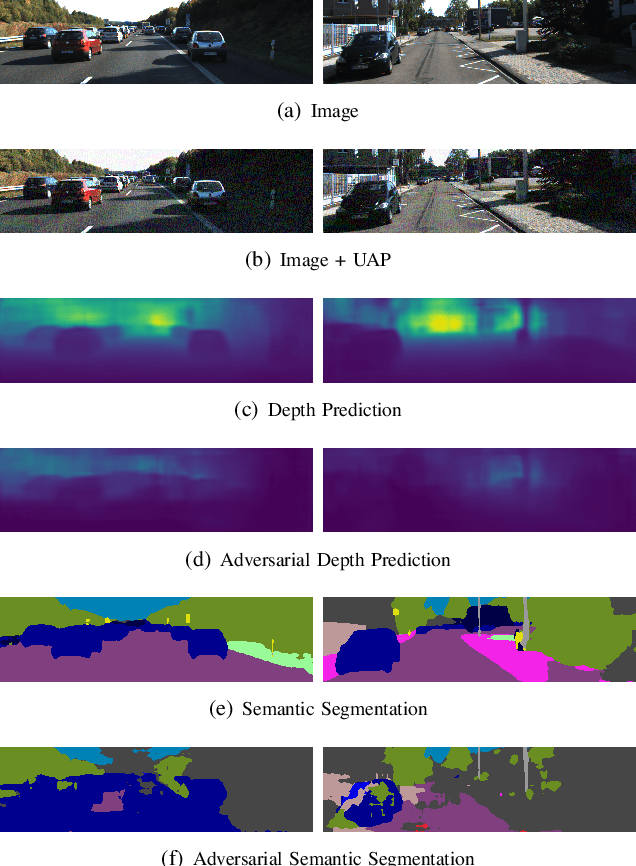
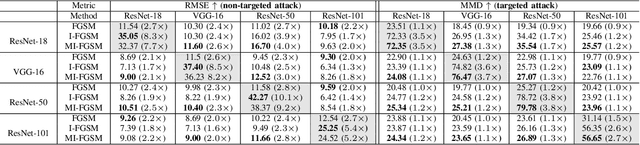
Recent advances of deep learning have brought exceptional performance on many computer vision tasks such as semantic segmentation and depth estimation. However, the vulnerability of deep neural networks towards adversarial examples have caused grave concerns for real-world deployment. In this paper, we present to the best of our knowledge the first systematic study of adversarial attacks on monocular depth estimation, an important task of 3D scene understanding in scenarios such as autonomous driving and robot navigation. In order to understand the impact of adversarial attacks on depth estimation, we first define a taxonomy of different attack scenarios for depth estimation, including non-targeted attacks, targeted attacks and universal attacks. We then adapt several state-of-the-art attack methods for classification on the field of depth estimation. Besides, multi-task attacks are introduced to further improve the attack performance for universal attacks. Experimental results show that it is possible to generate significant errors on depth estimation. In particular, we demonstrate that our methods can conduct targeted attacks on given objects (such as a car), resulting in depth estimation 3-4x away from the ground truth (e.g., from 20m to 80m).

AtomNAS: Fine-Grained End-to-End Neural Architecture Search
Dec 20, 2019
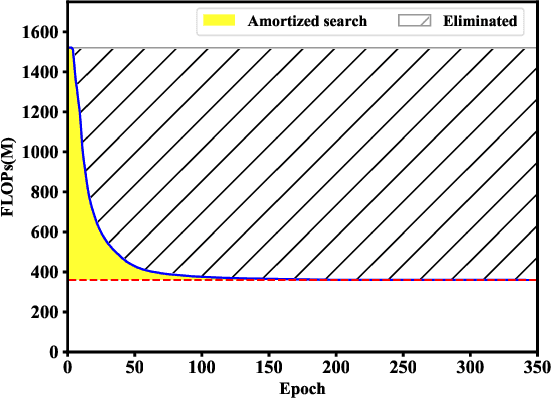
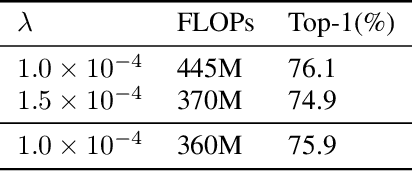
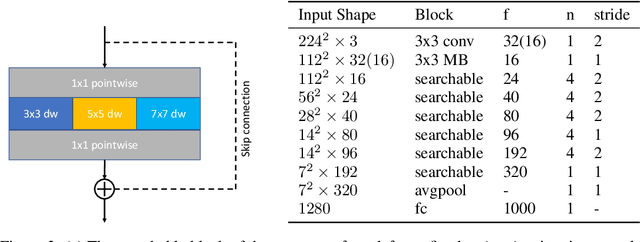
Designing of search space is a critical problem for neural architecture search (NAS) algorithms. We propose a fine-grained search space comprised of atomic blocks, a minimal search unit much smaller than the ones used in recent NAS algorithms. This search space facilitates direct selection of channel numbers and kernel sizes in convolutions. In addition, we propose a resource-aware architecture search algorithm which dynamically selects atomic blocks during training. The algorithm is further accelerated by a dynamic network shrinkage technique. Instead of a search-and-retrain two-stage paradigm, our method can simultaneously search and train the target architecture in an end-to-end manner. Our method achieves state-of-the-art performance under several FLOPS configurations on ImageNet with a negligible searching cost. We open our entire codebase at: https://github.com/meijieru/AtomNAS
Hyper-Pairing Network for Multi-Phase Pancreatic Ductal Adenocarcinoma Segmentation
Sep 03, 2019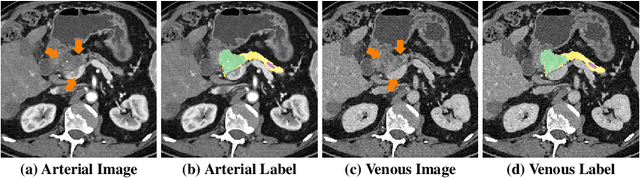
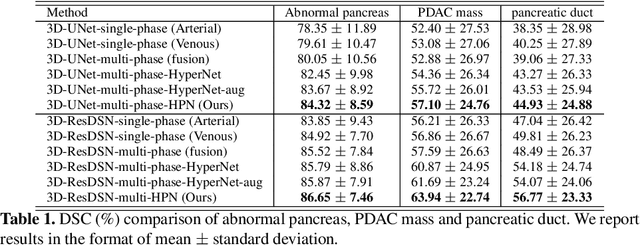
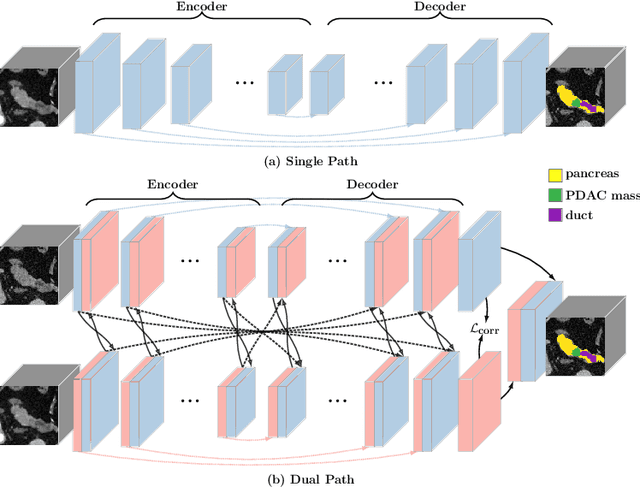
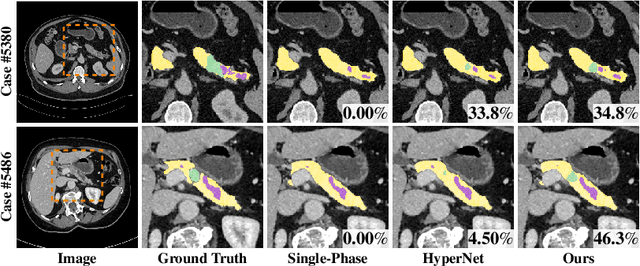
Pancreatic ductal adenocarcinoma (PDAC) is one of the most lethal cancers with an overall five-year survival rate of 8%. Due to subtle texture changes of PDAC, pancreatic dual-phase imaging is recommended for better diagnosis of pancreatic disease. In this study, we aim at enhancing PDAC automatic segmentation by integrating multi-phase information (i.e., arterial phase and venous phase). To this end, we present Hyper-Pairing Network (HPN), a 3D fully convolution neural network which effectively integrates information from different phases. The proposed approach consists of a dual path network where the two parallel streams are interconnected with hyper-connections for intensive information exchange. Additionally, a pairing loss is added to encourage the commonality between high-level feature representations of different phases. Compared to prior arts which use single phase data, HPN reports a significant improvement up to 7.73% (from 56.21% to 63.94%) in terms of DSC.
Multi-Scale Attentional Network for Multi-Focal Segmentation of Active Bleed after Pelvic Fractures
Jun 23, 2019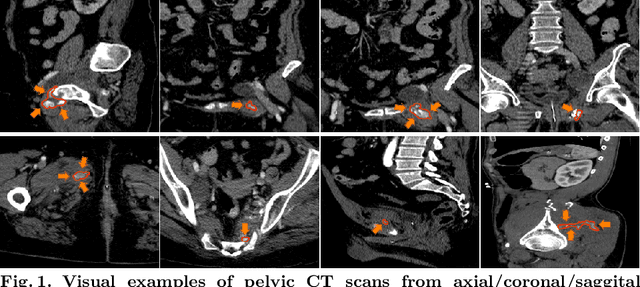
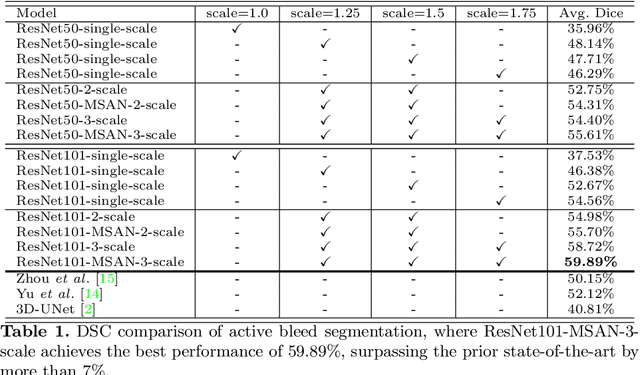
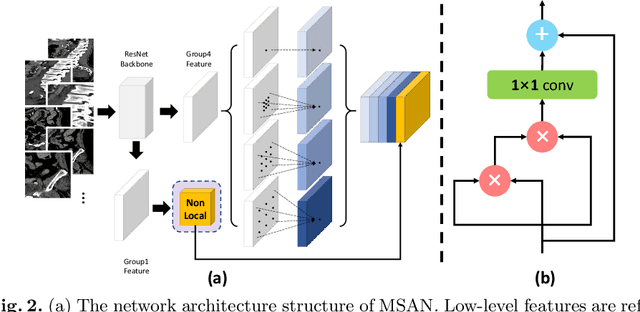
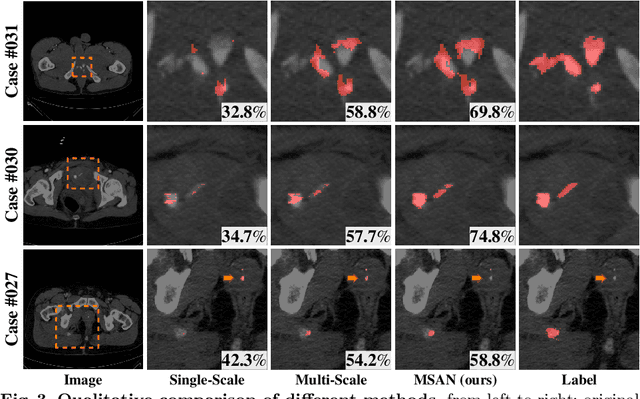
Trauma is the worldwide leading cause of death and disability in those younger than 45 years, and pelvic fractures are a major source of morbidity and mortality. Automated segmentation of multiple foci of arterial bleeding from abdominopelvic trauma CT could provide rapid objective measurements of the total extent of active bleeding, potentially augmenting outcome prediction at the point of care, while improving patient triage, allocation of appropriate resources, and time to definitive intervention. In spite of the importance of active bleeding in the quick tempo of trauma care, the task is still quite challenging due to the variable contrast, intensity, location, size, shape, and multiplicity of bleeding foci. Existing work [4] presents a heuristic rule-based segmentation technique which requires multiple stages and cannot be efficiently optimized end-to-end. To this end, we present, Multi-Scale Attentional Network (MSAN), the first yet reliable end-to-end network, for automated segmentation of active hemorrhage from contrast-enhanced trauma CT scans. MSAN consists of the following components: 1) an encoder which fully integrates the global contextual information from holistic 2D slices; 2) a multi-scale strategy applied both in the training stage and the inference stage to handle the challenges induced by variation of target sizes; 3) an attentional module to further refine the deep features, leading to better segmentation quality; and 4) a multi-view mechanism to fully leverage the 3D information. Our MSAN reports a significant improvement of more than 7% compared to prior arts in terms of DSC.
Regional Homogeneity: Towards Learning Transferable Universal Adversarial Perturbations Against Defenses
Apr 01, 2019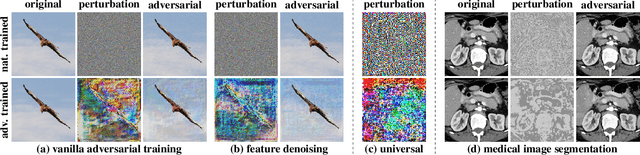

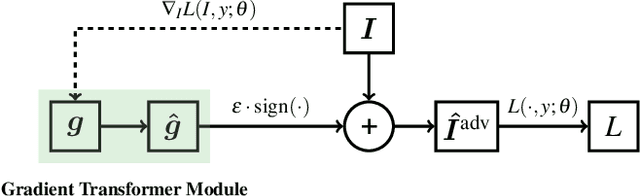
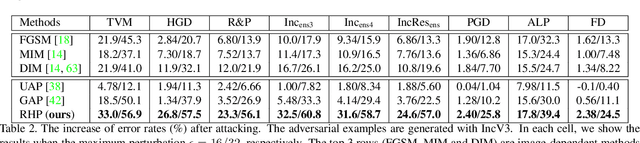
This paper focuses on learning transferable adversarial examples specifically against defense models (models to defense adversarial attacks). In particular, we show that a simple universal perturbation can fool a series of state-of-the-art defenses. Adversarial examples generated by existing attacks are generally hard to transfer to defense models. We observe the property of regional homogeneity in adversarial perturbations and suggest that the defenses are less robust to regionally homogeneous perturbations. Therefore, we propose an effective transforming paradigm and a customized gradient transformer module to transform existing perturbations into regionally homogeneous ones. Without explicitly forcing the perturbations to be universal, we observe that a well-trained gradient transformer module tends to output input-independent gradients (hence universal) benefiting from the under-fitting phenomenon. Thorough experiments demonstrate that our work significantly outperforms the prior art attacking algorithms (either image-dependent or universal ones) by an average improvement of 14.0% when attacking 9 defenses in the black-box setting. In addition to the cross-model transferability, we also verify that regionally homogeneous perturbations can well transfer across different vision tasks (attacking with the semantic segmentation task and testing on the object detection task).
Metric Attack and Defense for Person Re-identification
Mar 23, 2019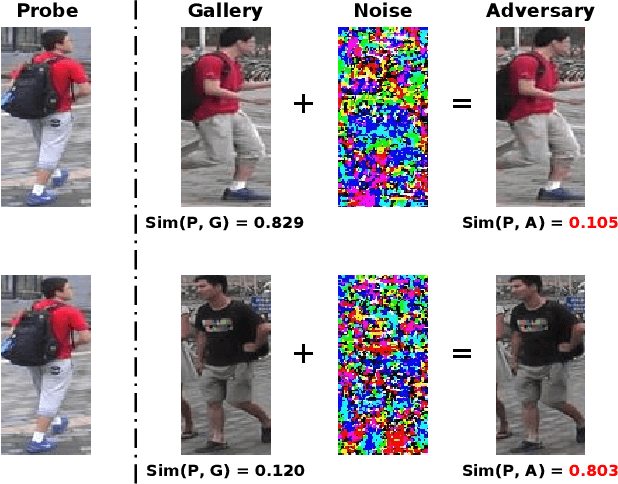
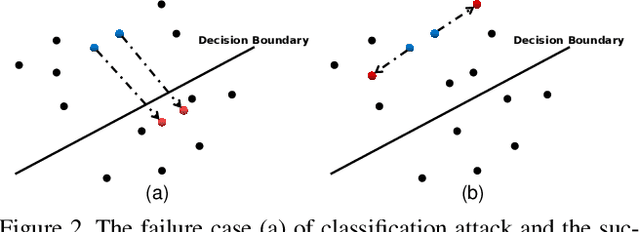
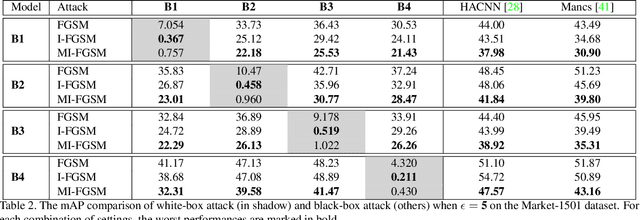
Person re-identification (re-ID) has attracted much attention recently due to its great importance in video surveillance. In general, distance metrics used to identify two person images are expected to be robust under various appearance changes. However, our work observes the extreme vulnerability of existing distance metrics to adversarial examples, generated by simply adding human-imperceptible perturbations to person images. Hence, the security danger is dramatically increased when deploying commercial re-ID systems in video surveillance. Although adversarial examples have been extensively applied for classification analysis, it is rarely studied in metric analysis like person re-identification. The most likely reason is the natural gap between the training and testing of re-ID networks, that is, the predictions of a re-ID network cannot be directly used during testing without an effective metric. In this work, we bridge the gap by proposing Adversarial Metric Attack, a parallel methodology to adversarial classification attacks. Comprehensive experiments clearly reveal the adversarial effects in re-ID systems. Meanwhile, we also present an early attempt of training a metric-preserving network, thereby defending the metric against adversarial attacks. At last, by benchmarking various adversarial settings, we expect that our work can facilitate the development of adversarial attack and defense in metric-based applications.
Learning Transferable Adversarial Examples via Ghost Networks
Dec 09, 2018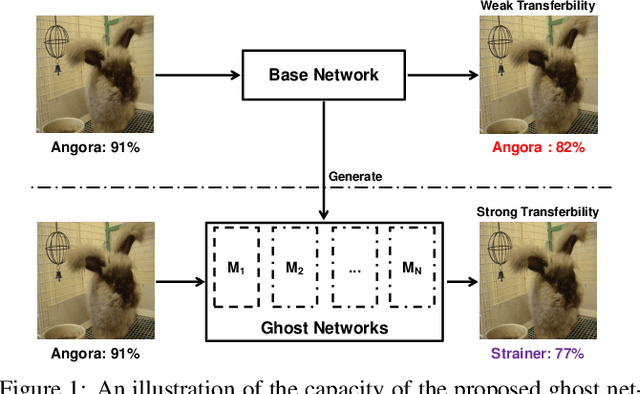

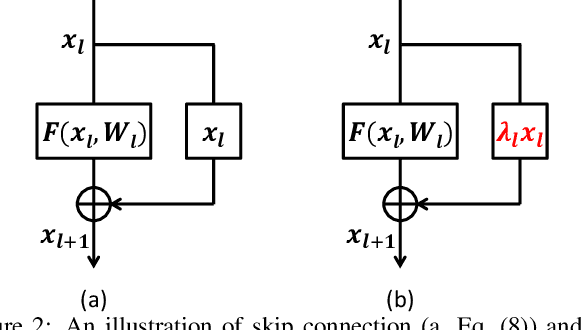
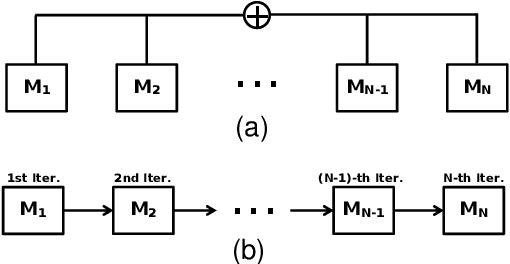
The recent development of adversarial attack has proven that ensemble-based methods can perform black-box attack better than the traditional, non-ensemble ones. However, those methods generally suffer from high complexity. They require a family of diverse models, and ensembling them afterward, both of which are computationally expensive. In this paper, we propose Ghost Networks to efficiently learn transferable adversarial examples. The key principle of ghost networks is to perturb an existing model, which potentially generates a huge set of diverse models. Those models are subsequently fused by longitudinal ensemble. Both steps almost require no extra time and space consumption. Extensive experimental results suggest that the number of networks is essential for improving the transferability of adversarial examples, but it is less necessary to independently train different networks and then ensemble them in an intensive aggregation way. Instead, our work can be a computationally cheap plug-in, which can be easily applied to improve adversarial approaches both in single-model attack and multi-model attack, compatible with both residual and non-residual networks. In particular, by re-producing the NIPS 2017 adversarial competition, our work outperforms the No.1 attack submission by a large margin, which demonstrates its effectiveness and efficiency.