 Add to Chrome
 Add to Firefox
 Add to Edge
Deep Learning-Based Estimation of Ground Reaction Forces in Parkinsonian Gait Using an Optimized Set of IMU Data
Aug 03, 2026
Accurate gait analysis in Parkinson's disease (PD) typically relies on laboratory-based systems to capture biomechanical data, such as ground reaction forces (GRFs). Estimating GRFs using inertial measurement units (IMUs) provides a feasible alternative. However, this approach remains challenging in pathological gait like PD due to its high variability and complexity. Moreover, existing monitoring approaches often require multiple body-mounted sensors, which limit practicality and reduce patient compliance. To date, no study has investigated the application of deep learning approaches to address this challenge. This study proposes, for the first time, a deep learning framework to estimate bilateral vertical GRFs (vGRFs) in PD using an optimized set of wearable IMUs. A hybrid CNN-BiLSTM model was trained separately on data from 61 PD patients and 65 healthy controls (HC) using 13 IMUs. The model achieved high intra-subject accuracy ($R^2$ = 0.98) and strong inter-subject generalization ($R^2$ = 0.93 for HC, $R^2$ = 0.91 for PD). Sensor configuration was found to significantly influence estimation accuracy, with optimal sensor placement varying between PD patients and HC. For PD patients, estimation accuracy dropped markedly when reducing to a single IMU. The optimal configuration for PD used four IMUs. We identified a minimal setup with only two IMUs still enabled robust estimation. This compact setup offers a practical and scalable solution. Overall, the proposed approach supports the development of wearable vGRF-based gait analysis systems for Parkinsonian gait and potentially other pathological conditions, enabling accessible clinical assessments, remote monitoring, and personalized rehabilitation.
* 13 pages, 5 figures, 6 tables. Published in IEEE Transactions on Neural Systems and Rehabilitation Engineering

NEvo: Neural-Guided Evolutionary Video Synthesis for Dynamic Visual Selectivity
Jul 02, 2026The human brain processes dynamic visual input through hierarchically organized, functionally specialized regions. While recent in silico brain encoding models can synthesize optimal stimuli to probe selectivity in different brain regions, prior work has been largely limited to static images, leaving dynamic visual processing underexplored. We introduce a novel neural-guided video synthesis framework that generates stimuli optimized for target brain regions across visual cortex. Our method performs evolutionary search over a structured prompt space, guided by a dynamic encoding model that predicts voxel-level responses to video inputs. By maximizing predicted activity for a target ROI, the framework efficiently discovers hyper-activating dynamic stimuli that consistently surpass handcrafted localizer videos. The synthesized videos recover known selectivities across ventral, dorsal, and lateral pathways, and further reveal systematic differences in sensitivity to temporal dynamics. A searchlight analysis provides new insight into the progression toward increasingly complex social-dynamic features along the lateral stream, further supported by probing with synthesized abstract, non-naturalistic stimuli. Taken together, our framework enables in silico exploration of dynamic visual selectivity, with new predictions for in vivo experiments
From Language to Cognition: How LLMs Outgrow the Human Language Network
Mar 03, 2025Large language models (LLMs) exhibit remarkable similarity to neural activity in the human language network. However, the key properties of language shaping brain-like representations, and their evolution during training as a function of different tasks remain unclear. We here benchmark 34 training checkpoints spanning 300B tokens across 8 different model sizes to analyze how brain alignment relates to linguistic competence. Specifically, we find that brain alignment tracks the development of formal linguistic competence -- i.e., knowledge of linguistic rules -- more closely than functional linguistic competence. While functional competence, which involves world knowledge and reasoning, continues to develop throughout training, its relationship with brain alignment is weaker, suggesting that the human language network primarily encodes formal linguistic structure rather than broader cognitive functions. We further show that model size is not a reliable predictor of brain alignment when controlling for feature size and find that the correlation between next-word prediction, behavioral alignment and brain alignment fades once models surpass human language proficiency. Finally, using the largest set of rigorous neural language benchmarks to date, we show that language brain alignment benchmarks remain unsaturated, highlighting opportunities for improving future models. Taken together, our findings suggest that the human language network is best modeled by formal, rather than functional, aspects of language.
Dreaming Out Loud: A Self-Synthesis Approach For Training Vision-Language Models With Developmentally Plausible Data
Oct 29, 2024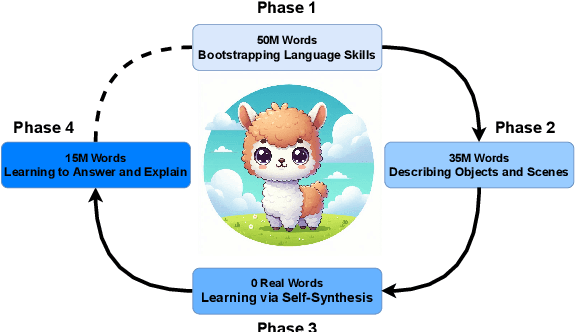
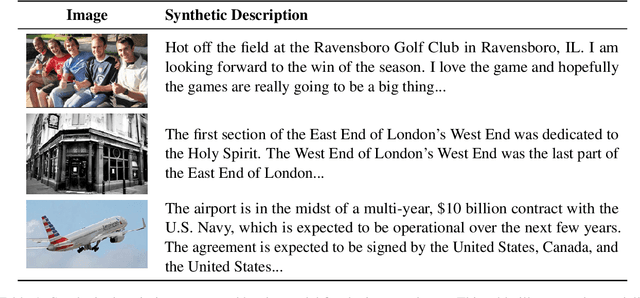
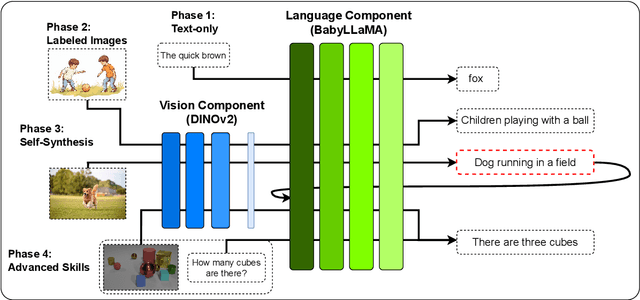
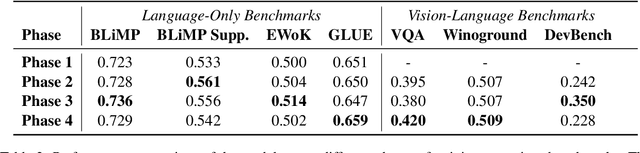
While today's large language models exhibit impressive abilities in generating human-like text, they require massive amounts of data during training. We here take inspiration from human cognitive development to train models in limited data conditions. Specifically we present a self-synthesis approach that iterates through four phases: Phase 1 sets up fundamental language abilities, training the model from scratch on a small corpus. Language is then associated with the visual environment in phase 2, integrating the model with a vision encoder to generate descriptive captions from labeled images. In the "self-synthesis" phase 3, the model generates captions for unlabeled images, that it then uses to further train its language component with a mix of synthetic, and previous real-world text. This phase is meant to expand the model's linguistic repertoire, similar to humans self-annotating new experiences. Finally, phase 4 develops advanced cognitive skills, by training the model on specific tasks such as visual question answering and reasoning. Our approach offers a proof of concept for training a multimodal model using a developmentally plausible amount of data.
When are Lemons Purple? The Concept Association Bias of CLIP
Dec 22, 2022Large-scale vision-language models such as CLIP have shown impressive performance on zero-shot image classification and image-to-text retrieval. However, such zero-shot performance of CLIP-based models does not realize in tasks that require a finer-grained correspondence between vision and language, such as Visual Question Answering (VQA). We investigate why this is the case, and report an interesting phenomenon of CLIP, which we call the Concept Association Bias (CAB), as a potential cause of the difficulty of applying CLIP to VQA and similar tasks. CAB is especially apparent when two concepts are present in the given image while a text prompt only contains a single concept. In such a case, we find that CLIP tends to treat input as a bag of concepts and attempts to fill in the other missing concept crossmodally, leading to an unexpected zero-shot prediction. For example, when asked for the color of a lemon in an image, CLIP predicts ``purple'' if the image contains a lemon and an eggplant. We demonstrate the Concept Association Bias of CLIP by showing that CLIP's zero-shot classification performance greatly suffers when there is a strong concept association between an object (e.g. lemon) and an attribute (e.g. its color). On the other hand, when the association between object and attribute is weak, we do not see this phenomenon. Furthermore, we show that CAB is significantly mitigated when we enable CLIP to learn deeper structure across image and text embeddings by adding an additional Transformer on top of CLIP and fine-tuning it on VQA. We find that across such fine-tuned variants of CLIP, the strength of CAB in a model predicts how well it performs on VQA.
Online Motion Style Transfer for Interactive Character Control
Mar 30, 2022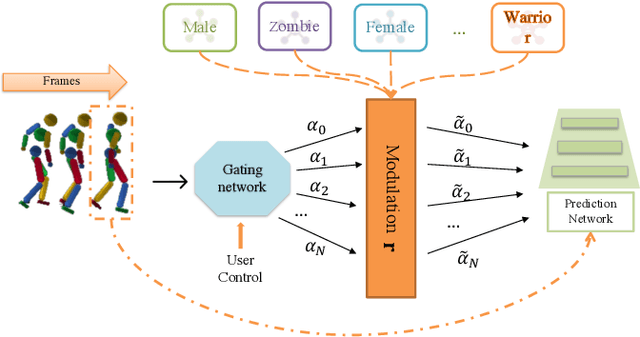
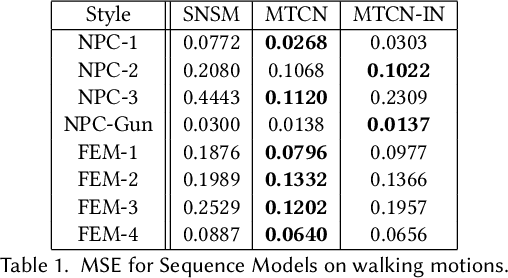
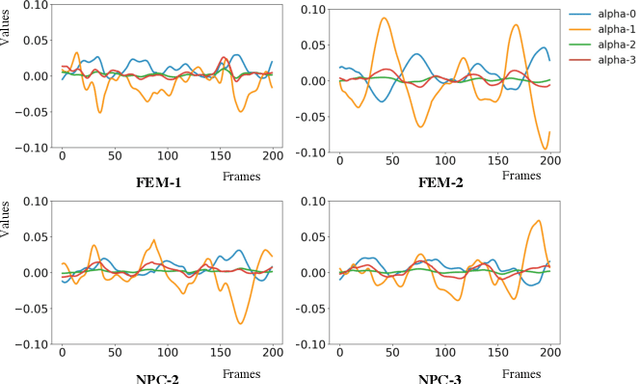
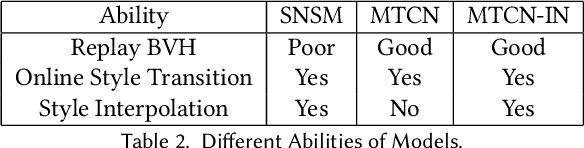
Motion style transfer is highly desired for motion generation systems for gaming. Compared to its offline counterpart, the research on online motion style transfer under interactive control is limited. In this work, we propose an end-to-end neural network that can generate motions with different styles and transfer motion styles in real-time under user control. Our approach eliminates the use of handcrafted phase features, and could be easily trained and directly deployed in game systems. In the experiment part, we evaluate our approach from three aspects that are essential for industrial game design: accuracy, flexibility, and variety, and our model performs a satisfying result.
Learning-Aided Heuristics Design for Storage System
Jun 14, 2021
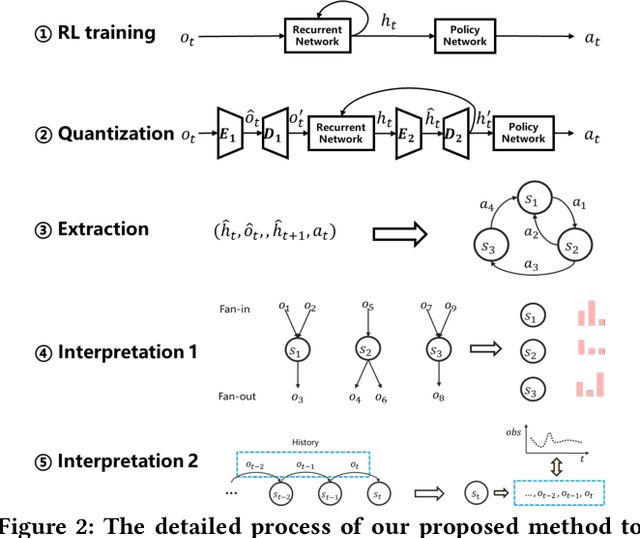
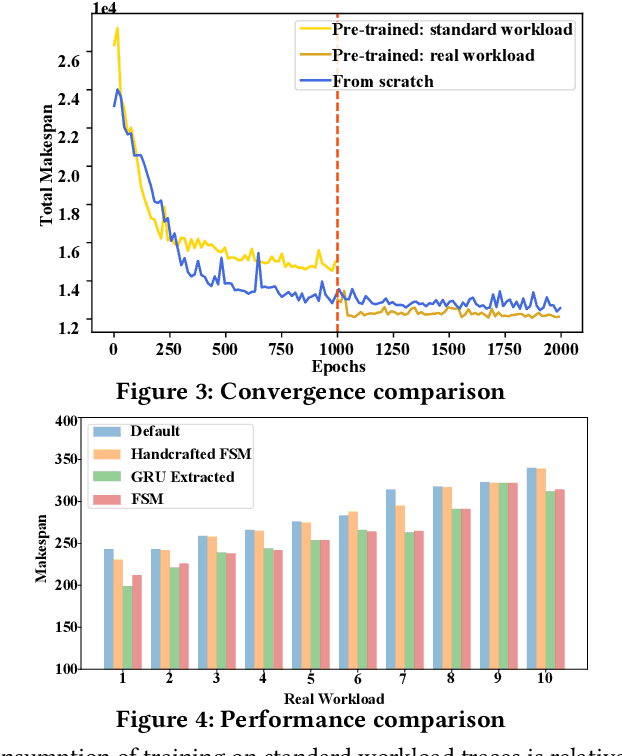
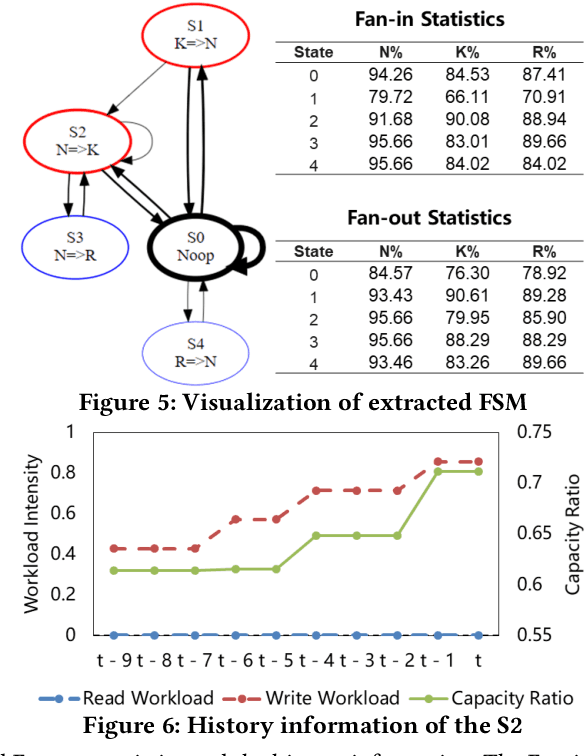
Computer systems such as storage systems normally require transparent white-box algorithms that are interpretable for human experts. In this work, we propose a learning-aided heuristic design method, which automatically generates human-readable strategies from Deep Reinforcement Learning (DRL) agents. This method benefits from the power of deep learning but avoids the shortcoming of its black-box property. Besides the white-box advantage, experiments in our storage productions resource allocation scenario also show that this solution outperforms the systems default settings and the elaborately handcrafted strategy by human experts.