 Add to Chrome
 Add to Firefox
 Add to Edge
NEvo: Neural-Guided Evolutionary Video Synthesis for Dynamic Visual Selectivity
Jul 02, 2026
The human brain processes dynamic visual input through hierarchically organized, functionally specialized regions. While recent in silico brain encoding models can synthesize optimal stimuli to probe selectivity in different brain regions, prior work has been largely limited to static images, leaving dynamic visual processing underexplored. We introduce a novel neural-guided video synthesis framework that generates stimuli optimized for target brain regions across visual cortex. Our method performs evolutionary search over a structured prompt space, guided by a dynamic encoding model that predicts voxel-level responses to video inputs. By maximizing predicted activity for a target ROI, the framework efficiently discovers hyper-activating dynamic stimuli that consistently surpass handcrafted localizer videos. The synthesized videos recover known selectivities across ventral, dorsal, and lateral pathways, and further reveal systematic differences in sensitivity to temporal dynamics. A searchlight analysis provides new insight into the progression toward increasingly complex social-dynamic features along the lateral stream, further supported by probing with synthesized abstract, non-naturalistic stimuli. Taken together, our framework enables in silico exploration of dynamic visual selectivity, with new predictions for in vivo experiments

ViPer: Visual Personalization of Generative Models via Individual Preference Learning
Jul 24, 2024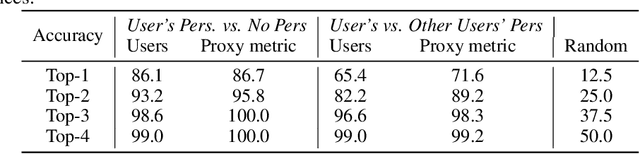
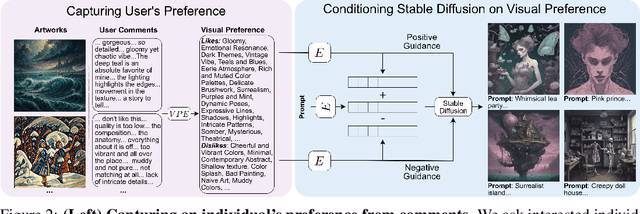
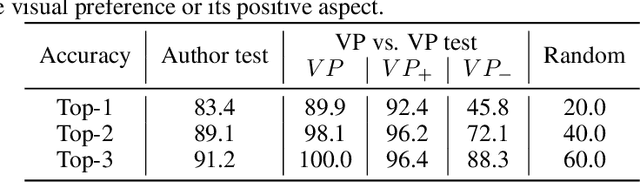
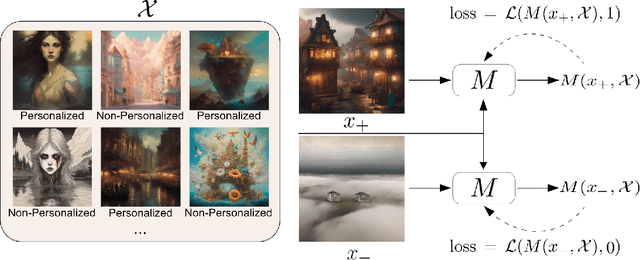
Different users find different images generated for the same prompt desirable. This gives rise to personalized image generation which involves creating images aligned with an individual's visual preference. Current generative models are, however, unpersonalized, as they are tuned to produce outputs that appeal to a broad audience. Using them to generate images aligned with individual users relies on iterative manual prompt engineering by the user which is inefficient and undesirable. We propose to personalize the image generation process by first capturing the generic preferences of the user in a one-time process by inviting them to comment on a small selection of images, explaining why they like or dislike each. Based on these comments, we infer a user's structured liked and disliked visual attributes, i.e., their visual preference, using a large language model. These attributes are used to guide a text-to-image model toward producing images that are tuned towards the individual user's visual preference. Through a series of user studies and large language model guided evaluations, we demonstrate that the proposed method results in generations that are well aligned with individual users' visual preferences.