 Add to Chrome
 Add to Firefox
 Add to Edge
Discovering Functionally Selective Brain Regions with a Deep Topographic Multimodal Model
Jun 08, 2026
Nearby neurons in cortex share similar response profiles, producing systematic spatial organization across sensory and cognitive systems. Recent topographic models reproduce aspects of this structure but remain unimodal and spatially constrain each layer separately, yielding fragmented maps that capture neither the contiguity of cortical processing streams nor their integration across modalities. We introduce Topo-Omni, a topographic multimodal model in which visual, auditory, and language/cognitive processing share a single contiguous in-silico sheet. Built by fine-tuning a pretrained foundation model with a spatial smoothness objective, this architecture develops clusters across modalities that are consistent with human neuroimaging, from sensory to cognitive systems. Driving or suppressing a cluster selectively biases or impairs perception, paralleling human intervention studies. Finally, we use our model to screen for novel clusters in-silico and discover new natural landscape and animal networks which we validate in human data. A single spatial principle thus organizes representations across modalities and processing stages, yielding testable hypotheses about cortical organization.

Dreaming Out Loud: A Self-Synthesis Approach For Training Vision-Language Models With Developmentally Plausible Data
Oct 29, 2024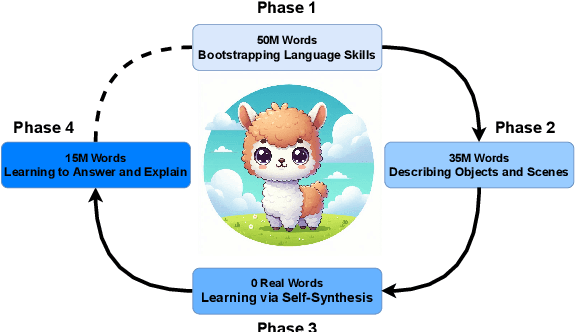

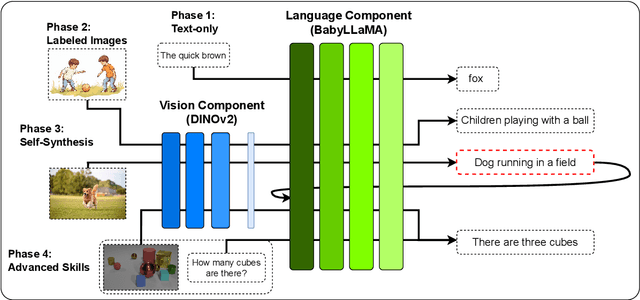
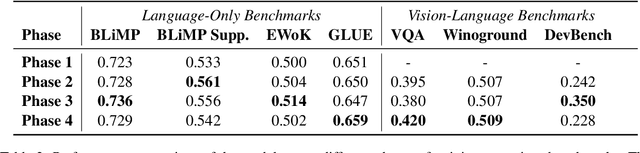
While today's large language models exhibit impressive abilities in generating human-like text, they require massive amounts of data during training. We here take inspiration from human cognitive development to train models in limited data conditions. Specifically we present a self-synthesis approach that iterates through four phases: Phase 1 sets up fundamental language abilities, training the model from scratch on a small corpus. Language is then associated with the visual environment in phase 2, integrating the model with a vision encoder to generate descriptive captions from labeled images. In the "self-synthesis" phase 3, the model generates captions for unlabeled images, that it then uses to further train its language component with a mix of synthetic, and previous real-world text. This phase is meant to expand the model's linguistic repertoire, similar to humans self-annotating new experiences. Finally, phase 4 develops advanced cognitive skills, by training the model on specific tasks such as visual question answering and reasoning. Our approach offers a proof of concept for training a multimodal model using a developmentally plausible amount of data.
TopoLM: brain-like spatio-functional organization in a topographic language model
Oct 15, 2024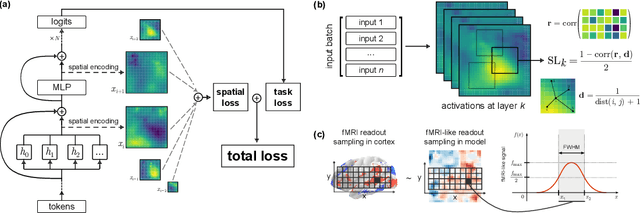


Neurons in the brain are spatially organized such that neighbors on tissue often exhibit similar response profiles. In the human language system, experimental studies have observed clusters for syntactic and semantic categories, but the mechanisms underlying this functional organization remain unclear. Here, building on work from the vision literature, we develop TopoLM, a transformer language model with an explicit two-dimensional spatial representation of model units. By combining a next-token prediction objective with a spatial smoothness loss, representations in this model assemble into clusters that correspond to semantically interpretable groupings of text and closely match the functional organization in the brain's language system. TopoLM successfully predicts the emergence of the spatio-functional organization of a cortical language system as well as the organization of functional clusters selective for fine-grained linguistic features empirically observed in human cortex. Our results suggest that the functional organization of the human language system is driven by a unified spatial objective, and provide a functionally and spatially aligned model of language processing in the brain.