 Add to Chrome
 Add to Firefox
 Add to Edge
Fast Pinching-Antenna Activation for AirComp
Jul 09, 2026
A pinching-antenna system (PASS) is considered for over-the-air computation (AirComp). Multiple dielectric waveguides are deployed at the base station, and one pinching antenna (PA) is activated on each waveguide. For practical implementation, each PA is restricted to a finite set of preconfigured locations. The resulting discrete activation problem is formulated to minimize the AirComp mean-squared error (MSE). After the optimal aggregation vector is derived, the minimum MSE is expressed through an inverse Gram matrix. A rank-one recursion is derived to evaluate the exact MSE reduction produced by each candidate. Greedy search and beam search are then developed for fast tree search. To further reduce complexity, coherent aggregation search is proposed from a first-order MSE approximation. It admits a separable closed-form selection rule and is asymptotically optimal in the low signal-to-noise ratio (SNR) regime. Numerical results show that the proposed methods substantially improve the AirComp accuracy of PASS over conventional antenna arrays.

Optimal Uplink Pinching-Antenna Activation
Jul 05, 2026An uplink multiuser pinching-antenna system (PASS) is considered, where multiple dielectric waveguides are deployed at the base station and one pinching antenna (PA) is activated on each waveguide. For practical implementation, each PA is restricted to a finite number of preconfigured locations. The resulting uplink sum-rate maximization problem is represented as a layered tree search. Three algorithms are then developed: a greedy search (GS), a beam search (BeS), and an optimal branch-and-bound (BnB) search. In GS, the locally best branch is selected through efficient matrix-inverse updates. In BeS, several promising partial paths are retained to provide a tunable performance-complexity tradeoff. In BnB, noncompetitive subtrees are pruned through a monotonic transformed objective without loss of optimality. Substantial gains over a conventional fixed array are demonstrated by numerical results. Near-optimal performance is also achieved by GS and moderate-width BeS at a lower computational co t than BnB.
Beamforming Gain with Single-RF Movable Arrays
Jun 09, 2026A single-radio-frequency (RF) movable array is investigated, in which all movable elements are driven by a single RF chain with equal amplitude and equal phase. The achievable beamforming gain enabled by antenna placement is analyzed. Linear beamforming gain scaling with the number of antennas is shown to be achievable in single-path channels, while coherent-combining conditions and aperture requirements are established for multipath channels. For multiuser transmission, the optimal max-min power allocation is derived in closed form, based on which an element-wise coordinate-search algorithm is developed for antenna placement design. Numerical results validate the analysis and reveal a fundamental tradeoff: beamforming gains can be achieved through antenna placement alone, but only at the expense of increased aperture resources.
Joint Segment Activation and Antenna Placement for Uplink SWAN Systems
May 13, 2026This article analyzes the achievable sum-rate of multiuser uplink segmented waveguide-enabled pinching-antenna systems (SWANs). To unveil system-design insights, an upper bound on the achievable sum-rate is derived, based on which the existence of an optimal segment activation level is theoretically established. Motivated by this result, hybrid segment selection and aggregation (HSS/A) schemes are proposed to jointly optimize segment activation and pinching-antenna (PA) placement. Correspondingly, low-complexity greedy algorithms are developed for the considered optimization problem. Numerical results validate the theoretical analysis and demonstrate that the proposed HSS/A schemes outperform conventional full-segment aggregation.
Secure Multiuser Beamforming With Movable Antenna Arrays
Jan 09, 2026A movable antennas (MAs)-enabled secure multiuser transmission framework is developed to enhance physical-layer security. Novel expressions are derived to characterize the achievable sum secrecy rate based on the secure channel coding theorem. On this basis, a joint optimization algorithm for digital beamforming and MA placement is proposed to maximize the sum secrecy rate via fractional programming and block coordinate descent. In each iteration, every variable admits either a closed-form update or a low-complexity one-dimensional or bisection search, which yields an efficient implementation. Numerical results demonstrate the effectiveness of the proposed method and show that the MA-enabled design achieves higher secrecy rates than conventional fixed-position antenna arrays.
Intelligent Reflecting Surfaces Aided Wireless Network: Deployment Architectures and Solutions
Jan 15, 2025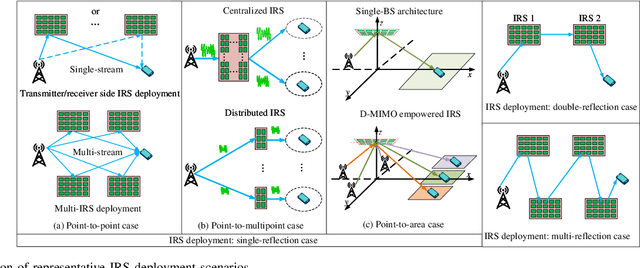
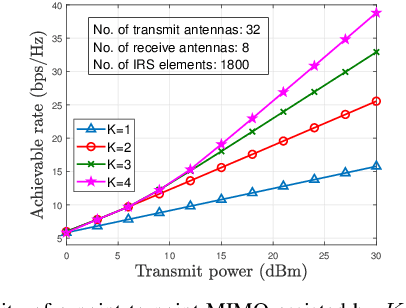
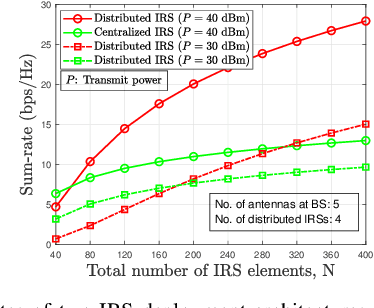
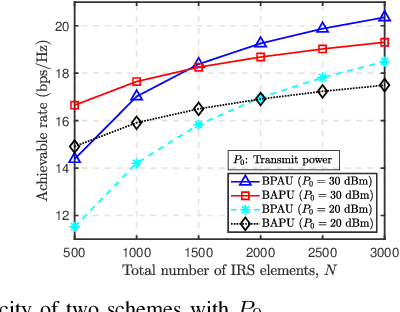
Intelligent reflecting surfaces (IRSs) have emerged as a transformative technology for wireless networks by improving coverage, capacity, and energy efficiency through intelligent manipulation of wireless propagation environments. This paper provides a comprehensive study on the deployment and coordination of IRSs for wireless networks. By addressing both single- and multi-reflection IRS architectures, we examine their deployment strategies across diverse scenarios, including point-to-point, point-to-multipoint, and point-to-area setups. For the single-reflection case, we highlight the trade-offs between passive and active IRS architectures in terms of beamforming gain, coverage extension, and spatial multiplexing. For the multi-reflection case, we discuss practical strategies to optimize IRS deployment and element allocation, balancing cooperative beamforming gains and path loss. The paper further discusses practical challenges in IRS implementation, including environmental conditions, system compatibility, and hardware limitations. Numerical results and field tests validate the effectiveness of IRS-aided wireless networks and demonstrate their capacity and coverage improvements. Lastly, promising research directions, including movable IRSs, near-field deployments, and network-level optimization, are outlined to guide future investigations.
Secure Wireless Communications via Frequency Diverse Arrays
Dec 29, 2024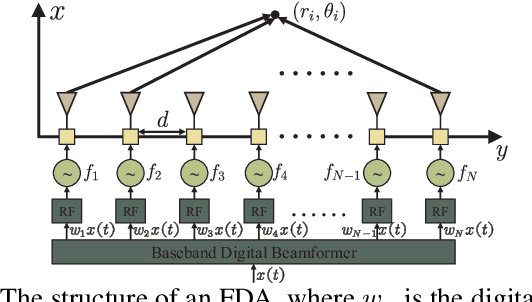
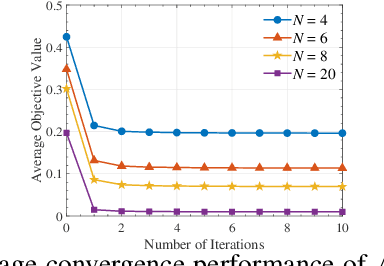
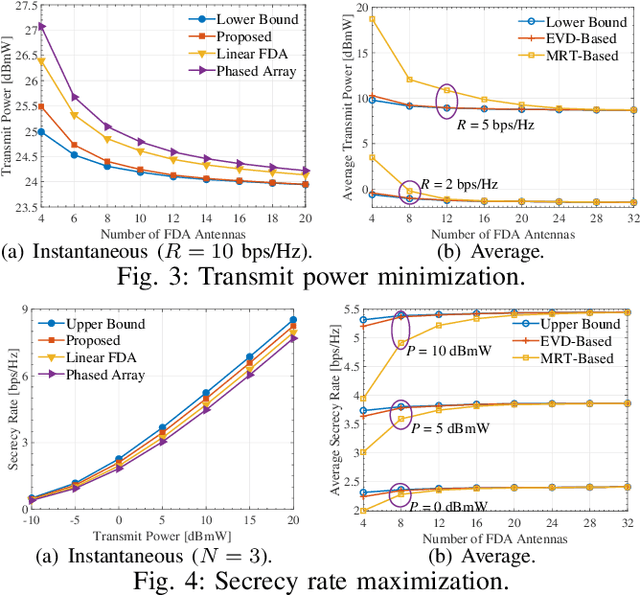
A novel frequency diverse array (FDA)-assisted secure transmission framework is proposed, which leverages additional frequency offsets to enhance physical layer security. Specifically, an FDA-assisted wiretap channel is considered, where the transmit beamforming and frequency offsets at each antenna are jointly optimized. A novel alternating optimization-based method is introduced to address the non-convex problem of secure transmission, focusing on minimizing transmit power and maximizing the secrecy rate. Numerical results are provided to demonstrate the superiority of the FDA-based framework compared to systems employing traditional phased array antennas in secure transmission.
Movable Antenna Aided Physical Layer Security with No Eavesdropper CSI
Dec 27, 2024
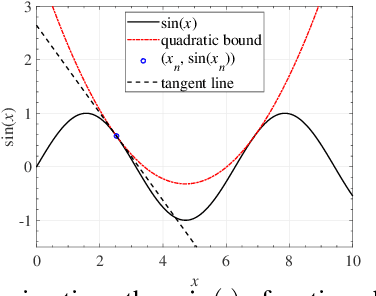


A novel movable antenna (MA)-aided secure transmission framework is proposed to enhance the secrecy transmission rate without relying on the eavesdropper's channel state information. Within this framework, a joint beamforming and jamming scheme is proposed, where the power of the confidential signal is minimized by optimizing the positions of the MAs, and the residual power is used to jam the eavesdropper. An efficient gradient-based method is employed to solve this non-convex problem. Numerical results are provided to demonstrate the superiority of the MA-based framework over systems using traditional fixed-position antennas in secure transmission.
Movable Antennas Aided Multicast MISO Communication Systems
May 12, 2024A novel multicast communication system with movable antennas (MAs) is proposed, where the antenna position optimization is exploited to enhance the transmission rate. Specifically, an MA-assisted two-user multicast multiple-input single-input system is considered. The joint optimization of the transmit beamforming vector and transmit MA positions is studied by modeling the motion of the MA elements as discrete movements. A low-complexity greedy search-based algorithm is proposed to tackle this non-convex inter-programming problem. A branch-and-bound (BAB)-based method is proposed to achieve the optimal multicast rate with a reduced time complexity than the brute-force search by assuming the two users suffer similar line-of-sight path losses. Numerical results reveal that the proposed MA systems significantly improve the multicast rate compared to conventional fixed-position antennas (FPAs)-based systems.
Enabling Secure Wireless Communications via Movable Antennas
Dec 21, 2023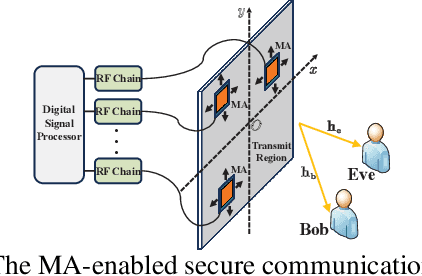
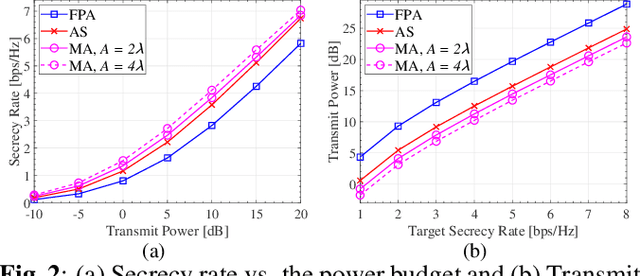
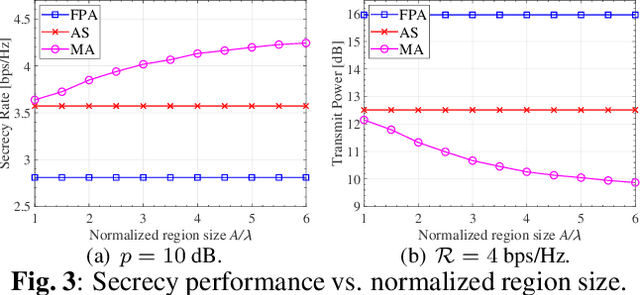
A pioneering secure transmission scheme is proposed, which harnesses movable antennas (MAs) to optimize antenna positions for augmenting the physical layer security. Particularly, an MA-enabled secure wireless system is considered, where a multi-antenna transmitter communicates with a single-antenna receiver in the presence of an eavesdropper. The beamformer and antenna positions at the transmitter are jointly optimized under two criteria: power consumption minimization and secrecy rate maximization. For each scenario, a novel suboptimal algorithm was proposed to tackle the resulting nonconvex optimization problem, capitalizing on the approaches of alternating optimization and gradient descent. Numerical results demonstrate that the proposed MA systems significantly improve physical layer security compared to various benchmark schemes relying on conventional fixed-position antennas (FPAs).