 Add to Chrome
 Add to Firefox
 Add to Edge
The Significance of Style Diversity in Annotation-Free Synthetic Data Generation
Jun 18, 2026
Generating high-utility synthetic data for intent classification typically requires human-annotated seed data, which is often unavailable in fast-paced industrial settings. In this paper, we propose a framework for synthetic dialogue generation that works entirely without human-annotated data, relying solely on intent definitions. Our proposed dialogue generation framework utilizes two different types of topic and style attributes to improve data diversity. Also, we propose two novel post-hoc stylization models called Univ and Exam to transform synthetic LLM-generated utterances into more varied, human-like linguistic styles. To enhance data quality, we utilize an LLM-as-a-judge filtering process. Experimental results on both industrial and public datasets demonstrate that the proposed approach achieves up to 93.3% of the performance obtained using human-annotated training data. Crucially, the findings reveal that style diversity is more critical than topic diversity for synthetic data utility, as it prevents models from learning spurious stylistic correlations. Furthermore, the study shows that incorporating style attributes during the generation process is more effective than post-hoc style adaptation.

uva-irlab-conv at SemEval-2026 Task 8: Multi-Turn RAG with Learned Sparse Retrieval and Listwise Reranking
Jun 10, 2026This report describes our participation in SemEval-2026 Task 8 on multi-turn retrieval and question answering. The task evaluates conversational systems across four domains (finance, cloud documentation, government, Wikipedia), and includes unanswerable queries where the available collection does not contain sufficient evidence to produce a complete response. We propose a multi-turn retrieval-augmented generation pipeline that combines learned sparse retrieval with LLM-based reranking and generation. Using sparse retrieval as the primary retrieval method, we leverage its strong generalization across domains. In addition, we make use of the long-context capabilities of LLMs for conversational query rewriting, pointwise and listwise reranking, and generating the final response, each conditioned on the full conversational history. This multi-step design enables effective integration of conversational context throughout retrieval and generation, improving robustness across domains.
Total Recall QA: A Verifiable Evaluation Suite for Deep Research Agents
Mar 19, 2026Deep research agents have emerged as LLM-based systems designed to perform multi-step information seeking and reasoning over large, open-domain sources to answer complex questions by synthesizing information from multiple information sources. Given the complexity of the task and despite various recent efforts, evaluation of deep research agents remains fundamentally challenging. This paper identifies a list of requirements and optional properties for evaluating deep research agents. We observe that existing benchmarks do not satisfy all identified requirements. Inspired by prior research on TREC Total Recall Tracks, we introduce the task of Total Recall Question Answering and develop a framework for deep research agents evaluation that satisfies the identified criteria. Our framework constructs single-answer, total recall queries with precise evaluation and relevance judgments derived from a structured knowledge base paired with a text corpus, enabling large-scale data construction. Using this framework, we build TRQA, a deep research benchmark constructed from Wikidata-Wikipedia as a real-world source and a synthetically generated e-commerce knowledge base and corpus to mitigate the effects of data contamination. We benchmark the collection with representative retriever and deep research models and establish baseline retrieval and end-to-end results for future comparative evaluation.
Do Images Clarify? A Study on the Effect of Images on Clarifying Questions in Conversational Search
Feb 09, 2026Conversational search systems increasingly employ clarifying questions to refine user queries and improve the search experience. Previous studies have demonstrated the usefulness of text-based clarifying questions in enhancing both retrieval performance and user experience. While images have been shown to improve retrieval performance in various contexts, their impact on user performance when incorporated into clarifying questions remains largely unexplored. We conduct a user study with 73 participants to investigate the role of images in conversational search, specifically examining their effects on two search-related tasks: (i) answering clarifying questions and (ii) query reformulation. We compare the effect of multimodal and text-only clarifying questions in both tasks within a conversational search context from various perspectives. Our findings reveal that while participants showed a strong preference for multimodal questions when answering clarifying questions, preferences were more balanced in the query reformulation task. The impact of images varied with both task type and user expertise. In answering clarifying questions, images helped maintain engagement across different expertise levels, while in query reformulation they led to more precise queries and improved retrieval performance. Interestingly, for clarifying question answering, text-only setups demonstrated better user performance as they provided more comprehensive textual information in the absence of images. These results provide valuable insights for designing effective multimodal conversational search systems, highlighting that the benefits of visual augmentation are task-dependent and should be strategically implemented based on the specific search context and user characteristics.
Query Understanding in LLM-based Conversational Information Seeking
Apr 08, 2025Query understanding in Conversational Information Seeking (CIS) involves accurately interpreting user intent through context-aware interactions. This includes resolving ambiguities, refining queries, and adapting to evolving information needs. Large Language Models (LLMs) enhance this process by interpreting nuanced language and adapting dynamically, improving the relevance and precision of search results in real-time. In this tutorial, we explore advanced techniques to enhance query understanding in LLM-based CIS systems. We delve into LLM-driven methods for developing robust evaluation metrics to assess query understanding quality in multi-turn interactions, strategies for building more interactive systems, and applications like proactive query management and query reformulation. We also discuss key challenges in integrating LLMs for query understanding in conversational search systems and outline future research directions. Our goal is to deepen the audience's understanding of LLM-based conversational query understanding and inspire discussions to drive ongoing advancements in this field.
Improving the Reusability of Conversational Search Test Collections
Mar 12, 2025Incomplete relevance judgments limit the reusability of test collections. When new systems are compared to previous systems that contributed to the pool, they often face a disadvantage. This is due to pockets of unjudged documents (called holes) in the test collection that the new systems return. The very nature of Conversational Search (CS) means that these holes are potentially larger and more problematic when evaluating systems. In this paper, we aim to extend CS test collections by employing Large Language Models (LLMs) to fill holes by leveraging existing judgments. We explore this problem using TREC iKAT 23 and TREC CAsT 22 collections, where information needs are highly dynamic and the responses are much more varied, leaving bigger holes to fill. Our experiments reveal that CS collections show a trend towards less reusability in deeper turns. Also, fine-tuning the Llama 3.1 model leads to high agreement with human assessors, while few-shot prompting the ChatGPT results in low agreement with humans. Consequently, filling the holes of a new system using ChatGPT leads to a higher change in the location of the new system. While regenerating the assessment pool with few-shot prompting the ChatGPT model and using it for evaluation achieves a high rank correlation with human-assessed pools. We show that filling the holes using few-shot training the Llama 3.1 model enables a fairer comparison between the new system and the systems contributed to the pool. Our hole-filling model based on few-shot training of the Llama 3.1 model can improve the reusability of test collections.
Conversational Gold: Evaluating Personalized Conversational Search System using Gold Nuggets
Mar 12, 2025The rise of personalized conversational search systems has been driven by advancements in Large Language Models (LLMs), enabling these systems to retrieve and generate answers for complex information needs. However, the automatic evaluation of responses generated by Retrieval Augmented Generation (RAG) systems remains an understudied challenge. In this paper, we introduce a new resource for assessing the retrieval effectiveness and relevance of response generated by RAG systems, using a nugget-based evaluation framework. Built upon the foundation of TREC iKAT 2023, our dataset extends to the TREC iKAT 2024 collection, which includes 17 conversations and 20,575 relevance passage assessments, together with 2,279 extracted gold nuggets, and 62 manually written gold answers from NIST assessors. While maintaining the core structure of its predecessor, this new collection enables a deeper exploration of generation tasks in conversational settings. Key improvements in iKAT 2024 include: (1) ``gold nuggets'' -- concise, essential pieces of information extracted from relevant passages of the collection -- which serve as a foundation for automatic response evaluation; (2) manually written answers to provide a gold standard for response evaluation; (3) unanswerable questions to evaluate model hallucination; (4) expanded user personas, providing richer contextual grounding; and (5) a transition from Personal Text Knowledge Base (PTKB) ranking to PTKB classification and selection. Built on this resource, we provide a framework for long-form answer generation evaluation, involving nuggets extraction and nuggets matching, linked to retrieval. This establishes a solid resource for advancing research in personalized conversational search and long-form answer generation. Our resources are publicly available at https://github.com/irlabamsterdam/CONE-RAG.
IRLab@iKAT24: Learned Sparse Retrieval with Multi-aspect LLM Query Generation for Conversational Search
Nov 22, 2024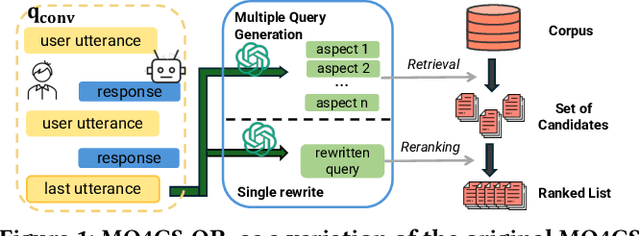
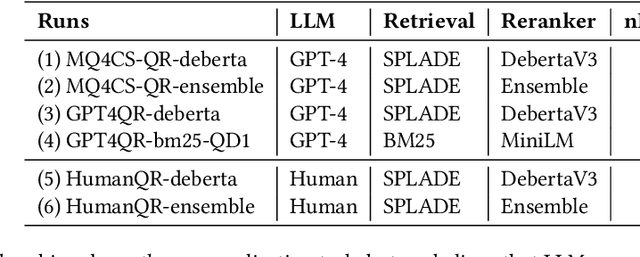
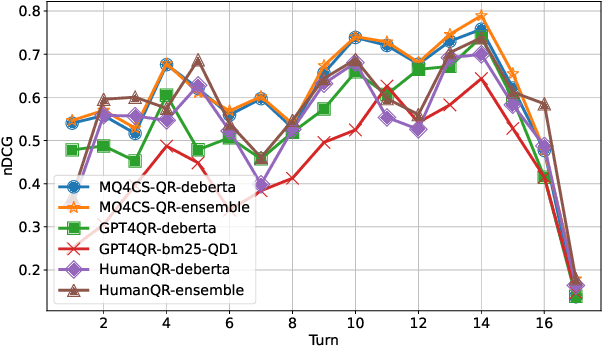
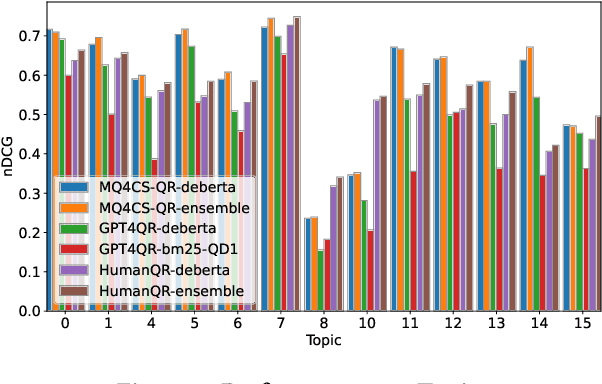
The Interactive Knowledge Assistant Track (iKAT) 2024 focuses on advancing conversational assistants, able to adapt their interaction and responses from personalized user knowledge. The track incorporates a Personal Textual Knowledge Base (PTKB) alongside Conversational AI tasks, such as passage ranking and response generation. Query Rewrite being an effective approach for resolving conversational context, we explore Large Language Models (LLMs), as query rewriters. Specifically, our submitted runs explore multi-aspect query generation using the MQ4CS framework, which we further enhance with Learned Sparse Retrieval via the SPLADE architecture, coupled with robust cross-encoder models. We also propose an alternative to the previous interleaving strategy, aggregating multiple aspects during the reranking phase. Our findings indicate that multi-aspect query generation is effective in enhancing performance when integrated with advanced retrieval and reranking models. Our results also lead the way for better personalization in Conversational Search, relying on LLMs to integrate personalization within query rewrite, and outperforming human rewrite performance.
Can We Use Large Language Models to Fill Relevance Judgment Holes?
May 09, 2024
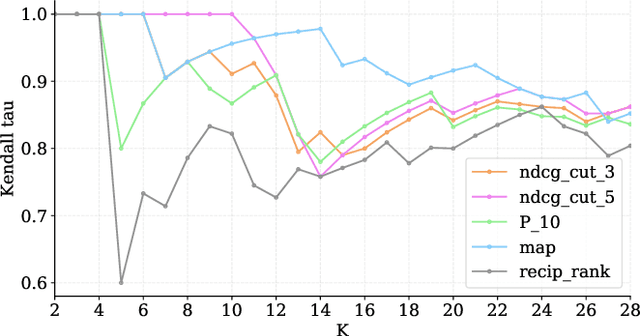
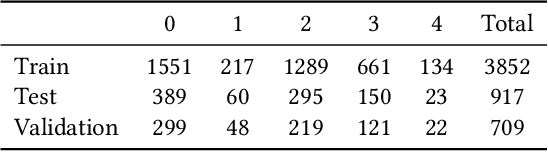
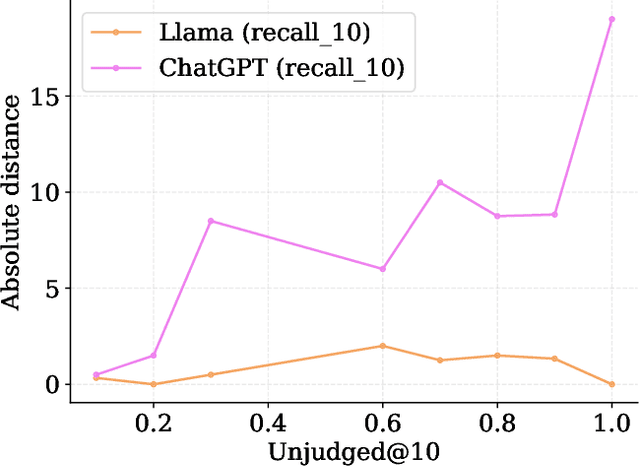
Incomplete relevance judgments limit the re-usability of test collections. When new systems are compared against previous systems used to build the pool of judged documents, they often do so at a disadvantage due to the ``holes'' in test collection (i.e., pockets of un-assessed documents returned by the new system). In this paper, we take initial steps towards extending existing test collections by employing Large Language Models (LLM) to fill the holes by leveraging and grounding the method using existing human judgments. We explore this problem in the context of Conversational Search using TREC iKAT, where information needs are highly dynamic and the responses (and, the results retrieved) are much more varied (leaving bigger holes). While previous work has shown that automatic judgments from LLMs result in highly correlated rankings, we find substantially lower correlates when human plus automatic judgments are used (regardless of LLM, one/two/few shot, or fine-tuned). We further find that, depending on the LLM employed, new runs will be highly favored (or penalized), and this effect is magnified proportionally to the size of the holes. Instead, one should generate the LLM annotations on the whole document pool to achieve more consistent rankings with human-generated labels. Future work is required to prompt engineering and fine-tuning LLMs to reflect and represent the human annotations, in order to ground and align the models, such that they are more fit for purpose.
TREC iKAT 2023: A Test Collection for Evaluating Conversational and Interactive Knowledge Assistants
May 04, 2024Conversational information seeking has evolved rapidly in the last few years with the development of Large Language Models (LLMs), providing the basis for interpreting and responding in a naturalistic manner to user requests. The extended TREC Interactive Knowledge Assistance Track (iKAT) collection aims to enable researchers to test and evaluate their Conversational Search Agents (CSA). The collection contains a set of 36 personalized dialogues over 20 different topics each coupled with a Personal Text Knowledge Base (PTKB) that defines the bespoke user personas. A total of 344 turns with approximately 26,000 passages are provided as assessments on relevance, as well as additional assessments on generated responses over four key dimensions: relevance, completeness, groundedness, and naturalness. The collection challenges CSA to efficiently navigate diverse personal contexts, elicit pertinent persona information, and employ context for relevant conversations. The integration of a PTKB and the emphasis on decisional search tasks contribute to the uniqueness of this test collection, making it an essential benchmark for advancing research in conversational and interactive knowledge assistants.