 Add to Chrome
 Add to Firefox
 Add to Edge
Talk, Evaluate, Diagnose: User-aware Agent Evaluation with Automated Error Analysis
Mar 16, 2026
Agent applications are increasingly adopted to automate workflows across diverse tasks. However, due to the heterogeneous domains they operate in, it is challenging to create a scalable evaluation framework. Prior works each employ their own methods to determine task success, such as database lookups, regex match, etc., adding complexity to the development of a unified agent evaluation approach. Moreover, they do not systematically account for the user's role nor expertise in the interaction, providing incomplete insights into the agent's performance. We argue that effective agent evaluation goes beyond correctness alone, incorporating conversation quality, efficiency and systematic diagnosis of agent errors. To address this, we introduce the TED framework (Talk, Evaluate, Diagnose). (1) Talk: We leverage reusable, generic expert and non-expert user persona templates for user-agent interaction. (2) Evaluate: We adapt existing datasets by representing subgoals-such as tool signatures, and responses-as natural language grading notes, evaluated automatically with LLM-as-a-judge. We propose new metrics that capture both turn efficiency and intermediate progress of the agent complementing the user-aware setup. (3) Diagnose: We introduce an automated error analysis tool that analyzes the inconsistencies of the judge and agents, uncovering common errors, and providing actionable feedback for agent improvement. We show that our TED framework reveals new insights regarding agent performance across models and user expertise levels. We also demonstrate potential gains in agent performance with peaks of 8-10% on our proposed metrics after incorporating the identified error remedies into the agent's design.

OCR or Not? Rethinking Document Information Extraction in the MLLMs Era with Real-World Large-Scale Datasets
Mar 03, 2026Multimodal Large Language Models (MLLMs) enhance the potential of natural language processing. However, their actual impact on document information extraction remains unclear. In particular, it is unclear whether an MLLM-only pipeline--while simpler--can truly match the performance of traditional OCR+MLLM setups. In this paper, we conduct a large-scale benchmarking study that evaluates various out-of-the-box MLLMs on business-document information extraction. To examine and explore failure modes, we propose an automated hierarchical error analysis framework that leverages large language models (LLMs) to diagnose error patterns systematically. Our findings suggest that OCR may not be necessary for powerful MLLMs, as image-only input can achieve comparable performance to OCR-enhanced approaches. Moreover, we demonstrate that carefully designed schema, exemplars, and instructions can further enhance MLLMs performance. We hope this work can offer practical guidance and valuable insight for advancing document information extraction.
Towards Efficient and Certified Recovery from Poisoning Attacks in Federated Learning
Jan 19, 2024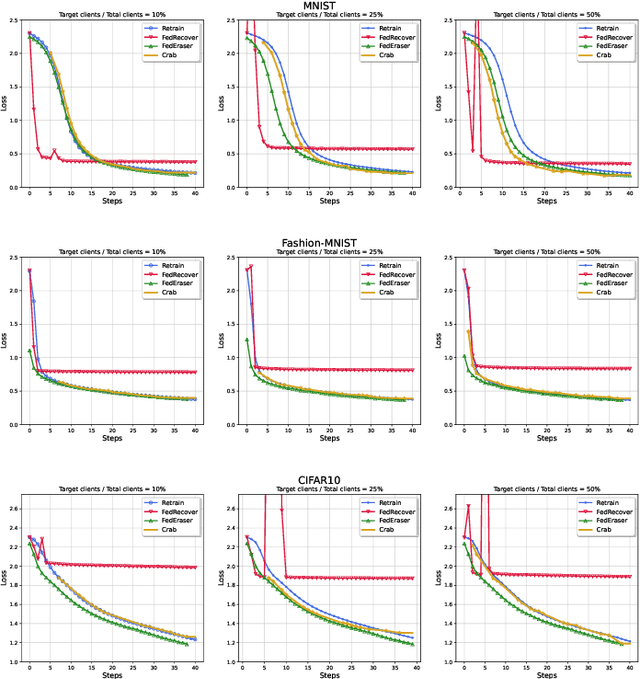
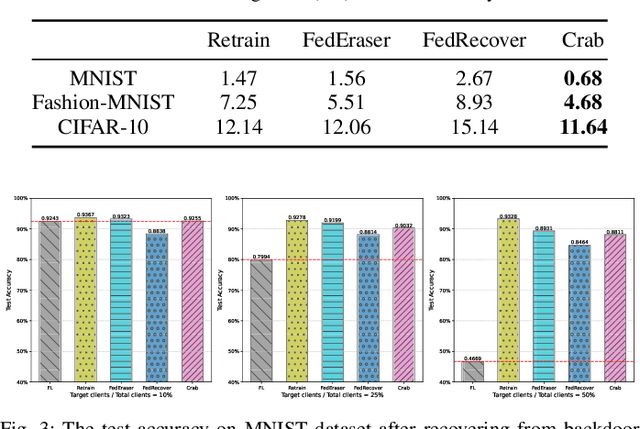
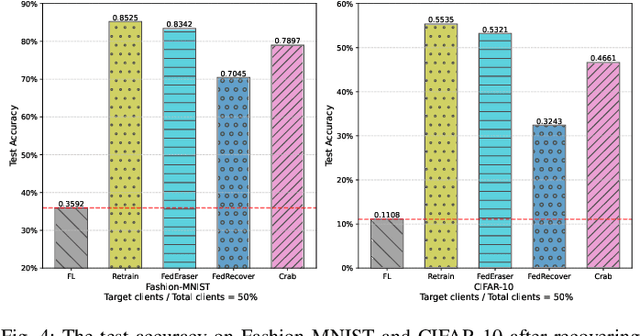
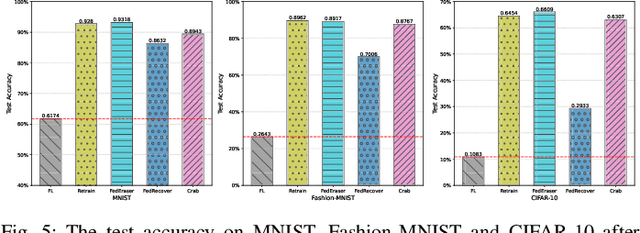
Federated learning (FL) is vulnerable to poisoning attacks, where malicious clients manipulate their updates to affect the global model. Although various methods exist for detecting those clients in FL, identifying malicious clients requires sufficient model updates, and hence by the time malicious clients are detected, FL models have been already poisoned. Thus, a method is needed to recover an accurate global model after malicious clients are identified. Current recovery methods rely on (i) all historical information from participating FL clients and (ii) the initial model unaffected by the malicious clients, leading to a high demand for storage and computational resources. In this paper, we show that highly effective recovery can still be achieved based on (i) selective historical information rather than all historical information and (ii) a historical model that has not been significantly affected by malicious clients rather than the initial model. In this scenario, while maintaining comparable recovery performance, we can accelerate the recovery speed and decrease memory consumption. Following this concept, we introduce Crab, an efficient and certified recovery method, which relies on selective information storage and adaptive model rollback. Theoretically, we demonstrate that the difference between the global model recovered by Crab and the one recovered by train-from-scratch can be bounded under certain assumptions. Our empirical evaluation, conducted across three datasets over multiple machine learning models, and a variety of untargeted and targeted poisoning attacks reveals that Crab is both accurate and efficient, and consistently outperforms previous approaches in terms of both recovery speed and memory consumption.
Efficient Dataset Distillation through Alignment with Smooth and High-Quality Expert Trajectories
Oct 16, 2023Training a large and state-of-the-art machine learning model typically necessitates the use of large-scale datasets, which, in turn, makes the training and parameter-tuning process expensive and time-consuming. Some researchers opt to distil information from real-world datasets into tiny and compact synthetic datasets while maintaining their ability to train a well-performing model, hence proposing a data-efficient method known as Dataset Distillation (DD). Despite recent progress in this field, existing methods still underperform and cannot effectively replace large datasets. In this paper, unlike previous methods that focus solely on improving the efficacy of student distillation, we are the first to recognize the important interplay between expert and student. We argue the significant impact of expert smoothness when employing more potent expert trajectories in subsequent dataset distillation. Based on this, we introduce the integration of clipping loss and gradient penalty to regulate the rate of parameter changes in expert trajectories. Furthermore, in response to the sensitivity exhibited towards randomly initialized variables during distillation, we propose representative initialization for synthetic dataset and balanced inner-loop loss. Finally, we present two enhancement strategies, namely intermediate matching loss and weight perturbation, to mitigate the potential occurrence of cumulative errors. We conduct extensive experiments on datasets of different scales, sizes, and resolutions. The results demonstrate that the proposed method significantly outperforms prior methods.