 Add to Chrome
 Add to Firefox
 Add to Edge
Expert-Guided g-computation with Large Language Models for Estimating Causal Effects on Timings: Applications to Hospital Quality Improvement
Aug 11, 2026
Hospital quality improvement (QI) programs routinely face multiple candidate interventions to optimize hospital flow, but existing methods struggle to estimate and rank the causal effects of such interventions. This work focuses on one of the most standard hospital metrics, the average length of stay (LOS), and its causal estimand, the average time saved. To characterize this causal effect, qualitative approaches rely on expert judgment to map patient trajectories, making them susceptible to cognitive biases; quantitative approaches rely on data-driven models, which fail when interventions are hypothetical with no historical data or have complex causal mechanisms that require clinical reasoning rather than data alone. We propose expert-guided g-computation, or egg-computation, which combines the complementary strengths of both approaches by connecting the Gantt charts commonly used to map patient trajectories with the causal DAG literature. We introduce a causal model over Gantt charts and establish identification using a variant of g-computation that seeks expert input only for components unidentifiable from data. To make egg-computation practical, we develop an LLM-assisted pipeline that reliably scales up expert reasoning. In simulations, egg-computation outperforms conventional causal inference methods when patients have diverse causal structures and intervention mechanisms. In a study of eleven candidate QI interventions at an urban safety-net hospital, the LLM pipeline generated graphs and time-saving estimates highly concordant with those of human experts. Beyond healthcare, egg-computation is a broadly applicable framework for estimating the average time saved for candidate interventions whose causal mechanisms can be represented using Gantt charts.

ERAlign: Energy-based Representation Alignment of GNNs and LLMs on Text-attributed Graphs
Jun 09, 2026Text-attributed Graphs (TAGs) incorporate textual node attributes with graph structures to describe rich relational semantics. Recent efforts to integrate Graph Neural Networks (GNNs) and Large Language Models (LLMs) have shown promise for learning on TAGs, yet achieving well-aligned representations remains challenging. Prior studies largely rely on heuristics that perform coarse-grained matching. They lack sufficient constraints and ignore distributional alignment, leading to representation drift and limited generalization. Building on Energy-based Models (EBMs), we propose an Energy-based Representation Alignment (ERAlign) framework that projects GNN-encoded graph structure and LLM-derived text embeddings in a shared latent space to achieve distribution consistency. Concretely, layer-wise alignment is quantified by a distance metric and optimized via an EBM objective. By decreasing energy values, our framework yields well-aligned representations for downstream tasks. During training, we introduce Energy Discrepancy (ED) to avoid high sampling costs associated with intractable normalization. ED also carries theoretical guarantees of higher training efficiency and reduced energy landscape distortion. Empirical evaluations on eight TAG datasets demonstrate that ERAlign obtains state-of-the-art performance across varying levels of supervision and cross-task transfer scenarios.
iDiff: Interpretable Difference-aware Framework for Pairwise Image Quality Assessment
May 19, 2026Pairwise image quality assessment (IQA) in professional photography requires a model not only to identify the preferred image between two candidates, but also to provide convincing and image-grounded reasoning. In the NTIRE 2026 RAIM challenge, this requirement is further emphasized by jointly evaluating preference prediction and rationale generation. To address this task, we propose iDiff, an Interpretable Difference-aware framework for pairwise image quality assessment. Our method adopts a dual-branch design consisting of an Answer Model and a Thinking Model. The Answer Model performs robust preference prediction by explicitly decomposing each sample into left/right global and local views, followed by content-aware specialization for person and scene images and ensemble-based aggregation across backbones. The Thinking Model focuses on rationale generation and is progressively enhanced with expert-style templates, multi-source quality features, and answer-aware supervision conditioned on the Answer Model prediction. In this way, iDiff jointly models discriminative decision making and structured explanation, improving both robustness and interpretability. Extensive experiments demonstrate the effectiveness of the proposed framework on both accuracy and reasoning-quality metrics. Our method achieved first place in the NTIRE 2026 RAIM challenge, showing the effectiveness of integrating explicit difference modeling with structured multimodal reasoning for pairwise IQA.
Virtual Width Networks
Nov 17, 2025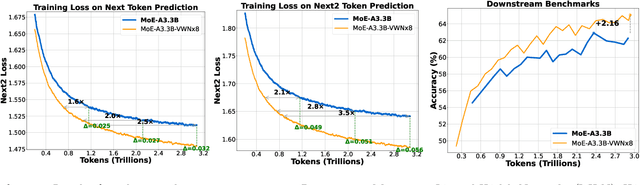
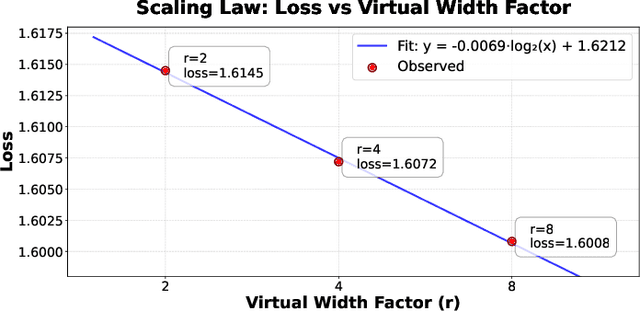
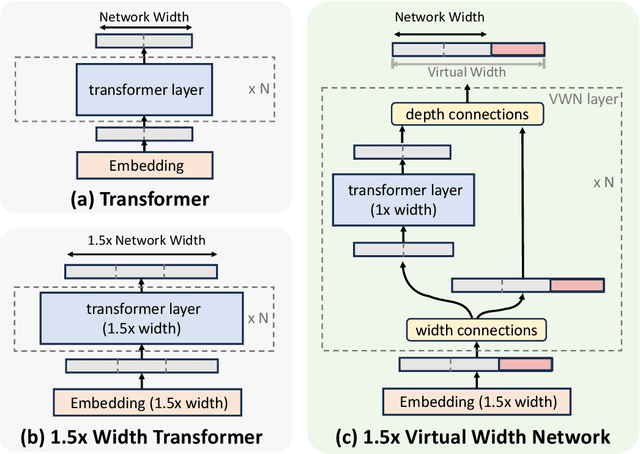
We introduce Virtual Width Networks (VWN), a framework that delivers the benefits of wider representations without incurring the quadratic cost of increasing the hidden size. VWN decouples representational width from backbone width, expanding the embedding space while keeping backbone compute nearly constant. In our large-scale experiment, an 8-times expansion accelerates optimization by over 2 times for next-token and 3 times for next-2-token prediction. The advantage amplifies over training as both the loss gap grows and the convergence-speedup ratio increases, showing that VWN is not only token-efficient but also increasingly effective with scale. Moreover, we identify an approximately log-linear scaling relation between virtual width and loss reduction, offering an initial empirical basis and motivation for exploring virtual-width scaling as a new dimension of large-model efficiency.
Judging LLMs on a Simplex
May 28, 2025Automated evaluation of free-form outputs from large language models (LLMs) is challenging because many distinct answers can be equally valid. A common practice is to use LLMs themselves as judges, but the theoretical properties of this approach are not yet well understood. We show that a geometric framework that represents both judges and candidates as points on a probability simplex can provide helpful insight on what is or is not identifiable using LLM judges. Our theoretical analysis uncovers a "phase transition" in ranking identifiability: for binary scoring systems, true rankings are identifiable even with weak judges under mild assumptions, while rankings become non-identifiable for three or more scoring levels even with infinite data, absent additional prior knowledge. This non-identifiability highlights how uncertainty in rankings stems from not only aleatoric uncertainty (i.e., inherent stochasticity in the data) but also epistemic uncertainty regarding which assumptions hold, an aspect that has received limited attention until now. To integrate both types of uncertainty, we use Bayesian inference to encode assumptions as priors and conduct sensitivity analysis of ranking estimates and credible intervals. Empirical evaluations across multiple benchmarks demonstrate that Bayesian inference yields more accurate rankings and substantially improves coverage rates. These results underscore the importance of taking a more holistic approach to uncertainty quantification when using LLMs as judges.
Instruction-augmented Multimodal Alignment for Image-Text and Element Matching
Apr 16, 2025With the rapid advancement of text-to-image (T2I) generation models, assessing the semantic alignment between generated images and text descriptions has become a significant research challenge. Current methods, including those based on Visual Question Answering (VQA), still struggle with fine-grained assessments and precise quantification of image-text alignment. This paper presents an improved evaluation method named Instruction-augmented Multimodal Alignment for Image-Text and Element Matching (iMatch), which evaluates image-text semantic alignment by fine-tuning multimodal large language models. We introduce four innovative augmentation strategies: First, the QAlign strategy creates a precise probabilistic mapping to convert discrete scores from multimodal large language models into continuous matching scores. Second, a validation set augmentation strategy uses pseudo-labels from model predictions to expand training data, boosting the model's generalization performance. Third, an element augmentation strategy integrates element category labels to refine the model's understanding of image-text matching. Fourth, an image augmentation strategy employs techniques like random lighting to increase the model's robustness. Additionally, we propose prompt type augmentation and score perturbation strategies to further enhance the accuracy of element assessments. Our experimental results show that the iMatch method significantly surpasses existing methods, confirming its effectiveness and practical value. Furthermore, our iMatch won first place in the CVPR NTIRE 2025 Text to Image Generation Model Quality Assessment - Track 1 Image-Text Alignment.
Survey and Improvement Strategies for Gene Prioritization with Large Language Models
Jan 30, 2025


Rare diseases are challenging to diagnose due to limited patient data and genetic diversity. Despite advances in variant prioritization, many cases remain undiagnosed. While large language models (LLMs) have performed well in medical exams, their effectiveness in diagnosing rare genetic diseases has not been assessed. To identify causal genes, we benchmarked various LLMs for gene prioritization. Using multi-agent and Human Phenotype Ontology (HPO) classification, we categorized patients based on phenotypes and solvability levels. As gene set size increased, LLM performance deteriorated, so we used a divide-and-conquer strategy to break the task into smaller subsets. At baseline, GPT-4 outperformed other LLMs, achieving near 30% accuracy in ranking causal genes correctly. The multi-agent and HPO approaches helped distinguish confidently solved cases from challenging ones, highlighting the importance of known gene-phenotype associations and phenotype specificity. We found that cases with specific phenotypes or clear associations were more accurately solved. However, we observed biases toward well-studied genes and input order sensitivity, which hindered gene prioritization. Our divide-and-conquer strategy improved accuracy by overcoming these biases. By utilizing HPO classification, novel multi-agent techniques, and our LLM strategy, we improved causal gene identification accuracy compared to our baseline evaluation. This approach streamlines rare disease diagnosis, facilitates reanalysis of unsolved cases, and accelerates gene discovery, supporting the development of targeted diagnostics and therapies.
A hierarchical decomposition for explaining ML performance discrepancies
Feb 22, 2024Machine learning (ML) algorithms can often differ in performance across domains. Understanding $\textit{why}$ their performance differs is crucial for determining what types of interventions (e.g., algorithmic or operational) are most effective at closing the performance gaps. Existing methods focus on $\textit{aggregate decompositions}$ of the total performance gap into the impact of a shift in the distribution of features $p(X)$ versus the impact of a shift in the conditional distribution of the outcome $p(Y|X)$; however, such coarse explanations offer only a few options for how one can close the performance gap. $\textit{Detailed variable-level decompositions}$ that quantify the importance of each variable to each term in the aggregate decomposition can provide a much deeper understanding and suggest much more targeted interventions. However, existing methods assume knowledge of the full causal graph or make strong parametric assumptions. We introduce a nonparametric hierarchical framework that provides both aggregate and detailed decompositions for explaining why the performance of an ML algorithm differs across domains, without requiring causal knowledge. We derive debiased, computationally-efficient estimators, and statistical inference procedures for asymptotically valid confidence intervals.
A Brief Tutorial on Sample Size Calculations for Fairness Audits
Dec 07, 2023

In fairness audits, a standard objective is to detect whether a given algorithm performs substantially differently between subgroups. Properly powering the statistical analysis of such audits is crucial for obtaining informative fairness assessments, as it ensures a high probability of detecting unfairness when it exists. However, limited guidance is available on the amount of data necessary for a fairness audit, lacking directly applicable results concerning commonly used fairness metrics. Additionally, the consideration of unequal subgroup sample sizes is also missing. In this tutorial, we address these issues by providing guidance on how to determine the required subgroup sample sizes to maximize the statistical power of hypothesis tests for detecting unfairness. Our findings are applicable to audits of binary classification models and multiple fairness metrics derived as summaries of the confusion matrix. Furthermore, we discuss other aspects of audit study designs that can increase the reliability of audit results.
Towards a Post-Market Monitoring Framework for Machine Learning-based Medical Devices: A case study
Nov 20, 2023


After a machine learning (ML)-based system is deployed in clinical practice, performance monitoring is important to ensure the safety and effectiveness of the algorithm over time. The goal of this work is to highlight the complexity of designing a monitoring strategy and the need for a systematic framework that compares the multitude of monitoring options. One of the main decisions is choosing between using real-world (observational) versus interventional data. Although the former is the most convenient source of monitoring data, it exhibits well-known biases, such as confounding, selection, and missingness. In fact, when the ML algorithm interacts with its environment, the algorithm itself may be a primary source of bias. On the other hand, a carefully designed interventional study that randomizes individuals can explicitly eliminate such biases, but the ethics, feasibility, and cost of such an approach must be carefully considered. Beyond the decision of the data source, monitoring strategies vary in the performance criteria they track, the interpretability of the test statistics, the strength of their assumptions, and their speed at detecting performance decay. As a first step towards developing a framework that compares the various monitoring options, we consider a case study of an ML-based risk prediction algorithm for postoperative nausea and vomiting (PONV). Bringing together tools from causal inference and statistical process control, we walk through the basic steps of defining candidate monitoring criteria, describing potential sources of bias and the causal model, and specifying and comparing candidate monitoring procedures. We hypothesize that these steps can be applied more generally, as causal inference can address other sources of biases as well.