 Add to Chrome
 Add to Firefox
 Add to Edge
Large Language Model-Empowered Interactive Load Forecasting
May 22, 2025
The growing complexity of power systems has made accurate load forecasting more important than ever. An increasing number of advanced load forecasting methods have been developed. However, the static design of current methods offers no mechanism for human-model interaction. As the primary users of forecasting models, system operators often find it difficult to understand and apply these advanced models, which typically requires expertise in artificial intelligence (AI). This also prevents them from incorporating their experience and real-world contextual understanding into the forecasting process. Recent breakthroughs in large language models (LLMs) offer a new opportunity to address this issue. By leveraging their natural language understanding and reasoning capabilities, we propose an LLM-based multi-agent collaboration framework to bridge the gap between human operators and forecasting models. A set of specialized agents is designed to perform different tasks in the forecasting workflow and collaborate via a dedicated communication mechanism. This framework embeds interactive mechanisms throughout the load forecasting pipeline, reducing the technical threshold for non-expert users and enabling the integration of human experience. Our experiments demonstrate that the interactive load forecasting accuracy can be significantly improved when users provide proper insight in key stages. Our cost analysis shows that the framework remains affordable, making it practical for real-world deployment.

V2V: Scaling Event-Based Vision through Efficient Video-to-Voxel Simulation
May 22, 2025Event-based cameras offer unique advantages such as high temporal resolution, high dynamic range, and low power consumption. However, the massive storage requirements and I/O burdens of existing synthetic data generation pipelines and the scarcity of real data prevent event-based training datasets from scaling up, limiting the development and generalization capabilities of event vision models. To address this challenge, we introduce Video-to-Voxel (V2V), an approach that directly converts conventional video frames into event-based voxel grid representations, bypassing the storage-intensive event stream generation entirely. V2V enables a 150 times reduction in storage requirements while supporting on-the-fly parameter randomization for enhanced model robustness. Leveraging this efficiency, we train several video reconstruction and optical flow estimation model architectures on 10,000 diverse videos totaling 52 hours--an order of magnitude larger than existing event datasets, yielding substantial improvements.
GlobalGeoTree: A Multi-Granular Vision-Language Dataset for Global Tree Species Classification
May 18, 2025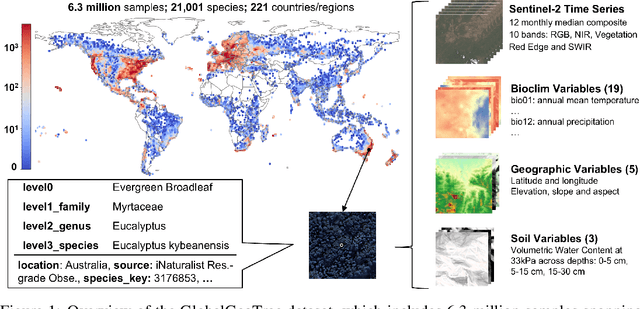
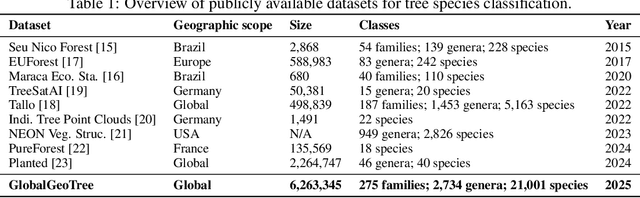
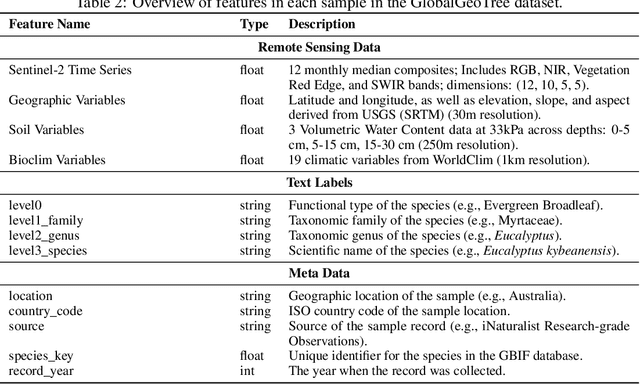
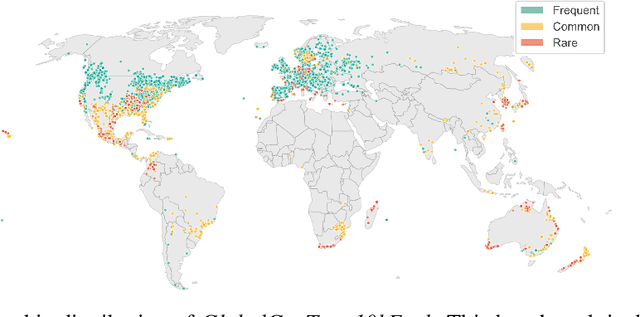
Global tree species mapping using remote sensing data is vital for biodiversity monitoring, forest management, and ecological research. However, progress in this field has been constrained by the scarcity of large-scale, labeled datasets. To address this, we introduce GlobalGeoTree, a comprehensive global dataset for tree species classification. GlobalGeoTree comprises 6.3 million geolocated tree occurrences, spanning 275 families, 2,734 genera, and 21,001 species across the hierarchical taxonomic levels. Each sample is paired with Sentinel-2 image time series and 27 auxiliary environmental variables, encompassing bioclimatic, geographic, and soil data. The dataset is partitioned into GlobalGeoTree-6M for model pretraining and curated evaluation subsets, primarily GlobalGeoTree-10kEval for zero-shot and few-shot benchmarking. To demonstrate the utility of the dataset, we introduce a baseline model, GeoTreeCLIP, which leverages paired remote sensing data and taxonomic text labels within a vision-language framework pretrained on GlobalGeoTree-6M. Experimental results show that GeoTreeCLIP achieves substantial improvements in zero- and few-shot classification on GlobalGeoTree-10kEval over existing advanced models. By making the dataset, models, and code publicly available, we aim to establish a benchmark to advance tree species classification and foster innovation in biodiversity research and ecological applications.
CTP: A hybrid CNN-Transformer-PINN model for ocean front forecasting
May 16, 2025This paper proposes CTP, a novel deep learning framework that integrates convolutional neural network(CNN), Transformer architectures, and physics-informed neural network(PINN) for ocean front prediction. Ocean fronts, as dynamic interfaces between distinct water masses, play critical roles in marine biogeochemical and physical processes. Existing methods such as LSTM, ConvLSTM, and AttentionConv often struggle to maintain spatial continuity and physical consistency over multi-step forecasts. CTP addresses these challenges by combining localized spatial encoding, long-range temporal attention, and physical constraint enforcement. Experimental results across south China sea(SCS) and Kuroshio(KUR) regions from 1993 to 2020 demonstrate that CTP achieves state-of-the-art(SOTA) performance in both single-step and multi-step predictions, significantly outperforming baseline models in accuracy, $F_1$ score, and temporal stability.
Discovering Fine-Grained Visual-Concept Relations by Disentangled Optimal Transport Concept Bottleneck Models
May 12, 2025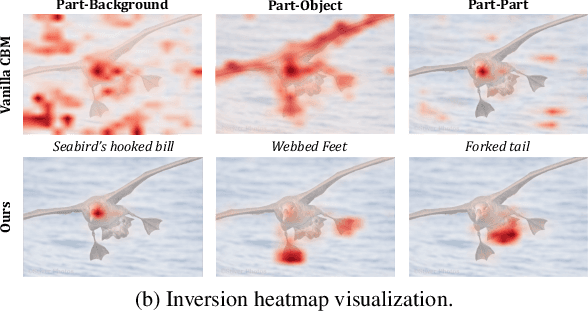
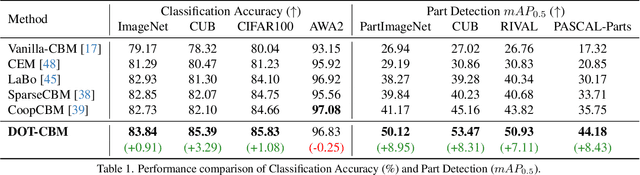
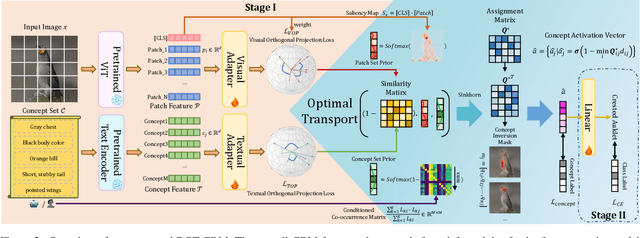
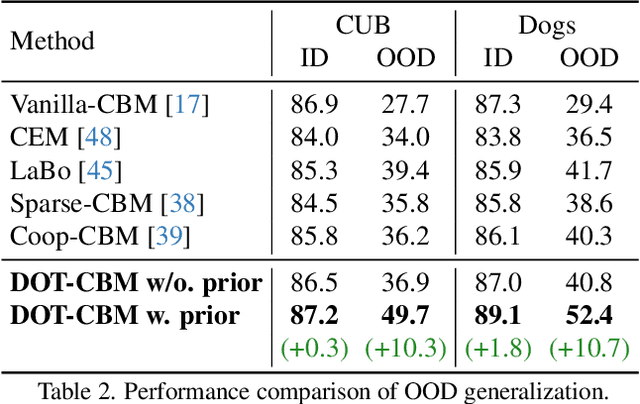
Concept Bottleneck Models (CBMs) try to make the decision-making process transparent by exploring an intermediate concept space between the input image and the output prediction. Existing CBMs just learn coarse-grained relations between the whole image and the concepts, less considering local image information, leading to two main drawbacks: i) they often produce spurious visual-concept relations, hence decreasing model reliability; and ii) though CBMs could explain the importance of every concept to the final prediction, it is still challenging to tell which visual region produces the prediction. To solve these problems, this paper proposes a Disentangled Optimal Transport CBM (DOT-CBM) framework to explore fine-grained visual-concept relations between local image patches and concepts. Specifically, we model the concept prediction process as a transportation problem between the patches and concepts, thereby achieving explicit fine-grained feature alignment. We also incorporate orthogonal projection losses within the modality to enhance local feature disentanglement. To further address the shortcut issues caused by statistical biases in the data, we utilize the visual saliency map and concept label statistics as transportation priors. Thus, DOT-CBM can visualize inversion heatmaps, provide more reliable concept predictions, and produce more accurate class predictions. Comprehensive experiments demonstrate that our proposed DOT-CBM achieves SOTA performance on several tasks, including image classification, local part detection and out-of-distribution generalization.
Prompting Large Language Models for Training-Free Non-Intrusive Load Monitoring
May 09, 2025Non-intrusive Load Monitoring (NILM) aims to disaggregate aggregate household electricity consumption into individual appliance usage, enabling more effective energy management. While deep learning has advanced NILM, it remains limited by its dependence on labeled data, restricted generalization, and lack of interpretability. In this paper, we introduce the first prompt-based NILM framework that leverages Large Language Models (LLMs) with in-context learning. We design and evaluate prompt strategies that integrate appliance features, timestamps and contextual information, as well as representative time-series examples, using the REDD dataset. With optimized prompts, LLMs achieve competitive state detection accuracy, reaching an average F1-score of 0.676 on unseen households, and demonstrate robust generalization without the need for fine-tuning. LLMs also enhance interpretability by providing clear, human-readable explanations for their predictions. Our results show that LLMs can reduce data requirements, improve adaptability, and provide transparent energy disaggregation in NILM applications.
FedRE: Robust and Effective Federated Learning with Privacy Preference
May 08, 2025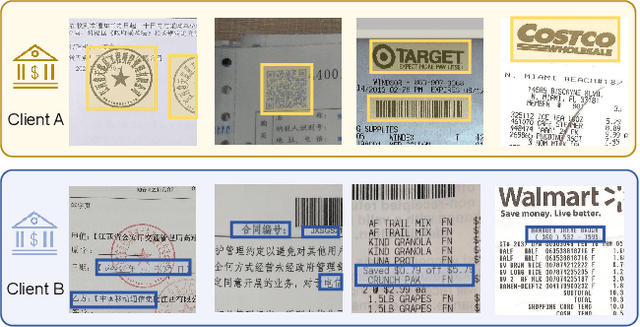
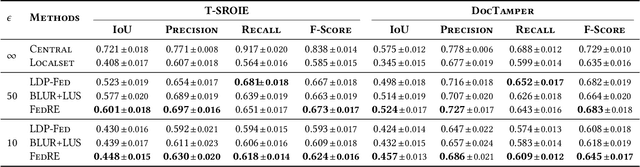
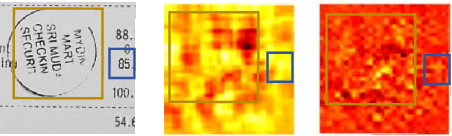
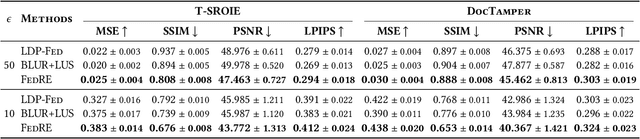
Despite Federated Learning (FL) employing gradient aggregation at the server for distributed training to prevent the privacy leakage of raw data, private information can still be divulged through the analysis of uploaded gradients from clients. Substantial efforts have been made to integrate local differential privacy (LDP) into the system to achieve a strict privacy guarantee. However, existing methods fail to take practical issues into account by merely perturbing each sample with the same mechanism while each client may have their own privacy preferences on privacy-sensitive information (PSI), which is not uniformly distributed across the raw data. In such a case, excessive privacy protection from private-insensitive information can additionally introduce unnecessary noise, which may degrade the model performance. In this work, we study the PSI within data and develop FedRE, that can simultaneously achieve robustness and effectiveness benefits with LDP protection. More specifically, we first define PSI with regard to the privacy preferences of each client. Then, we optimize the LDP by allocating less privacy budget to gradients with higher PSI in a layer-wise manner, thus providing a stricter privacy guarantee for PSI. Furthermore, to mitigate the performance degradation caused by LDP, we design a parameter aggregation mechanism based on the distribution of the perturbed information. We conducted experiments with text tamper detection on T-SROIE and DocTamper datasets, and FedRE achieves competitive performance compared to state-of-the-art methods.
SCFormer: Structured Channel-wise Transformer with Cumulative Historical State for Multivariate Time Series Forecasting
May 05, 2025The Transformer model has shown strong performance in multivariate time series forecasting by leveraging channel-wise self-attention. However, this approach lacks temporal constraints when computing temporal features and does not utilize cumulative historical series effectively.To address these limitations, we propose the Structured Channel-wise Transformer with Cumulative Historical state (SCFormer). SCFormer introduces temporal constraints to all linear transformations, including the query, key, and value matrices, as well as the fully connected layers within the Transformer. Additionally, SCFormer employs High-order Polynomial Projection Operators (HiPPO) to deal with cumulative historical time series, allowing the model to incorporate information beyond the look-back window during prediction. Extensive experiments on multiple real-world datasets demonstrate that SCFormer significantly outperforms mainstream baselines, highlighting its effectiveness in enhancing time series forecasting. The code is publicly available at https://github.com/ShiweiGuo1995/SCFormer
Dual-Forecaster: A Multimodal Time Series Model Integrating Descriptive and Predictive Texts
May 02, 2025Most existing single-modal time series models rely solely on numerical series, which suffer from the limitations imposed by insufficient information. Recent studies have revealed that multimodal models can address the core issue by integrating textual information. However, these models focus on either historical or future textual information, overlooking the unique contributions each plays in time series forecasting. Besides, these models fail to grasp the intricate relationships between textual and time series data, constrained by their moderate capacity for multimodal comprehension. To tackle these challenges, we propose Dual-Forecaster, a pioneering multimodal time series model that combines both descriptively historical textual information and predictive textual insights, leveraging advanced multimodal comprehension capability empowered by three well-designed cross-modality alignment techniques. Our comprehensive evaluations on fifteen multimodal time series datasets demonstrate that Dual-Forecaster is a distinctly effective multimodal time series model that outperforms or is comparable to other state-of-the-art models, highlighting the superiority of integrating textual information for time series forecasting. This work opens new avenues in the integration of textual information with numerical time series data for multimodal time series analysis.
Optimizing Mouse Dynamics for User Authentication by Machine Learning: Addressing Data Sufficiency, Accuracy-Practicality Trade-off, and Model Performance Challenges
Apr 30, 2025User authentication is essential to ensure secure access to computer systems, yet traditional methods face limitations in usability, cost, and security. Mouse dynamics authentication, based on the analysis of users' natural interaction behaviors with mouse devices, offers a cost-effective, non-intrusive, and adaptable solution. However, challenges remain in determining the optimal data volume, balancing accuracy and practicality, and effectively capturing temporal behavioral patterns. In this study, we propose a statistical method using Gaussian kernel density estimate (KDE) and Kullback-Leibler (KL) divergence to estimate the sufficient data volume for training authentication models. We introduce the Mouse Authentication Unit (MAU), leveraging Approximate Entropy (ApEn) to optimize segment length for efficient and accurate behavioral representation. Furthermore, we design the Local-Time Mouse Authentication (LT-AMouse) framework, integrating 1D-ResNet for local feature extraction and GRU for modeling long-term temporal dependencies. Taking the Balabit and DFL datasets as examples, we significantly reduced the data scale, particularly by a factor of 10 for the DFL dataset, greatly alleviating the training burden. Additionally, we determined the optimal input recognition unit length for the user authentication system on different datasets based on the slope of Approximate Entropy. Training with imbalanced samples, our model achieved a successful defense AUC 98.52% for blind attack on the DFL dataset and 94.65% on the Balabit dataset, surpassing the current sota performance.