 Add to Chrome
 Add to Firefox
 Add to Edge
Geospatial Diffusion-based Evolution Synthesis (GeoDES) for Storm-Centered Weather Augmentation
Jul 21, 2026
While machine learning-based weather models hold significant promise, they struggle to predict the detailed structure of large-scale weather systems such as cyclonic storms. Regional models are constrained by limited historical records within fixed geographic boundaries, while global models are computationally expensive and often operate at resolutions too coarse to capture fine-grained storm dynamics. To bridge this gap, we introduce the Geospatial Diffusion-based Evolution Synthesis (GeoDES) model, a custom image-to-video diffusion model. By focusing generation strictly on the evolving storm structure, GeoDES synthesizes physically consistent, high-fidelity weather events suitable for stress-testing forecast models and expanding meteorological datasets. Evaluations demonstrate that GeoDES outperforms prior methods on key metrics, achieving $52\%$ lower Peak Vorticity Error and $8\%$ higher Anomaly Correlation Coefficient than the next strongest methods on the North Atlantic test set.

CommonRoad-Game: A Human-in-the-Loop Simulation Framework for Autonomous Driving
Jul 01, 2026Motion planning algorithms should be evaluated in human-in-the-loop environments to ensure they produce safe and efficient behaviors during interactions. However, existing simulation platforms often rely on recorded datasets, lack dedicated interfaces for real-time human interaction, or remain weakly integrated with an autonomous driving ecosystem. Moreover, many human-in-the-loop simulators are computationally intensive by design, making them less suitable for rapid prototyping and flexible experimentation in early-stage autonomous driving research. To address these limitations, we present CommonRoad-Game, a lightweight human-in-the-loop simulation framework tightly integrated with the CommonRoad platform, focusing on the systematic testing of motion planners with human participation and the analysis of human driving behaviors in interactive scenarios. We introduce a multi-threaded architecture with a robust synchronization mechanism that aligns simulation time with wall-clock time, enabling deterministic and temporally consistent interaction between autonomous and human-driven vehicles. In addition, the framework provides a scenario generation module that records driving logs, allowing diverse and reproducible test cases to be constructed from human-in-the-loop experiments. Experimental results demonstrate that CommonRoad-Game achieves stable temporal synchronization, supports scalable multi-agent simulation, and seamlessly integrates CommonRoad-compatible motion planners to generate interactive driving scenarios. The source code is publicly available at https://github.com/Yunfei-Bi8/CommonRoad-Game.
Results of the 2024 CommonRoad Motion Planning Competition for Autonomous Vehicles
Dec 22, 2025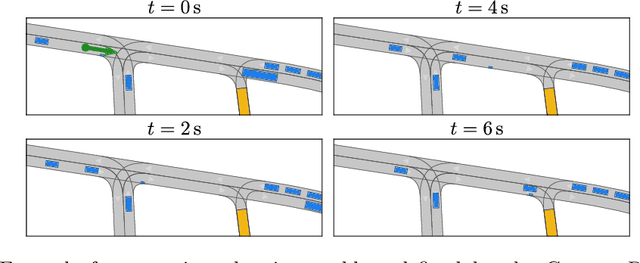

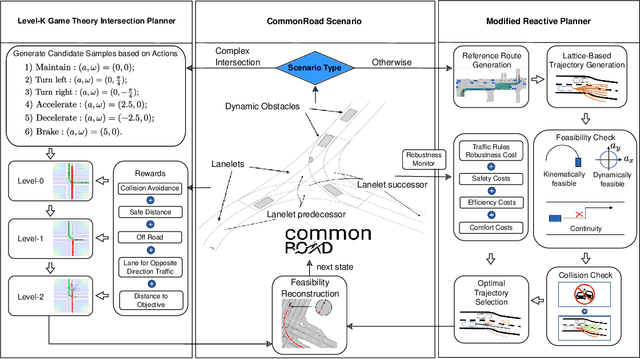
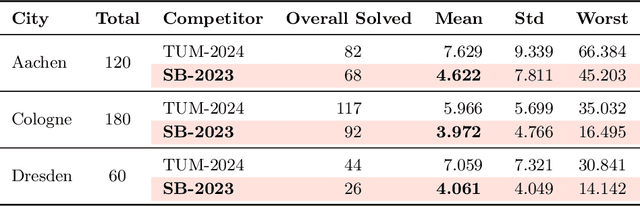
Over the past decade, a wide range of motion planning approaches for autonomous vehicles has been developed to handle increasingly complex traffic scenarios. However, these approaches are rarely compared on standardized benchmarks, limiting the assessment of relative strengths and weaknesses. To address this gap, we present the setup and results of the 4th CommonRoad Motion Planning Competition held in 2024, conducted using the CommonRoad benchmark suite. This annual competition provides an open-source and reproducible framework for benchmarking motion planning algorithms. The benchmark scenarios span highway and urban environments with diverse traffic participants, including passenger cars, buses, and bicycles. Planner performance is evaluated along four dimensions: efficiency, safety, comfort, and compliance with selected traffic rules. This report introduces the competition format and provides a comparison of representative high-performing planners from the 2023 and 2024 editions.
Results of the 2023 CommonRoad Motion Planning Competition for Autonomous Vehicles
Nov 10, 2024
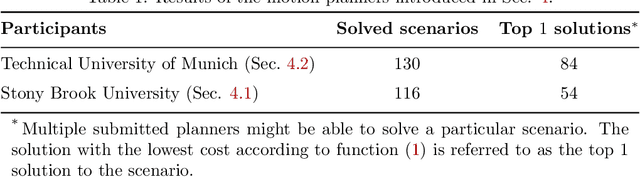


In recent years, different approaches for motion planning of autonomous vehicles have been proposed that can handle complex traffic situations. However, these approaches are rarely compared on the same set of benchmarks. To address this issue, we present the results of a large-scale motion planning competition for autonomous vehicles based on the CommonRoad benchmark suite. The benchmark scenarios contain highway and urban environments featuring various types of traffic participants, such as passengers, cars, buses, etc. The solutions are evaluated considering efficiency, safety, comfort, and compliance with a selection of traffic rules. This report summarizes the main results of the competition.