 Add to Chrome
 Add to Firefox
 Add to Edge
CompCPZ: Preserving Multi-Modal Intent in Language-Guided Robot Manipulation
Aug 18, 2026
A robot asked to "place the cup near the red plate or the blue plate" may reach the centroid between them and appear geometrically successful, while satisfying neither disjunct of the instruction. This silent semantic failure exposes a structural limitation of language-conditioned robot policies: representations that collapse a disjunctive instruction into a single connected set cannot preserve all feasible modes, and planners that commit to one action degrade under run-time mode uncertainty. We address this limitation with CompCPZ, a sound algebraic layer that language-conditioned learning systems wrap to recover multi-modal disjunctive representation, recursively composing per-primitive constrained polynomial zonotope enclosures along the language parse tree with distribution-free conformal coverage and sub-millisecond runtime. On a closed-loop ManiSkill3 tabletop-manipulation benchmark, CompCPZ outperforms convex set baselines, multi-peak decoders, and a zero-shot vision-language-action model (1,900/1,918 paired wins, p << 10^(-30)); the same compiler also transfers without retuning to planar real-robot trials on a Unitree Go2 quadruped under motion capture. These results suggest that compositional language grounding should be evaluated not only by reaching a decoded target, but by whether the represented feasibility set preserves the connected-component structure of the user's intent.

Cross-View Correspondence Is a Measurement Intervention: Two-Sided Validation for Agent Evaluation and Credit Assignment
Aug 18, 2026Agent evaluations and trace-based learning often compare outputs across transformed views through a post-response correspondence treated as neutral preprocessing. We show that this correspondence is a measurement intervention: omitting it can manufacture sensitivity, an over-aggressive map can manufacture invariance, and multiple optimal correspondences can leave mechanism labels and signed learning credit unidentified. We develop a validity theory and audit with three components: two-sided validation of nuisance removal and response preservation, all-optima identification of downstream conclusions, and uncertainty propagation after validity is established. We characterize the linear feasibility boundary for response-preserving nuisance removal, compute sharp ranges over exact-optimum correspondence sets, and give a distribution-free certificate that retains a credit coordinate only when all exact optima agree on its nonzero sign. Across public code and SQL pipelines, two deterministic optimal tracebacks disagree on temporal localization for 55.9% of 1,586 nonzero trajectory pairs; two frozen 800-rollout tool-use audits, including a task-and-seed-disjoint replication, expose exact-optimum reversals of intended turn-level credit, although a clean public quick-start subset shows none. A pre-registered transport gate failed on natural responses; frozen corrected and held-out controls then show that a map calibrated only on benign examples erases every retained harmful response, while two-sided validation selects response-preserving alternatives. Cross-view correspondence must therefore be declared, validated, and propagated into uncertainty before agent evaluation or credit assignment supports a point conclusion.
Certifying Plans under Model Mismatch: A Trilemma for Reachability from Scarce Data
Aug 03, 2026Sim-to-real policies are designed under nominal dynamics, but target-system trials may yield only a few isolated one-step transitions. We study pre-execution certification of a fixed control sequence, such as an action chunk produced by a learned policy. If the sequence reaches an unobserved state-input region, the observations remain consistent with target systems whose trajectories separate along it by an arbitrarily large amount. Any deterministic certifier sound for all of them must then decline to certify or return a reachable tube with arbitrarily large projected width. For bounded smooth classes of the target-nominal model error, we derive a finite plan-dependent projected-width lower bound. These results expose a trilemma among uniform trajectory containment, finite projected width, and unrestricted model-error behavior beyond the observations. ForeReach requires a supplied componentwise Lipschitz bound on the model error. Observed transition pairs can refute this declaration but cannot establish it outside the observed locations. Conditional on a valid declaration, our method constructs a set-membership envelope for the model error, propagates a zonotopic reachable tube, and certifies only when propagation remains within the certification domain and every projected tube slice avoids the unsafe set. In two benchmark systems, calibration baselines may remain narrow after losing trajectory containment outside data support, whereas our method declines to certify unsupported sequences and recovers certification when relevant target data and sufficient obstacle clearance are available.
Safe LLM-Controlled Robots with Formal Guarantees via Reachability Analysis
Mar 05, 2025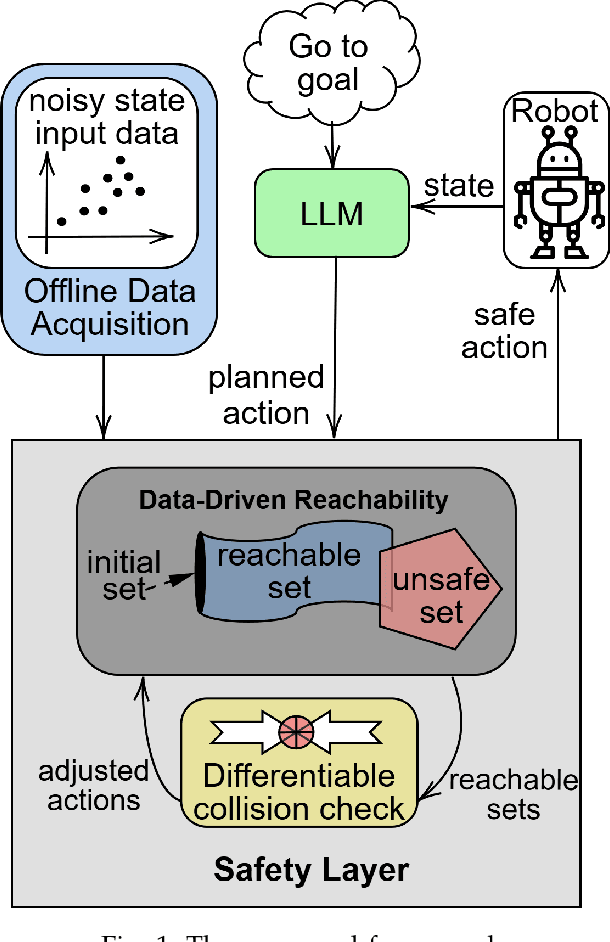
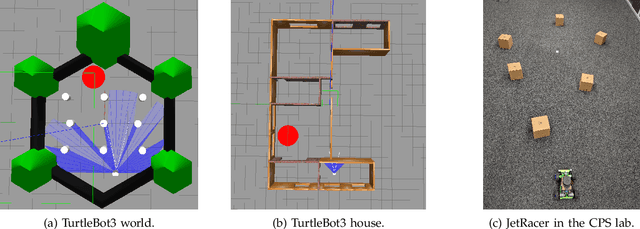
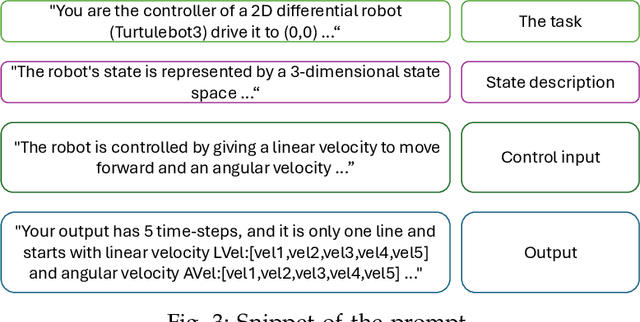
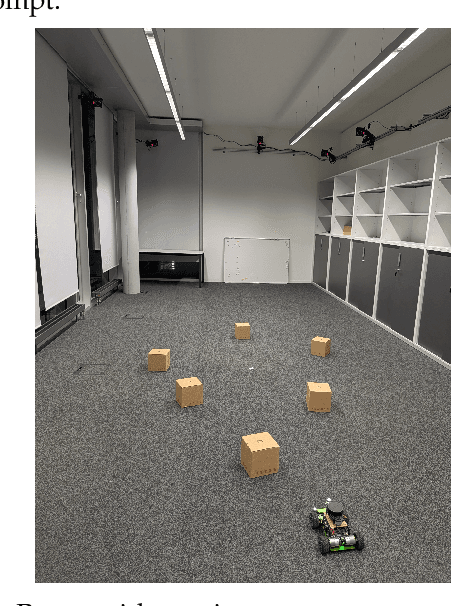
The deployment of Large Language Models (LLMs) in robotic systems presents unique safety challenges, particularly in unpredictable environments. Although LLMs, leveraging zero-shot learning, enhance human-robot interaction and decision-making capabilities, their inherent probabilistic nature and lack of formal guarantees raise significant concerns for safety-critical applications. Traditional model-based verification approaches often rely on precise system models, which are difficult to obtain for real-world robotic systems and may not be fully trusted due to modeling inaccuracies, unmodeled dynamics, or environmental uncertainties. To address these challenges, this paper introduces a safety assurance framework for LLM-controlled robots based on data-driven reachability analysis, a formal verification technique that ensures all possible system trajectories remain within safe operational limits. Our framework specifically investigates the problem of instructing an LLM to navigate the robot to a specified goal and assesses its ability to generate low-level control actions that successfully guide the robot safely toward that goal. By leveraging historical data to construct reachable sets of states for the robot-LLM system, our approach provides rigorous safety guarantees against unsafe behaviors without relying on explicit analytical models. We validate the framework through experimental case studies in autonomous navigation and task planning, demonstrating its effectiveness in mitigating risks associated with LLM-generated commands. This work advances the integration of formal methods into LLM-based robotics, offering a principled and practical approach to ensuring safety in next-generation autonomous systems.
ConvDySAT: Deep Neural Representation Learning on Dynamic Graphs via Self-Attention and Convolutional Neural Networks
Jun 21, 2021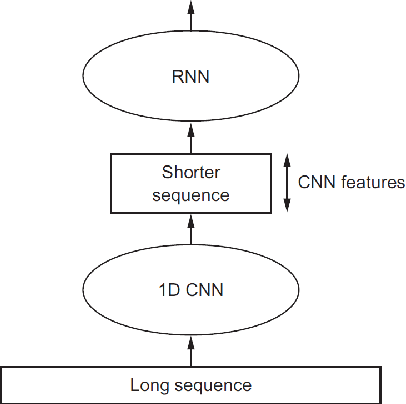
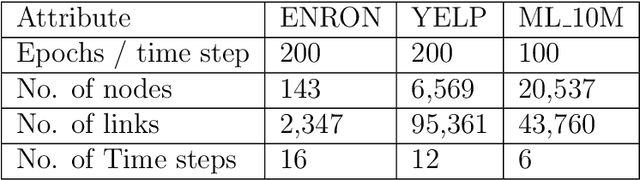
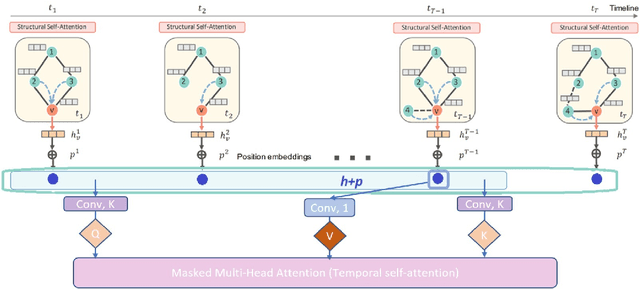
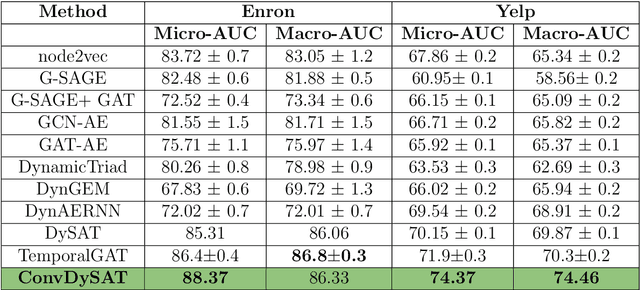
Learning node representations on temporal graphs is a fundamental step to learn real-word dynamic graphs efficiently. Real-world graphs have the nature of continuously evolving over time, such as changing edges weights, removing and adding nodes and appearing and disappearing of edges, while previous graph representation learning methods focused generally on static graphs. We present ConvDySAT as an enhancement of DySAT, one of the state-of-the-art dynamic methods, by augmenting convolution neural networks with the self-attention mechanism, the employed method in DySAT to express the structural and temporal evolution. We conducted single-step link prediction on a communication network and rating network, Experimental results show significant performance gains for ConvDySAT over various state-of-the-art methods.