 Add to Chrome
 Add to Firefox
 Add to Edge
Kernel-Smith: A Unified Recipe for Evolutionary Kernel Optimization
Mar 30, 2026
We present Kernel-Smith, a framework for high-performance GPU kernel and operator generation that combines a stable evaluation-driven evolutionary agent with an evolution-oriented post-training recipe. On the agent side, Kernel-Smith maintains a population of executable candidates and iteratively improves them using an archive of top-performing and diverse programs together with structured execution feedback on compilation, correctness, and speedup. To make this search reliable, we build backend-specific evaluation services for Triton on NVIDIA GPUs and Maca on MetaX GPUs. On the training side, we convert long-horizon evolution trajectories into step-centric supervision and reinforcement learning signals by retaining correctness-preserving, high-gain revisions, so that the model is optimized as a strong local improver inside the evolutionary loop rather than as a one-shot generator. Under a unified evolutionary protocol, Kernel-Smith-235B-RL achieves state-of-the-art overall performance on KernelBench with Nvidia Triton backend, attaining the best average speedup ratio and outperforming frontier proprietary models including Gemini-3.0-pro and Claude-4.6-opus. We further validate the framework on the MetaX MACA backend, where our Kernel-Smith-MACA-30B surpasses large-scale counterparts such as DeepSeek-V3.2-think and Qwen3-235B-2507-think, highlighting potential for seamless adaptation across heterogeneous platforms. Beyond benchmark results, the same workflow produces upstream contributions to production systems including SGLang and LMDeploy, demonstrating that LLM-driven kernel optimization can transfer from controlled evaluation to practical deployment.

DIDS: Domain Impact-aware Data Sampling for Large Language Model Training
Apr 17, 2025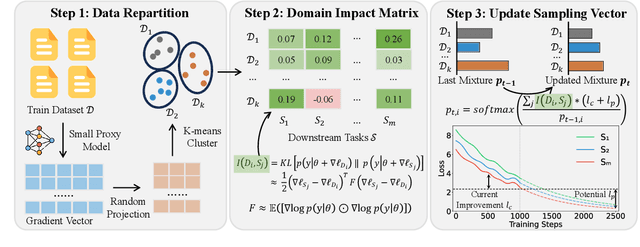
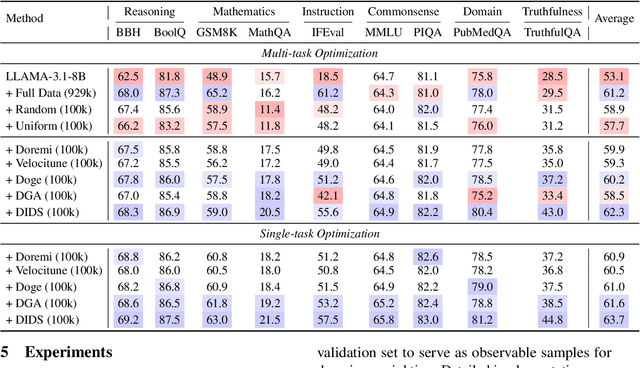
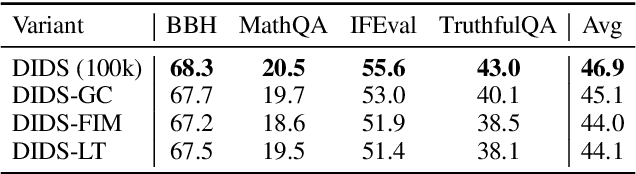
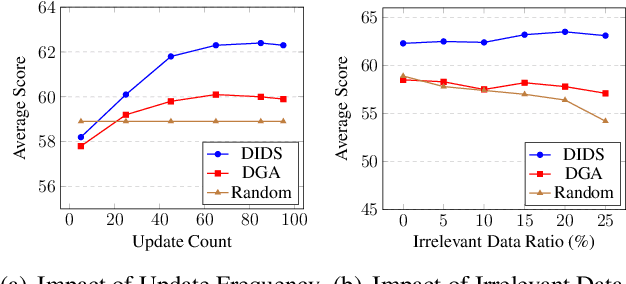
Large language models (LLMs) are commonly trained on multi-domain datasets, where domain sampling strategies significantly impact model performance due to varying domain importance across downstream tasks. Existing approaches for optimizing domain-level sampling strategies struggle with maintaining intra-domain consistency and accurately measuring domain impact. In this paper, we present Domain Impact-aware Data Sampling (DIDS). To ensure intra-domain consistency, a gradient clustering algorithm is proposed to group training data based on their learning effects, where a proxy language model and dimensionality reduction are employed to reduce computational overhead. To accurately measure domain impact, we develop a Fisher Information Matrix (FIM) guided metric that quantifies how domain-specific parameter updates affect the model's output distributions on downstream tasks, with theoretical guarantees. Furthermore, to determine optimal sampling ratios, DIDS combines both the FIM-guided domain impact assessment and loss learning trajectories that indicate domain-specific potential, while accounting for diminishing marginal returns. Extensive experiments demonstrate that DIDS achieves 3.4% higher average performance while maintaining comparable training efficiency.
Unit Region Encoding: A Unified and Compact Geometry-aware Representation for Floorplan Applications
Jan 19, 2025We present the Unit Region Encoding of floorplans, which is a unified and compact geometry-aware encoding representation for various applications, ranging from interior space planning, floorplan metric learning to floorplan generation tasks. The floorplans are represented as the latent encodings on a set of boundary-adaptive unit region partition based on the clustering of the proposed geometry-aware density map. The latent encodings are extracted by a trained network (URE-Net) from the input dense density map and other available semantic maps. Compared to the over-segmented rasterized images and the room-level graph structures, our representation can be flexibly adapted to different applications with the sliced unit regions while achieving higher accuracy performance and better visual quality. We conduct a variety of experiments and compare to the state-of-the-art methods on the aforementioned applications to validate the superiority of our representation, as well as extensive ablation studies to demonstrate the effect of our slicing choices.
LocRef-Diffusion:Tuning-Free Layout and Appearance-Guided Generation
Nov 22, 2024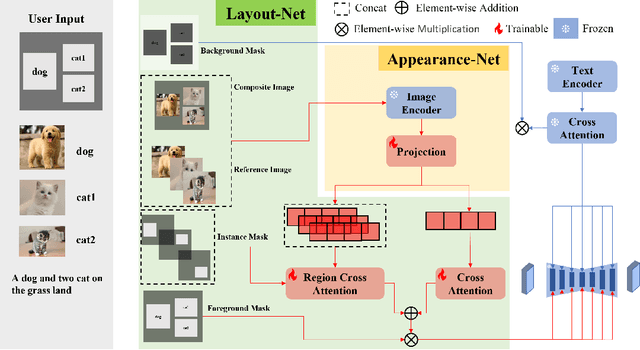
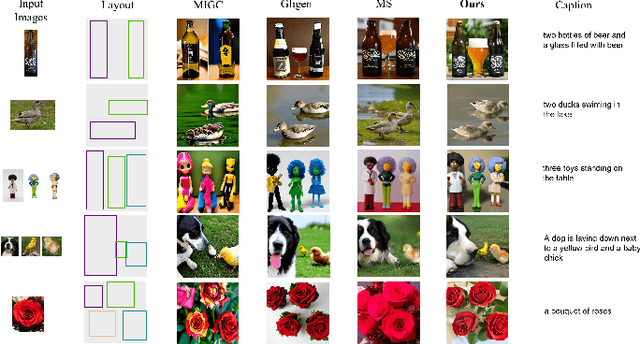
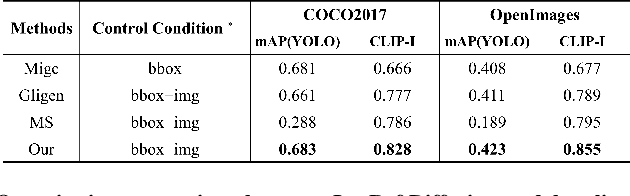
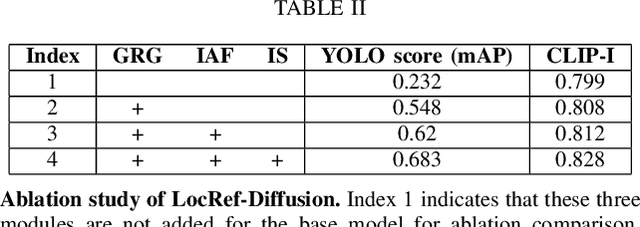
Recently, text-to-image models based on diffusion have achieved remarkable success in generating high-quality images. However, the challenge of personalized, controllable generation of instances within these images remains an area in need of further development. In this paper, we present LocRef-Diffusion, a novel, tuning-free model capable of personalized customization of multiple instances' appearance and position within an image. To enhance the precision of instance placement, we introduce a Layout-net, which controls instance generation locations by leveraging both explicit instance layout information and an instance region cross-attention module. To improve the appearance fidelity to reference images, we employ an appearance-net that extracts instance appearance features and integrates them into the diffusion model through cross-attention mechanisms. We conducted extensive experiments on the COCO and OpenImages datasets, and the results demonstrate that our proposed method achieves state-of-the-art performance in layout and appearance guided generation.